
Yes, you can grow cranberries in Ohio. It takes real effort and a purpose-built growing environment, but Ohio's climate is not the barrier most people assume. The state sits within the broader native range of Vaccinium macrocarpon, receives enough chilling hours to satisfy dormancy needs, and has a growing season long enough to ripen fruit. The catch is soil and water: cranberries demand extremely acidic, high-organic media and near-constant moisture at the root zone. Replicate those conditions through a constructed bog, a raised bed, or even a large container, and a home gardener or small-scale grower in Ohio can produce cranberries. It is not a casual backyard project, but it is genuinely doable.
Can You Grow Cranberries in Ohio? Feasibility & How-To
Marcus Holloway
9 Aug 2026
Ohio climate and site factors that determine success
Ohio spans USDA hardiness zones 5b in the northeast and northwest corners to 6b in the southwestern counties, with pockets along Lake Erie occasionally reaching zone 7a due to lake-effect moderation. Cranberries are hardy to zone 2, so winter cold is never a limiting factor here. What matters more is the warm-season heat profile and whether a site can deliver roughly 1,000 hours below 45°F during dormancy, which Ohio's winters routinely provide across all regions.
Ohio's growing season runs approximately 160 to 185 frost-free days depending on location, with last spring frost dates ranging from early April in the south to mid-May in cooler northern areas and first fall frosts arriving September through October. Cranberry vegetative growth kicks off around 500 GDD (base 40°F) and fruit development needs roughly 1,500 GDD by harvest. Ohio accumulates those heat units comfortably between May and September. The bigger concern is summer heat: cranberries photosynthesise best at around 25 to 29°C, and Ohio summers regularly push above 85°F, which can stress plants and cause fruit scald. Afternoon shade from a fence or structure, and overhead irrigation for evaporative cooling during heat spikes, both help manage that.
Microclimate matters a lot. A site with morning sun, afternoon shade, access to water, and protection from desiccating winter winds is meaningfully better than an open, south-facing slope. Low spots that naturally collect moisture are ideal candidates for a constructed bog. Avoid sites with heavy clay that drains poorly in an uncontrolled way, since you need to manage the water table deliberately, not just let the ground stay soggy.
Cranberry biology and essential growing requirements
Vaccinium macrocarpon is a low, creeping, woody perennial that spreads via runners (uprights emerge from horizontal vines) and keeps its small leathery leaves year-round. It evolved in nutrient-poor, saturated, acidic peat environments in northeastern North America, and every growth requirement reflects that origin. The roots are fine and shallow, depending almost entirely on mycorrhizal associations that only function well at low pH. Feed the plant a neutral or alkaline soil and you are essentially poisoning its nutrient-uptake system.
The plant does not tolerate standing water over its crown during active growth, but it does need the water table kept close to the root zone, typically within 12 to 18 inches of the surface. Flooding is used commercially for frost protection, harvest, and pest control, not as the normal growing condition. The practical takeaway for Ohio growers is that you need a growing medium that holds moisture like a sponge but does not leave the crown submerged, and you need a way to flood or soak the bed deliberately when needed. That is the entire engineering challenge of growing cranberries outside a natural bog.
Soil pH targets and ready media recipes
Commercial cranberry bogs average around pH 4.4, with more than 85 percent of production sites sitting between pH 4.0 and 5.0. The target for Ohio home growers should be the same range: aim for pH 4.0 to 4.5. If your growing medium has more than 5 percent organic matter (and a peat-based mix always will), keep pH at or below 4.5. Going above 5.0 leads to iron and manganese deficiencies and poor growth. Do not try to grow cranberries in native Ohio soil without serious amendment. Most Ohio soils test between pH 6.0 and 7.0.
To lower pH, incorporate elemental sulfur into the top 4 inches of your growing medium before planting and retest after several months. Microbial oxidation converts sulfur to sulfuric acid slowly, so this is a fall-prep or early-spring task, not a same-day fix. Ohio State Extension's blueberry guidance (which shares the same pH targets for Vaccinium crops) provides useful tables of elemental sulfur rates by current soil pH and texture. For sandy peat mixes, rates are lower than for loam or clay-based soils because there is less buffering capacity.
| Growing system | Recommended media recipe | Target pH | Depth |
|---|---|---|---|
| Constructed bog | 60–70% sphagnum peat, 30–40% coarse sand (>70% particles 0.5–2 mm); remove native soil and replace | 4.0–4.5 | 12–18 in root zone over impermeable liner |
| Raised bed | 50% sphagnum peat, 40% coarse sand, 10% aged pine bark; line base with landscape fabric to slow drainage | 4.0–4.5 | 8–12 in deep minimum |
| Container | 60% sphagnum peat, 30% coarse perlite or coarse sand, 10% aged pine bark; no standard potting mix | 4.0–4.5 | 12–18 in container depth minimum |
Do not use fine builder's sand or play sand. Cranberry root zones in commercial settings use coarse sand with more than 70 percent of particles in the 0.5 to 2 mm range for drainage control. Standard bags of play sand are mostly fine-grained and will compact into a near-impermeable layer over time. Look for horticultural coarse sand or poultry grit (granite grit) as a practical substitute from farm supply stores.
Water management fundamentals and bog construction options
Commercial cranberry systems are engineered around water control: wells or surface impoundments supply water, lift pumps move it, flumes and flood gates direct it. That scale is not realistic for a backyard Ohio grower, but the underlying principle is. You need a growing bed with an impermeable base to hold water when you flood it, a controlled drain so you can lower the water level, and irrigation to maintain moisture between events. Without an impermeable base, the water simply drains away and you lose all control.
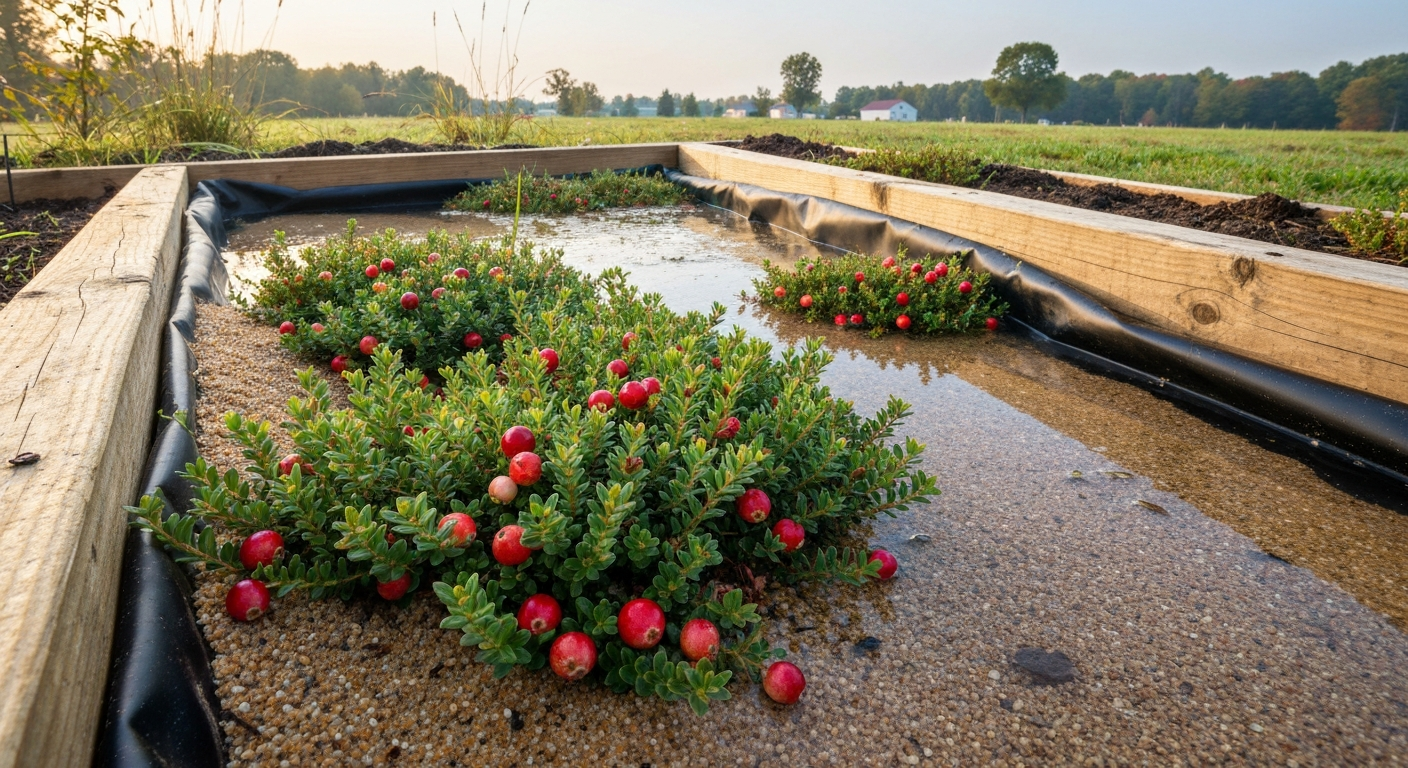
For a home-scale constructed bog, excavate the area to a depth of 18 to 24 inches, line the entire excavation with a 20- or 30-mil EPDM pond liner or heavy polyethylene sheeting, and install a drain pipe with a standpipe riser at one end so you can control the water-table height by adjusting where the standpipe overflow sits. Fill the lined area with your peat-sand mix and plant into that. Average weekly water demand during the growing season runs about 1 inch, with peaks up to 2 inches per week during dry hot stretches. A drip system or soaker hose laid on the surface is the most efficient delivery method for maintaining that baseline.
If you are considering a true flood system for frost protection or future wet harvest, be aware that Ohio water law requires registration if any withdrawal facility has the capacity to pull more than 100,000 gallons per day (Ohio Revised Code 1521.16). That threshold is far beyond what a backyard bog needs, but if you are planning a larger installation, check with the Ohio DNR Division of Water Resources. Any project that fills or alters an existing wetland would also likely require a Section 404 permit from the US Army Corps of Engineers and Ohio EPA 401 water quality certification, so avoid siting a constructed bog in or adjacent to natural wetland areas.
Constructed bog, raised bed, or container: which one makes sense for you
This is the practical decision most Ohio growers need to make before buying a single plant. Each approach has a different cost, labor requirement, and long-term potential.
| Approach | Startup cost (rough estimate) | Space needed | Flood capability | Longevity | Best for |
|---|---|---|---|---|---|
| Constructed bog (lined in-ground) | $200–$800+ depending on size | 50+ sq ft ideal | Yes, with standpipe drain | 20+ years | Serious growers with outdoor space and access to water |
| Raised bed | $75–$250 | 4×8 ft minimum | Limited (subirrigation possible) | 10–15 years before media refresh | Home gardeners wanting a manageable, semi-permanent planting |
| Container (large pot or half-barrel) | $30–$80 per container | 1–4 sq ft per container | No | Refresh media every 3–5 years | Small-space growers, renters, or those testing before committing |
My honest take: if you have a yard and want to actually harvest meaningful amounts of fruit, build a small lined bog or a deep raised bed. Containers are a satisfying experiment and good for learning the plant, but a single half-barrel holds maybe two plants and will never produce more than a handful of fruit. Extension guides such as Cranberries, UConn Home & Garden Education Center (extension guidance for home beds/containers) confirm cranberries can be grown in raised beds or containers using an acidic peat‑moss plus coarse sand mix and recommend container/bed depths of at least 12–18 inches with regular moisture monitoring Cranberries — UConn Home & Garden Education Center (extension guidance for home beds/containers). A 4x8 raised bed can hold 8 to 10 plants and start producing a pint or two of berries by year three or four. A modest 50-square-foot lined bog gets you into real harvest territory by year four to five.
Cultivar and plant selection for Ohio
Most cultivars available to home growers will survive Ohio winters without any issues since the plant is cold-hardy well below the temperatures the state produces. The more relevant differences between cultivars involve vigor, fruit size, ripening timing relative to Ohio's frost dates, and chilling requirements.
- Stevens: the most widely planted commercial cultivar in the US, vigorous, large-fruited, late-mid season ripening (September to early October in most Ohio locations); higher nitrogen needs than some cultivars; reliable choice for first-time Ohio growers.
- Ben Lear: earlier ripening (late August to mid-September), smaller fruit, productive, well-documented cold hardiness; useful if you are in northern Ohio and want to beat the first frost.
- Early Black: very early ripening (late August), small dark fruit with good flavor; less vigor than Stevens; suited to colder northern Ohio sites where season length is tighter.
- Pilgrim: large fruit, mid-late season, high yields when established; worth considering for central and southern Ohio where the longer frost-free season accommodates the late ripening.
- McFarlin: older heirloom variety, moderate yields, sometimes available from specialty nurseries; mid-to-late season.
Source plants from specialty fruit nurseries rather than big-box garden centers, which rarely carry true named cranberry cultivars. Rooted cuttings or 2-inch potted plugs are the most common form available to home growers. Suppliers like Hartmann's Plant Company (Michigan), Indiana Berry, and One Green World regularly carry Vaccinium macrocarpon in named cultivars and ship to Ohio addresses. Buy from a nursery that labels cultivars clearly. 'Generic cranberry' plugs of unknown variety are not worth the setup cost.
Propagation, planting timing, spacing and establishment timeline
Cranberries root readily from cuttings if you want to propagate your own plants after establishment, but for first planting, start with purchased rooted plugs or bare-root cuttings. The best planting window in Ohio is mid-April through late May (after the last hard frost, soil workable and warming) or alternatively in early September (6 weeks before first frost). Spring planting gives the plant a full growing season to establish roots before winter.
Space plants 12 to 18 inches apart in all directions. Cranberry runners spread horizontally and will fill the gaps within two to three seasons, forming a dense mat. Planting too far apart just delays canopy closure; planting too close wastes plants and money. For a 4x8 raised bed, 8 to 10 plants is the right quantity.
Set realistic expectations for the timeline. Year one is all establishment: the plant puts energy into roots and short runners, and you may see a few flowers but no significant fruit. Year two brings light runner spread and possibly a small amount of fruit. Year three is when most growers see their first real (if modest) harvest. A full mature yield, where the bed or bog is completely covered in a dense mat, typically happens in year four to five. Commercial operators say the same thing: patience is the defining requirement of cranberry growing.
Step-by-step site prep and planting checklist
- Test your native soil pH and organic matter content before doing anything else. Ohio State Extension offers soil testing through the C. Wayne Ellett Plant and Pest Diagnostic Clinic; basic tests cost around $20.
- Choose your growing system (lined bog, raised bed, or container) and assemble materials: EPDM liner or heavy poly sheeting for the bog option, sphagnum peat, coarse sand, aged pine bark, elemental sulfur.
- Excavate or frame your growing area. For a lined bog, dig 18–24 inches deep, smooth the base, lay liner with 6 inches of overlap on all sides, and install a PVC drain pipe with a removable standpipe at the low end.
- Mix your growing medium off-site in a wheelbarrow or tub: roughly 60% sphagnum peat and 40% coarse sand for bogs; adjust to the recipe for your chosen system.
- Incorporate elemental sulfur into the mix before filling if your peat is not already acidic (most commercial sphagnum peat starts at pH 3.5–4.5, so test first before adding sulfur).
- Fill the bed or bog to within 2 inches of the rim. Water thoroughly and allow to settle for a few days; add more mix if needed.
- Retest pH of the filled medium a few days after watering. Adjust with additional elemental sulfur if above 4.5 and allow weeks for oxidation before planting.
- Plant rooted plugs at 12–18-inch spacing, setting the crown at or just above the medium surface. Do not bury the crown.
- Topdress with 1–2 inches of coarse sand after planting. This replicates commercial sanding practices that reduce disease, suppress weeds, and encourage rooting of runners.
- Water in thoroughly and set up your drip or soaker irrigation before plants dry out.
Routine care: irrigation, fertilization, pruning and winter management
Irrigation
Plan on delivering about 1 inch of water per week from May through September, scaling up to 1.5 to 2 inches per week during hot dry stretches. Drip or soaker irrigation is efficient and keeps foliage dry, which reduces fungal disease. During heat events above 85°F, overhead sprinkler irrigation for evaporative cooling during the hottest part of the day (noon to 3 p.m.) protects the plant from heat stress and reduces midday photosynthesis depression. Even 15 to 20 minutes of overhead misting can cut leaf temperature meaningfully.
Fertilization
Cranberries are low-fertility plants that evolved in nutrient-poor environments. Over-fertilizing, especially with nitrogen, produces excessive vegetative growth at the expense of fruit and makes plants more susceptible to disease. Use an acid-formulated slow-release fertilizer (such as one formulated for blueberries and azaleas) at low rates in early spring. A general starting point is roughly 0.5 oz of actual nitrogen per 10 square feet in year one, increasing slightly in subsequent years as the mat matures. Test tissue and soil regularly rather than applying on a fixed schedule. Never use lime or any pH-raising amendment near the plants.
Pruning
Pruning in the first two years should be minimal, limited to removing dead or obviously diseased material. Once the bed matures (year three onward), uprights that are too dense can shade out lower growth and reduce fruiting. Light thinning in late winter or very early spring before new growth emerges is the right time. Topdressing with a thin layer of coarse sand every two to three years also helps keep the mat vigorous by encouraging runner rooting and suppressing the buildup of old organic matter.
Winter and frost management
Established cranberry plants in Ohio need no special winter protection since the plant is far hardier than Ohio winters demand. New plantings in their first fall can be protected with a 2-to-3-inch layer of pine straw mulch laid over the bed after the ground freezes in November, then removed in early April. The bigger frost risk is spring: late frosts in April and May can damage new growth and flower buds. If you have irrigation set up, overhead sprinkling during a frost event (running water continuously while temperatures are below 32°F) protects flowers and new growth using the latent heat of freezing water, exactly as commercial growers do.
Pests, diseases and common problems to watch for in Ohio
Ohio growers will not face the full pest pressure of a commercial Massachusetts bog, but several problems are worth knowing before they appear.
| Problem | What to look for | Basic management |
|---|---|---|
| Mummy berry (Monilinia oxycocci) | Infected uprights wilt and turn brown in spring; fruit shrivels and turns tan/mummified | Remove and destroy mummified fruit; improve air circulation; copper fungicide at bud break if history of infection |
| Fruit rot (Botrytis and Phytophthora spp.) | Soft, water-soaked fruit; gray mold visible in humid conditions | Avoid overhead irrigation when fruit is ripening; improve drainage; remove affected fruit promptly |
| Tipworm (Dasineura oxycoccana) | Distorted, swollen shoot tips; larvae visible inside swollen tissue | Monitor in spring; targeted spinosad application if infestation is significant |
| Spotted wing drosophila (SWD) | Small larvae inside ripening fruit; soft spots and early decay | Monitor with traps; harvest promptly at ripeness; kaolin clay or spinosad sprays pre-harvest |
| Iron/manganese deficiency (pH too high) | Interveinal chlorosis on new leaves; stunted growth | Retest pH immediately; lower with elemental sulfur if above 4.5; do not apply lime |
| Crown rot from overwatering | Plant wilts despite adequate water; crown tissue blackened at base | Improve drainage; ensure standpipe height keeps water table 12–18 in below surface; reduce irrigation frequency |
Many of these problems are aggravated by the same thing: a growing medium that is too wet at the crown, or a pH that has drifted upward. Retest pH every spring and after any heavy lime or hard water application. Ohio tap water often has a pH of 7.0 or higher, and using it exclusively without acidifying can slowly push your growing medium pH up over time. Collect rainwater where you can, or acidify tap water by adding a small amount of horticultural vinegar or phosphoric acid to bring it to pH 5.0 to 5.5 before irrigating.
Harvest methods, expected yields and storage
Commercial cranberry operations use wet harvesting: the bog is flooded, a water reel churns the water to knock fruit off the vines, and the floating berries are corralled and conveyor-loaded. That method is not feasible at backyard scale in Ohio. Home growers use dry harvesting: a handheld or wheeled cranberry scoop (essentially a wide-toothed comb rake) dragged through the mat to pull ripe berries off uprights. It is slower but works well for beds up to a few hundred square feet. You can also hand-pick, which is time-consuming but useful for early selective harvesting.
Harvest timing in Ohio runs from mid-September for early varieties like Ben Lear and Early Black to mid-October for later ones like Stevens and Pilgrim. Berries are ripe when they are fully red and give slightly under thumb pressure. A small white dot at the blossom end often persists even on ripe fruit, so color alone is not the only indicator. Taste one: ripe cranberries are tart but not bitter-green.
Expected yield for a mature (year 4 to 5) raised bed or small bog is roughly 0.5 to 1.5 pounds of fresh fruit per square foot per year once the mat is fully established. A 4x8 raised bed at full maturity might produce 15 to 50 pounds in a good year, comparable to a few bags from the grocery store. Larger bogs scale proportionally. Fresh cranberries store in the refrigerator for 2 to 3 months and freeze well for up to a year with no processing needed. They also juice, sauce, and dry well if you want to preserve larger harvests.
Costs, labor and realistic pros and cons for Ohio growers
The honest picture: cranberries are one of the more demanding specialty crops for a home grower. The setup cost is real, the payoff is slow (minimum 3 years to first meaningful harvest), and the plant requires more active moisture management than almost any other garden crop. But for the right grower, the result is a long-lived, low-annual-cost bed that produces fruit for decades.
| Factor | Details |
|---|---|
| Startup cost (raised bed) | $100–$300 for materials, plants, soil amendments for a 4×8 bed |
| Startup cost (lined bog, 50 sq ft) | $300–$800 including liner, fill materials, irrigation, and plants |
| Annual operating cost (established) | $20–$60/year for irrigation, fertilizer, and occasional soil amendments |
| Time to first real harvest | 3–4 years from planting |
| Annual maintenance time | 4–8 hours/year for an established bed (irrigating, fertilizing, pruning, harvesting) |
| Lifespan of the planting | 20+ years with proper management |
| Yield at maturity (4×8 raised bed) | Roughly 15–50 lbs fresh fruit in a good year |
| Major pro | Long-lived, low annual cost once established; unique crop with strong culinary uses |
| Major con | Slow establishment, strict soil and water requirements, higher upfront effort than most garden crops |
Easier acid-berry alternatives if cranberries feel like too much
If the soil-engineering and water-management requirements of cranberries feel like more than you want to take on right now, Ohio has better options for acid-loving berry crops that are substantially easier to establish and produce fruit much faster. If you want a very different, lower-water warm-season option, see can you grow chickpeas in Wisconsin for guidance on whether chickpeas suit your location. If you’re exploring easier alternatives, also consider legumes, see Can you grow chickpeas in Pennsylvania for regional suitability and timing. For guidance on a very different specialty fruit, see can quenepas grow in New York to learn whether quenepas are suitable for cooler climates.
- Blueberries (Vaccinium corymbosum or V. angustifolium): the most practical acid-berry crop for Ohio home growers. Highbush and half-high varieties thrive in zones 5 and 6, fruit in year 2 to 3, and require similar pH targets (4.5 to 5.5) without the bog infrastructure. Ohio State Extension's Ohioline has detailed Ohio-specific guidance.
- Lingonberries (Vaccinium vitis-idaea): a close relative of cranberry that forms a low ground cover and produces small tart red berries in late summer. More drought-tolerant than cranberry, does not require flooding, and grows well in raised beds with acidic peat-based media. Cold-hardy and well-suited to Ohio's climate.
- Aronia (black chokeberry, Aronia melanocarpa): native to eastern North America including Ohio, adaptable to a wide pH range, extremely cold-hardy, and produces large yields of tart, antioxidant-rich berries in year 2 to 3. Not a direct cranberry substitute in flavor, but highly productive with almost no special soil management needed.
If you are in Michigan or Indiana and thinking about similar specialty crops, the calculus is broadly similar: blueberries remain the most accessible acid-berry for the Midwest, while cranberries require the extra investment in water and soil infrastructure regardless of which state you are in. For localized advice on a different cool-season vegetable, see can you grow celery in Indiana.
Next steps: how to move from curious to actually growing
Here is a simple starting plan. In late summer or early fall, get a soil test from Ohio State Extension (submit through the C. Wayne Ellett Plant and Pest Diagnostic Clinic, around $20 for a basic test) to understand your baseline pH and soil texture. Use that data to plan your media recipe and sulfur amendment needs. Over fall and winter, order your materials: sphagnum peat, coarse horticultural sand, EPDM liner if building a bog, and a soaker hose or drip line. Order plants from a specialty nursery in February or March for spring delivery. Build or fill your growing system in April, allow a few weeks for pH to stabilize, and plant in mid-to-late May after the last frost. Set your irrigation timer and be patient.
Ohio State University Extension (Ohioline at ohioline.osu.edu) is your best local resource for soil testing interpretation, fertilization rates for Vaccinium crops, and any questions about Ohio-specific water or land use. The UMass Cranberry Station's production guide (freely available online) is the most detailed single technical reference for anyone going beyond a hobby-scale planting. For plant sourcing, contact Hartmann's Plant Company in Michigan or Indiana Berry and compare their current cultivar availability before you commit to a variety.
Cranberries in Ohio are a project, not a quick win. But if you build the system right and give the plants time, you will end up with a perennial planting that outlasts most things in the garden and produces a crop that feels genuinely rewarding to grow far from the commercial bogs of Massachusetts and Wisconsin.
FAQ
Can you grow cranberries in Ohio?
Short answer: Yes — but with conditions. Cranberry (Vaccinium macrocarpon) is within the species’ native/distributional region that includes parts of Ohio, so home gardeners and small-scale growers can succeed if they recreate the acidic, organic, water-managed root zone cranberries require. Commercial-style flooded bogs are uncommon in Ohio; most successful small-scale plantings use constructed bogs, deep raised beds or containers with careful water control, soil acidification and cultivar selection. (See UMass Cranberry Production Guide: https://www.umass.edu/agriculture-food-environment/sites/ag.umass.edu/files/pdf-doc-ppt/cranberry_production_guide.pdf)
Which Ohio climates/sites are most suitable?
Best sites: cooler microclimates with reliable winter chill and moderate summer heat — northern and higher-elevation central Ohio are more favorable. Use USDA hardiness zones (Ohio ranges mostly zones 5b–6b) and check local microclimate for late-spring frost risk and summer heat. Cranberries need sufficient chill hours (cultivar-dependent; many perform with ≈1,000 hours below ~45°F but requirements range ~600–2,500 hrs), and moderate summer temperatures (optimum daytime ≈60–80°F). Avoid hot, dry sites without reliable irrigation or extreme heat exposure. (See chilling discussion: UMass Guide)
What exact soil and root-zone pH and organic matter do cranberries need?
Target root-zone pH: 4.0–4.5 (commercial bogs average ≈4.4; most growers keep pH between 4.0–5.0). Organic matter: high — peat-dominated media are standard. If organic matter >5% aim for pH ≤4.5. Always test soil before amendments and re-test after adjustments. (UMass pH/OM guidance: https://www.umass.edu/agriculture-food-environment/sites/ag.umass.edu/files/pdf-doc-ppt/cranberry_production_guide.pdf)
What media recipe works for raised beds or containers in Ohio?
Home/small-scale recipe (proven approach): 60–70% sphagnum peat moss + 30–40% coarse horticultural sand (or 1:1 peat:coarse sand by volume for many containers) with total container depth ≥12–18 in (preferably 18+ in). Sand should be coarse (0.5–2 mm particles) for root-zone structure and drainage. Amend pH with elemental sulfur if needed to reach 4.0–4.5 (see sulfur tables from OSU extension). Mix thoroughly; avoid garden soil unless sterilized and acidified.
How do I acidify soil to pH ~4.0–4.5 in Ohio?
Use elemental sulfur incorporated into the top 3–4 in of media in fall or early spring and allow microbial oxidation (weeks–months). Application rates depend on starting pH and texture — follow a soil test and extension tables (Ohio State publishes sulfur application guidance for Vaccinium crops). After application, retest after 2–3 months and adjust. Do not use lime; avoid fast-acting chemicals that can damage roots. (OSU extension: Growing Blueberries guide — sulfur tables: https://stark.osu.edu/sites/stark/files/imce/Program_Pages/ANR/communitygardenfactsheets/Growing%20Blueberries%20in%20the%20Home%20Garden%20_%20Ohioline.pdf)
Should I build a bog, raised bed, or use containers? How to decide?
Decision points: - Constructed bog: closest to commercial practice; allows temporary flooding for frost control and harvest, requires engineered subgrade, impermeable/confining layer, water control structures and more permitting/water. Best if you have land, water source and want larger acreage. - Raised beds: practical compromise for small plots; build 6–12 in (minimum) up to 18+ in beds lined with peat/sand mix, include impermeable liner at base if you must retain moisture, and provide irrigation/drainage. - Containers: easiest for beginners and urban gardeners; use deep (18–24 in) pots or troughs with peat:sand mix, easiest to control pH and water but require more frequent irrigation and overwintering protection. Choose: containers for experimentation/limited space; raised beds for patch-scale production; full bog only if you can engineer water control and comply with permits.
Next Articles
Can You Grow Celery in Indiana? Planting Guide & Tips
Yes, you can grow celery in Indiana: region-specific dates, best varieties, step-by-step planting, care, pests & harvest.
Can You Grow Celery in Michigan? Regional Guide & Schedule
Can you grow celery in Michigan? Yes, planting calendar, best varieties, season‑extension tips, pests and harvest guide
Can Quenepas Grow in New York? Indoor and Outdoor Guide
Learn if quenepas can grow in New York, with zone limits plus indoor and outdoor container overwintering steps.