
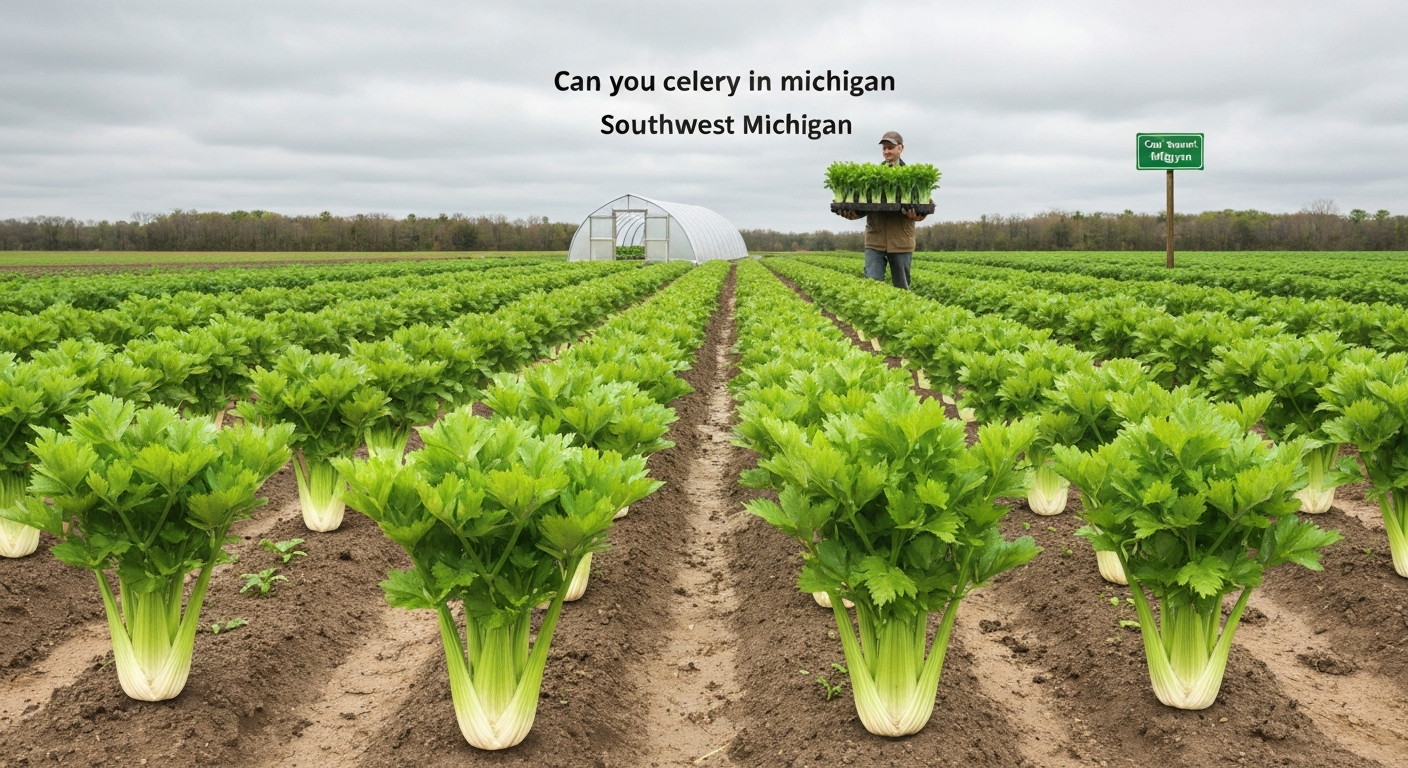
Yes, you can grow celery in Michigan, and it's not just a backyard curiosity. Michigan is actually one of the few Midwest states with a commercial celery industry, concentrated in the southwest part of the state where the climate and soils line up well. That said, celery is one of the more demanding vegetables you can put in the ground. It needs a long, cool growing season, consistent moisture, and fertile soil. Southern Lower Peninsula growers have the best odds with full-size Pascal types. If you're in northern Michigan or the Upper Peninsula, you're not out of luck, but you'll need to lean on short-season varieties, early transplants, and some season-extension tools to pull off a decent harvest.
Can You Grow Celery in Michigan? Regional Guide & Schedule
Marcus Holloway
14 Jul 2026
Michigan's climates and what they mean for celery
Michigan isn't one growing zone. The state spans USDA zones 4a through 6b, and the difference between growing celery in Kalamazoo and growing it in Marquette is enormous. Here's how the three main regions break down.
Southern Lower Peninsula (zones 5b–6b)
This is where Michigan's commercial celery operations are, especially in the southwest. The frost-free season typically runs from mid-April through late October, giving you around 160–180 frost-free days in the best locations. Cumulative growing degree days (base 50°F) average around 2,700–3,100 for the season in southwest Michigan per MSU Enviroweather data. That's enough heat accumulation for full-size celery varieties, particularly when you're starting transplants indoors well ahead of the field date. Southeast Michigan (the Detroit metro corridor) also benefits from a longer season, though it lacks the muck and sandy loam soils that make southwest Michigan so productive commercially.
Northern Lower Peninsula (zones 4b–5b)
Here the frost-free window tightens to roughly 120–150 days, and cumulative GDDs drop to the 1,900–2,500 range. You can still grow celery here, but full-size types with 100+ days to maturity from transplant get uncomfortably close to your first fall frost. Short-season varieties (80–90 days from transplant) and protected culture become important tools rather than optional upgrades.
Upper Peninsula (zones 4a–5a)
The UP is the hardest place to grow celery in Michigan. Frost-free seasons of 100–130 days are common, and late spring frosts can push into June in some spots. Full-size celery is genuinely difficult here without a high tunnel or greenhouse. Cutting celery, leaf celery, and celeriac are more forgiving options for UP growers who want celery-flavored crops without fighting the clock.
Choosing the right celery varieties for Michigan
Variety selection can make or break your celery crop in Michigan, especially if you're outside the southwest corner. There are three things to prioritize: days to maturity from transplant, cold tolerance, and disease resistance (particularly Fusarium yellows, which is a known problem in Michigan production areas).
For southern Michigan, you have more flexibility. Standard Pascal types like Utah 52-70 are workhorses and are specifically listed in MSU Extension's commercial vegetable recommendations (E-1308) as main-season cultivars for the state. The Utah 52-70 HK selection adds Fusarium yellows resistance, which is worth choosing if you're in an area with a history of that disease. Deacon is another MSU-recommended cultivar that performs well in Michigan conditions.
For northern Michigan and the UP, focus on varieties that reach marketable maturity in 80–90 days from transplant. Merengo F1 and Tango have shown roughly 80-day maturity in short-season university trials. Conquistador clocks in around 80 days as well. These earlier types give you a real cushion against fall frosts in shorter-season regions. Cutting celery (also called leaf celery or smallage) is worth mentioning for UP gardeners specifically. It's more cold-tolerant, matures faster, and you can harvest it cut-and-come-again style well into fall.
| Variety | Days to Maturity (from transplant) | Best For | Notes |
|---|---|---|---|
| Utah 52-70 | ~100 days | Southern Michigan | MSU-recommended main-season type |
| Utah 52-70 HK | ~100 days | Southern Michigan | Fusarium yellows resistance; MSU-recommended |
| Deacon | ~95–100 days | Southern Michigan | MSU-recommended; good vigor |
| Conquistador | ~80 days | Statewide | Early hybrid; good for shorter seasons |
| Tango | ~80–90 days | Northern Michigan / UP | Short-season trial performer |
| Merengo F1 | ~80 days | Northern Michigan / UP | Early maturity in short-season trials |
| Cutting/Leaf Celery | ~70–75 days | UP / containers | Cut-and-come-again; most cold-tolerant |
Where to get seeds and what to look for
For home gardeners, Johnny's Selected Seeds and High Mowing Organic Seeds both carry a solid range of celery varieties including short-season hybrids, and their catalog notes are honest about days to maturity. Fedco Seeds is another good option, especially for heirloom types like Tall Utah 52-70. If you're growing at any kind of commercial scale, check MSU Extension's current E-1308 bulletin for the most up-to-date cultivar recommendations, since variety performance data gets updated as new trials are completed.
When buying seeds, look at the actual days-to-maturity figure and whether it's measured from transplant or from direct sow. Most commercial and university figures for celery are from transplant. A variety listed at 100 days from transplant means you're adding another 10–12 weeks of indoor seed-starting time on top of that. For disease resistance, look for explicit notation of Fusarium yellows resistance if you're in the southwest Michigan production region or a lower-lying area with wet soils.
When to start seeds and transplant in Michigan
Celery needs to be started indoors. There's no shortcut here, and 10–12 weeks before your planned transplant date is the standard recommendation from UNH Extension and Rutgers commercial guides. In practice, that means Michigan growers are starting seeds in late January to mid-February for a May transplant in southern Michigan, or early-to-mid February for a late May transplant further north.
- Fill seed trays or small cells with a fine, moist seed-starting mix. Celery seeds are tiny and need good contact with the medium.
- Sow seeds on the surface or press them barely 1/8 inch deep. Light aids germination, so don't bury them.
- Maintain germination temperature around 70–75°F. Germination is slow and uneven, often 10–21 days, so don't give up early.
- Once seedlings emerge, drop temperatures to around 60–65°F during the day and 55°F at night to promote stocky, sturdy growth rather than leggy seedlings.
- Thin or pot up to one plant per cell once seedlings have their first true leaves.
- Keep consistent moisture throughout — celery seedlings do not recover well from drying out.
- If transplants get too tall and leggy before field date, cut them back to 5–6 inches. Rutgers commercial guidelines specifically recommend this to promote sturdier plants.
- Begin hardening off 7–10 days before transplanting. The key note from Rutgers: harden by withholding water slightly, not by dropping temperatures. Cold exposure during hardening can trigger bolting.
- Transplant to the field or garden after your last expected frost date and once soil temps are consistently above 50°F.
For transplant timing by region: southern Lower Peninsula growers can generally target transplanting around May 1–May 15 (after April 20 is often safe in the southwest per MSU commercial guidelines, though a light frost cloth is worth having on hand). Northern Lower Peninsula growers should target late May, roughly May 20–June 1. UP growers should wait until at least June 1–June 10 and really should be using cold frames or row covers at transplant time.
Direct sow vs. transplanting: what actually works in Michigan
Almost every serious production guide, including MSU's own E-1308 bulletin and the SARE Northeast crop manual, treats celery as a transplant crop. Direct sowing full-size Pascal celery in Michigan is risky and generally not recommended for a few reasons. Celery seed is slow to germinate (up to three weeks), it needs consistent moisture from the moment it's in the ground, and it simply doesn't have enough time to reach maturity if you're starting the clock at direct-sow date rather than indoor-start date. In a state where your transplanting window is already compressed by late spring frosts, losing another 10–12 weeks to outdoor germination makes a tough crop nearly impossible in most Michigan regions.
That said, direct sowing can work in a limited way for cutting celery and celeriac. These types are more tolerant of variable germination conditions, mature faster, and don't require the same uniform stand that commercial full-size celery demands. If you're curious about growing chickpeas or other direct-sow-friendly crops in the Midwest, the timing logic is quite different, but for celery in Michigan, commit to transplants. For region-specific advice on chickpeas and direct-sow-friendly crops, see the guide 'Can you grow chickpeas in Pennsylvania'.
| Method | Pros | Cons | Michigan Verdict |
|---|---|---|---|
| Transplanting | Maximizes season length; better establishment; standard practice | Requires 10–12 weeks indoor space and care | Strongly recommended for all Michigan regions |
| Direct Sow | Less labor upfront | Slow germination, poor season fit, high failure risk | Not recommended for Pascal types; marginal for cutting celery only |
Michigan planting calendar at a glance
The timing windows below are based on typical last-frost dates and MSU Extension seasonal guidance. Use MSU Enviroweather's station data or NOAA's 1991–2020 climate normals for your specific county to fine-tune these dates. Use Enviroweather, MSU (GDD maps and station data) and NOAA/NCEI climate normals for frost dates to fine‑tune station‑specific frost dates and growing‑degree accumulation Enviroweather — MSU (GDD maps and station data); NOAA/NCEI climate normals for frost dates.
| Month | Southern Lower Peninsula | Northern Lower Peninsula | Upper Peninsula |
|---|---|---|---|
| January | Start seeds indoors (late Jan for May 1 transplant) | Start seeds indoors (late Jan–early Feb) | — |
| February | Continue indoor growing; pot up seedlings | Continue indoor growing; pot up seedlings | Start seeds indoors (mid-Feb for June transplant) |
| March | Continue growing; monitor for leggy plants | Continue growing under lights | Continue indoor growing |
| April | Begin hardening off late April; beds prepped after Apr 20 | Continue indoor growing; harden off late April | Continue indoor growing |
| May | Transplant May 1–15; row covers ready for frost | Harden off; transplant May 20–June 1 | Continue hardening off |
| June | Side-dress nitrogen; irrigate consistently | Side-dress nitrogen; monitor moisture | Transplant June 1–10 with row covers |
| July | Hill/blanch stalks if desired; continue sidedress N | Continue care; watch for pests | Side-dress; season underway |
| August | Harvest begins for early varieties | Harvest begins for short-season varieties | Harvest begins; watch frost forecast |
| September | Main harvest window; begin storage prep | Harvest; move to storage before first frost | Harvest early Sept; first frosts possible mid-Sept |
| October | Late harvest if weather holds; muck/field cleanup | Wrap up harvest before mid-Oct frosts | Season typically over |
Getting your soil right for Michigan celery
Celery is a heavy feeder and a shallow-rooted crop that demands consistent moisture and good soil structure. In Michigan, the best natural soils for celery are muck soils (the organic-rich, poorly-drained soils common in southwest Michigan's celery-growing areas) and well-amended sandy loams. For information on growing bog-adapted crops in nearby states, see can you grow cranberries in Ohio for a regional look at cranberry culture on muck soils. Heavy clay soils in parts of southeast Michigan tend to drain poorly in spring and bake in summer, which creates inconsistent moisture conditions that stress celery. Raised beds and heavy organic matter additions help a lot on clay ground.
Target pH and soil prep
MSU Extension's E-1308 bulletin is specific about this: target a soil pH of 6.5 on mineral soils and greater than 5.5 on muck soils. The saturation-extract conductivity target (a measure of soluble salts) is 1.50–3.50 mS/cm. For most home gardeners, the practical takeaway is: get a soil test before you plant, lime if you're below 6.0 on mineral soils, and incorporate generous amounts of compost (2–4 inches worked in 8–10 inches deep) to improve water retention and organic matter. MSU's Soil Test Lab processes Michigan samples and provides state-specific lime and fertilizer recommendations.
Fertility: celery is a hungry crop
Celery removes large amounts of nutrients, and MSU's commercial guidelines are unusually specific about this. For production soils, MSU recommends maintaining soil phosphorus (P2O5) at 120–150 lb/acre and potassium (K2O) at 400–500 lb/acre. For home gardeners, this translates to: use a balanced preplant fertilizer based on your soil test, then sidedress with nitrogen starting about 25 days after transplanting and again approximately every two weeks through the growing season. A granular or liquid nitrogen source banded alongside the row (not broadcast on the leaves) is the standard approach. If you see pale yellow-green leaves midseason, a nitrogen sidedress is almost always the first thing to check.
Troubleshooting poor Michigan soils
- Sandy soils: Add 3–4 inches of compost and consider a light straw mulch to reduce moisture loss. You'll need to irrigate more frequently.
- Heavy clay: Build raised beds with a blend of topsoil, compost, and perlite or coarse sand. Avoid working clay soil when wet.
- Low pH (acidic): Apply agricultural lime the fall before planting to allow time for pH adjustment. Don't lime and fertilize at the same time.
- Compacted soils: Deep-till to 10–12 inches before planting to allow celery roots to penetrate and access consistent moisture.
- Muck soils: Already excellent for celery, but monitor for pH carefully. Muck soils naturally acidify and pH can drop below 5.5 without management.
Containers and raised beds for Michigan gardeners
Containers are genuinely useful for Michigan celery, especially for growers in northern Michigan or the UP who want to move plants under cover during surprise late frosts or get a jump on the season in a greenhouse. The minimum practical container size is 7–10 gallons per plant with at least 12 inches of depth. Use a high-organic, moisture-retentive potting mix rather than straight garden soil, which compacts and dries unevenly in containers. One plant per container keeps root competition down and makes watering management more predictable. Plan to water daily in warm weather (celery in containers dries out fast) and feed with a balanced liquid fertilizer every two weeks once plants are established.
Raised beds offer a middle ground: better drainage control than in-ground beds on heavy clay soils, earlier soil warming in spring, and easy amendment with high-quality compost. A raised bed 10–12 inches deep filled with a well-composted, loamy mix is an excellent setup for celery across all Michigan regions.
Extending the season: cold frames, row covers, and high tunnels
Season extension is practically a requirement for northern Michigan and the UP, and it's a smart investment even in southern Michigan where a surprise late frost can wipe out freshly transplanted starts. Row covers (floating fabric rated for 4–6°F of frost protection) are the simplest tool and well worth keeping on hand from transplant day through late May statewide. Low tunnels over celery rows with a single layer of row cover can buy you 2–4 weeks of season extension at both ends of the season.
High tunnels (unheated gothic-arch structures with plastic covering) are a significant investment but transform celery production in northern Michigan. They allow transplanting 3–4 weeks earlier in spring and protect the crop from early fall frosts, effectively closing the gap between the short-season climate of northern Michigan and the growing-degree requirements of full-size celery. MSU Extension has high tunnel production resources through the Michigan High Tunnel Initiative worth consulting if you're considering this route.
Common pests and diseases to watch for in Michigan
Michigan's celery-growing conditions, particularly the moist soils and cool temperatures, create favorable conditions for certain diseases. The biggest threat in established production areas is Fusarium yellows (Fusarium oxysporum f. sp. apii), a soilborne disease that causes yellowing and stunting. Choosing resistant varieties (Utah 52-70 HK, Deacon) and practicing crop rotation are your primary defenses. There is no effective chemical control once Fusarium is established in the soil.
Septoria leaf blight is the most common foliar disease in Michigan celery. It shows up as small brown spots with yellow halos on leaves and can spread quickly in wet weather. Copper-based fungicides or chlorothalonil (for conventional production) applied preventatively during wet periods are standard controls. Early blight (Cercospora) is similar in appearance and management.
On the pest side, celery leaftier (a caterpillar that folds leaves and feeds inside) and aphids are the most common problems in Michigan gardens. Handpicking leaftiers and a strong blast of water for aphids handle most home-garden-scale infestations. Aster yellows, a phytoplasma disease spread by leafhoppers, causes distorted, yellowed growth and has no cure once a plant is infected. Controlling leafhoppers with row covers during early establishment and removing infected plants promptly are the practical responses.
Troubleshooting: bolting, hollow stems, and bitterness
Bolting (premature flowering) is the most common frustration with celery in Michigan. The trigger is extended cold exposure, typically temperatures below 50°F for more than 10 consecutive days on plants that have already developed several true leaves. This is exactly why hardening off by withholding water rather than lowering temperature is the right approach. If you expose well-developed transplants to cold during hardening, you're essentially telling the plant to bolt. Planting too early in cold soil is the other common cause. Wait for consistent 50°F soil temperatures.
Hollow stems are usually a calcium or boron deficiency, often compounded by inconsistent watering. Celery is one of the more calcium-demanding vegetables. A foliar calcium spray (calcium chloride or calcium nitrate at low concentration) during the main growing period helps, and maintaining steady soil moisture is critical since calcium uptake is tied closely to consistent transpiration. If you have acidic soils and haven't limed, that's often the root of both calcium and boron availability problems.
Bitterness in celery stalks is almost always due to heat stress (temperatures above 85°F for extended periods) or water stress. In Michigan's climate, summer heat stress is less of a problem than in southern states, but dry spells during July and August in a drought year can produce noticeably bitter stalks. Mulching heavily and maintaining consistent irrigation are the practical fixes. Blanching (excluding light from the stalks by hilling soil around them or wrapping them in paper for 2–3 weeks before harvest) reduces bitterness and produces paler, more tender stalks, which is why commercial Michigan celery operations have historically used this technique.
Harvesting, storing, and preserving your Michigan celery
For full-size celery, harvest the whole plant by cutting at or just below the soil line when stalks are firm, upright, and at least 8–10 inches tall. The outer stalks should have some color and firmness; if they're going hollow, stringy, or yellowing, you've waited too long. You can also harvest outer stalks individually over a longer period, which works well in the home garden. Celery is surprisingly frost-tolerant at harvest time and can handle light frosts (28–30°F) once mature, which gives you some flexibility in the fall.
Freshly harvested celery stores well at 32–34°F with high humidity (95–98%). A perforated plastic bag in the refrigerator works for a few weeks. For longer storage, celery can be blanched and frozen (it softens and is best used in cooked dishes after freezing), or dehydrated for use in soups and stews. Celery leaves dry particularly well and make a flavorful seasoning. If you're growing at any volume, note that MSU's commercial yield data shows Michigan celery averaging around 23 tons per acre with potential above 40 tons per acre under well-managed conditions, so even a small well-managed plot can produce more than you expect.
What to do when the season feels too short
If you're in the UP or northern Michigan and full-size celery keeps getting cut off by early fall frosts, a few practical pivots are worth trying. First, shift to cutting celery or celeriac entirely. Celeriac (celery root) is actually a bit more cold-tolerant and can stay in the ground until after hard frosts, giving you much more flexibility. Cutting celery matures faster and is harvested by the leaf rather than waiting for a full heart to develop. Second, lean into containers so you can move plants under cover quickly. Third, run a small high tunnel if you're serious about it. Growers in similar short-season climates in Indiana face the same constraints with celery, and the same tools apply across the northern tier. For practical guidance on whether you can grow celery in Indiana and how those strategies compare, see our guide on can you grow celery in Indiana. If you're curious about whether tropical fruits can be grown in cooler states, see the guide 'Can quenepas grow in New York?' for information on growing quenepas in marginal climates.
Michigan resources worth bookmarking
- MSU Extension Bulletin E-1308 (Celery: Commercial Vegetable Recommendations): the most Michigan-specific celery production guide available, covering varieties, fertility, pest management, and planting schedules.
- MSU Enviroweather (enviroweather.msu.edu): free tool for checking local GDD accumulation, soil temperatures, and weather station data by county. Invaluable for timing transplants and sidedress applications.
- MSU Soil Test Lab: submit a soil sample before planting to get Michigan-calibrated lime and fertilizer recommendations. Worth the small fee.
- NOAA/NCEI climate normals: use the 1991–2020 climate normals for your nearest weather station to find your reliable last-frost and first-fall-frost dates.
- MSU Extension frost-date guidance: MSU publishes region-specific frost-date discussions useful for both home gardeners and small commercial growers planning transplant schedules.
FAQ
Can you grow celery in Michigan?
Yes — celery can be grown successfully in Michigan. The best results are in southern Lower Peninsula where the season is longer and heat accumulation higher, but with careful variety choice, early transplants or protected culture (cold frames, high tunnels, containers, greenhouses) gardeners across the state — including northern Lower Peninsula and parts of the Upper Peninsula — can grow full‑size celery or suitable alternatives (cutting celery, celeriac, or short‑season hybrids). Michigan State University Extension documents commercial and home success and provides region‑specific management guidance.
Which Michigan regions are most suitable and what adjustments do growers in colder areas need to make?
Most suitable: southwest and southeast Lower Peninsula (earlier last frost, higher GDD). Marginal/shorter season: northern Lower Peninsula and Upper Peninsula. Adjustments for colder/short seasons: pick short‑season or cold‑tolerant varieties; start seed very early indoors and harden transplants; use season extension (cold frames, row covers, high tunnels, greenhouses); grow in large containers that can be moved to warmer microclimates; or grow cutting celery/celeriac which matures faster.
What planting schedule should Michigan gardeners follow (seed starting, transplanting, direct sow)?
Seed start: 10–12 weeks before planned field transplant date (common guidance). For southern Lower Peninsula, start seed in late February–March for May plantings; for northern Michigan and UP, start later relative to your last frost but still give 10–12 weeks. Transplant to field: typically after soil is workable and risk of hard frost is low — many Michigan operations set transplants from about late April–May through early summer depending on region; aim to transplant when seedlings are sturdy and about 6–8 in tall. Direct sow: generally not recommended for full‑size Pascal celery because of slow, uneven germination and moisture needs; direct sowing is more feasible for cutting celery or celeriac in short windows.
Which varieties work best in Michigan, especially for short seasons or disease pressure?
Choose short‑season and disease‑resistant types. Recommended and commonly used varieties for Michigan: Utah 52‑70 (Tall and HK for Fusarium resistance), Deacon, and early hybrids such as Merengo, Tango, or Conquistador (often ~80 days from transplant in trials). Prefer Fusarium‑resistant cultivars if Fusarium yellows is a risk. For marginal seasons, prioritize hybrids labeled ‘early’, ‘short‑season’ or with trial data showing marketable size in ~80 days from transplant.
What soil and fertility conditions does celery need in Michigan?
Soil: rich, deeply worked, high organic matter, well‑drained mineral or muck soils; target pH about 5.5–7.0 (mineral ≈6.5; muck >5.5). Salinity: keep soluble salts low (MSU saturation‑extract EC target ≈1.5–3.5 mS/cm). Fertility: celery removes large amounts of nutrients — follow a soil test and MSU fertilizer tables. Typical guidance includes substantial P and K reserves and frequent sidedress nitrogen (first sidedress ≈25 days after transplant, then every ~2 weeks). On small scale, convert rates from extension recommendations and sidedress regularly to maintain steady growth.
How should I water and irrigate celery in Michigan?
Celery needs consistent, even moisture; fluctuations cause hollow stems, bitterness and bolting. Use drip irrigation or soaker hoses to keep the root zone evenly moist, especially during establishment and heat spells. Mulch to conserve moisture and moderate soil temperature. In containers, water daily in hot periods; in beds, monitor soil moisture with a probe and irrigate before the root zone dries out.
Next Articles
Can Quenepas Grow in New York? Indoor and Outdoor Guide
Learn if quenepas can grow in New York, with zone limits plus indoor and outdoor container overwintering steps.
Can You Grow Agave in Canada? Zone Guide & Growing Tips
Can you grow agave in Canada? Practical region-by-region guide, hardy species, container tips & winter care.
Can You Grow Okra in Canada? Ontario Guide & Short‑Season Tips
Can you grow okra in Canada? Regional verdict, Ontario-specific steps, varieties, season-extension & harvest tips.