
Yes, you can grow dates in Australia, but only in specific regions and with a real commitment to irrigation and pollination management. The Riverland in South Australia, the Sunraysia district straddling the Victoria/NSW border, and parts of the Northern Territory around Alice Springs are the most established growing zones. Home gardeners in tropical northern Australia can grow the palms for ornament but will struggle to ripen high-quality fruit. If you are in coastal NSW, Victoria, or Tasmania, outdoor fruiting is essentially off the table without a greenhouse. The short version: hot, dry inland Australia is genuinely good date country, and small-scale commercial production is already happening there.
Can You Grow Dates in Australia? Feasibility & Guide
Marcus Holloway
8 Aug 2026
Quick verdict: home gardeners vs small-scale farmers
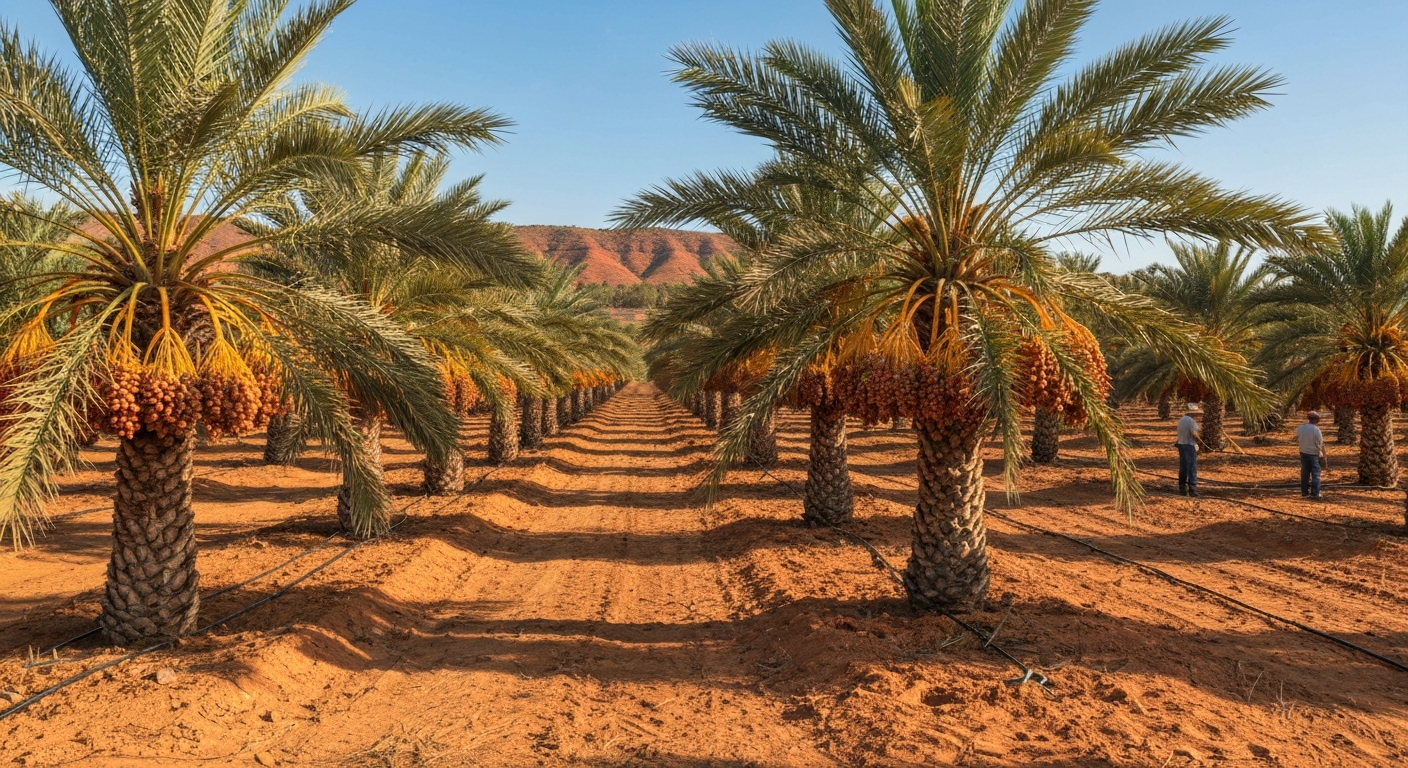
For home gardeners in the right regions, a date palm is a completely realistic long-term project. You will need patience, a dependable irrigation system, at least one male and several female palms, and the willingness to hand-pollinate every season. For small-scale farmers, Australia already has a functioning, if niche, date industry valued at roughly AU$2 million annually, with R&D infrastructure at places like Gurra Downs in the Riverland. The barriers are not climate in the right zones but rather capital cost, the long juvenile period before a palm produces meaningful yields, and careful biosecurity compliance when moving planting material between states. If you are in a marginal climate zone, such as humid coastal Queensland or the temperate south, fruiting quality drops sharply and the investment becomes very hard to justify outdoors.
What Phoenix dactylifera actually needs
Date palms are a desert crop that evolved in the Middle East and North Africa, and they have specific requirements that are genuinely demanding. Getting all four pillars right simultaneously is what separates growers who harvest dates from those who just own a nice palm tree.
- Climate: long, hot, dry summers with sustained temperatures above 25°C during fruit development; a mild cool period that triggers flowering (but no hard frost); minimal rainfall or humidity during ripening
- Soil: deep, free-draining sandy loam to sandy soil; pH around 7.0–8.0; tolerant of moderate salinity but leaching must be managed
- Water: consistent irrigation supplying roughly 60–200 cubic metres per tree per year depending on age, spacing and climate; drip or furrow systems preferred
- Pollination: dioecious species requiring at least one male palm for every 25 or so females; hand pollination is standard for reliable fruit set
Where in Australia is suitable
Australia's climate is varied enough that date suitability really does split along regional lines. The inland arid and semi-arid zones tick most of the boxes. The humid tropics and the temperate south mostly do not.
| Region | Climate Type | Date Fruiting Feasibility | Key Limitation |
|---|---|---|---|
| Riverland, SA | Hot semi-arid (BSk/BWh) | Excellent | Frost risk in some years; irrigation required |
| Sunraysia/Mildura (VIC/NSW) | Hot semi-arid (BSk) | Very good | Occasional cool humid spells at ripening |
| Alice Springs / Central NT | Hot desert (BWh) | Very good to excellent | Parlatoria date scale present; biosecurity rules apply |
| Pilbara / Carnarvon, WA | Hot arid (BWh) | Good to very good | High summer heat can be extreme; heritage plantings exist |
| Tropical north (Darwin, Broome) | Tropical savanna (Aw) | Poor for fruiting | High humidity and wet season cause fruit rot |
| Coastal QLD (Brisbane north) | Humid subtropical (Cfa) | Marginal outdoor fruiting | Humidity during ripening damages fruit quality |
| Temperate SE (Sydney, Melbourne, Adelaide metro) | Temperate (Cfb/Cfa) | Not suitable outdoors | Insufficient heat accumulation; cool wet winters |
| Tasmania / Southern VIC | Cool temperate (Cfb) | Not suitable outdoors | Too cold; frost risk; insufficient summer heat |
The Riverland and Sunraysia regions are where Australia's commercial date industry is currently concentrated, and both have active nurseries and R&D trials to learn from. The NT around Alice Springs has suitable desert heat but requires careful attention to the Parlatoria date scale biosecurity rules before moving planting material in or out of the territory.
Detailed climate requirements: heat, sunlight, humidity, frost and season length
Date palms are one of the most heat-demanding fruit crops you can grow. Flowering initiates once shade temperatures consistently exceed around 18°C in spring. Fruit development requires sustained temperatures above 25°C, and the ripening stage from khalal (crisp, full-sized) through to rutab and tamr (soft, cured) needs prolonged heat. Some varieties require accumulated heat units in the order of 5,100°C-days from flowering to full ripeness, which translates to a long, reliably hot summer with minimal cloud cover. The Riverland records average summer maxima in the high 30s°C and regularly hits 40°C-plus days, making it climatically comparable to productive date regions in the southwestern United States, which is why comparisons to growing conditions in Arizona are quite apt.
Sunlight hours matter as much as temperature. Date palms fruit poorly under shade and need an unobstructed position. At least six hours of direct sun per day is the bare minimum, and full all-day exposure is ideal. Humidity is the enemy during ripening: rain or high relative humidity on maturing bunches causes fruit to split, ferment or develop fungal issues. This is precisely why tropical northern Australia, despite having high temperatures, struggles to produce good quality dates. The dry inland regions deliver the low humidity at ripening that makes the difference.
On frost: vegetative growth slows below 10°C and stops below around 4°C. Mature, established palms can tolerate brief overnight frosts down to approximately -5°C without permanent damage to the trunk, but the developing flower bunches and young fruit are frost-sensitive and can be destroyed by even a light frost in spring. Young palms under three years old are significantly more vulnerable. In the Riverland and Sunraysia, late-spring frosts are uncommon but not impossible, so site selection within the region matters.
Soil and site selection: drainage, pH, salinity and preparation
Date palms genuinely do not like wet feet. Waterlogged soil is one of the fastest ways to kill a date palm or suppress its yield. Sandy loam or sandy soils with deep profiles are ideal, and the palms will find water at depth if it is there. In heavier clay soils, you need to either raise beds or work in significant amounts of coarse sand and organic matter before planting. The Riverland's soils, many of which are sandy over limestone, suit date palms well naturally.
Target a soil pH of around 7.0 to 8.0. Date palms tolerate mild alkalinity and are actually listed by FAO as relatively salt-tolerant compared with most fruit trees. They will cope with moderately saline irrigation water better than an apple or citrus would, but sustained high salinity still reduces yield and fruit quality. If you are irrigating with saline water, which is a real scenario in parts of inland Australia, you will need to factor in a leaching fraction to prevent salt accumulation in the root zone. Soil testing before planting is worthwhile, particularly for salinity and pH in areas with known saline groundwater.
Pick the hottest, most sheltered spot on your property. A north-facing aspect protected from cold southerly winds is ideal in Australian conditions. Avoid low-lying frost pockets. If you are on a larger property, slight elevation above a frost hollow with full northern exposure is the best site you can give a date palm.
Water and irrigation: how much, when, and what system to use
Date palms are not drought-tolerant when you want them to produce fruit. They evolved in oasis environments where their roots access deep water. In a commercial orchard context, mature palms typically consume somewhere between 60 and 200 cubic metres of water per tree per year depending on climate, age, and spacing. Field studies and FAO-based estimates frequently cite a practical range of around 86 to 124 cubic metres per tree per year under efficient irrigation. At the lower end of spacing density, whole-orchard water use commonly sits between 10,000 and 15,000 cubic metres per hectare per year. For a home grower with a handful of palms, that works out to roughly 80,000 to 150,000 litres per palm per year from irrigation under warm, dry conditions, which is a significant water commitment.
Drip irrigation is the most water-efficient choice and the standard in Australian commercial plantings. It delivers water directly to the root zone, reduces evaporative loss, and keeps the trunk and fronds dry, which helps limit fungal disease. Furrow or basin irrigation is still used in some older plantings but wastes considerably more water and can contribute to soil waterlogging if not managed carefully. Micro-sprinklers can work for young palms.
Scheduling matters as much as total volume. Palms need the most water from spring through to harvest in autumn. During winter, irrigation can be reduced significantly. Deficit irrigation strategies, where water is mildly reduced during specific reproductive stages, are used in commercial settings to influence fruit quality and reduce water bills, but this is a refinement for experienced growers rather than something a first-time planter needs to manage in year one or two.
Pollination and sexing your palms
This is the piece that trips up most new date growers. Phoenix dactylifera is dioecious, meaning individual trees are either male or female. Female palms produce the fruit; male palms produce pollen. If you plant only female palms, you get nothing. Natural wind pollination does occur but is unreliable for consistent fruit set, particularly in smaller plantings where the pollen source might be distant. Commercial growers and serious home growers use hand pollination, which gives them control over timing, pollen application, and ultimately yield.
In a managed planting, one male palm can realistically supply pollen for around 25 female palms, with some research reporting ratios as low as 1.5 males per 50 females when using dried or stored pollen and careful hand-dusting techniques. For a home planting of, say, four to six female palms, a single male or even stored pollen from a known source is sufficient. Australian nurseries such as Gurra Downs supply named male varieties including Oliver, Fard, and Jarvis alongside their female stock.
The hand pollination process works like this: male palms flower before females, so you collect the male spathes just as they begin to open, remove the flower strands, and either use them fresh or dry the pollen for storage. When the female spathes open and the stigmas are receptive (typically sticky and pale yellow), you insert strands of male flowers among the female spikelets or dust dry pollen directly onto them. Timing is critical: the female receptivity window is around three to five days. Missing it means waiting another full season. Tissue-culture-raised palms from nurseries are sexed before sale, which solves the frustrating problem of waiting years to discover whether a palm is male or female.
Best date varieties for Australian conditions
Variety selection genuinely affects whether your palms thrive in Australian conditions. The main commercially trialled varieties in Australia include Medjool, Deglet Noor, Barhee, Khadrawy, Zahidi, and Khalas, all of which are available as tissue-culture stock from Australian nurseries. Each has different heat requirements, moisture tolerances, and end-use qualities.
| Variety | Ripening Class | Heat Requirement | Humidity Tolerance | Best for Australian Growers | Notes |
|---|---|---|---|---|---|
| Medjool | Soft (tamr) | High | Low — sensitive to rain/humidity | Riverland SA, Sunraysia | Premium market price; large fruit; most widely grown commercially in Australia |
| Deglet Noor | Semi-dry | High | Moderate | Riverland SA, Sunraysia, Central NT | Firm texture; long shelf life; good for export |
| Barhee | Soft; also eaten at khalal stage | Moderate-high | Low-moderate | Riverland, Sunraysia, Pilbara WA | Can be eaten crunchy at khalal; more forgiving of slightly shorter seasons |
| Khadrawy | Soft (tamr) | Moderate-high | Low | Riverland SA, Sunraysia | Rich flavour; smaller fruit; ripens relatively early |
| Zahidi | Semi-dry | High | Moderate | All suitable inland regions | Hardy, productive; less premium price but reliable yields |
| Khalas | Soft (tamr) | High | Very low | Riverland SA, Central NT | Highly regarded flavour; sensitive to humidity; suited to driest sites |
For most Australian home growers starting out, Barhee is a practical first choice because it can be harvested and eaten at the khalal (crunchy) stage, which requires less accumulated heat than full tamr ripening, giving you a marketable or edible product even in slightly marginal seasons. Medjool is the premium commercial choice but demands the hottest, driest conditions and careful bunch management. Deglet Noor and Zahidi are reliable workhorses for growers focused on yield over premium pricing.
Planting, establishment and early care
Plant tissue-culture palms in spring after the last frost risk has passed, ideally when soil temperatures are consistently above 20°C. Dig a hole at least twice the diameter of the container and backfill with the native soil mixed with coarse sand if drainage is borderline. Avoid adding excessive organic matter to the backfill, as it can encourage anaerobic decomposition in the root zone. Set the palm at the same depth it was in the container and water it in thoroughly. Stake young palms in exposed sites for the first one to two years.
Commercial date palms are typically spaced at 8 to 10 metres between trees in rows, which gives roughly 100 to 150 trees per hectare. For a home garden, three to four female palms with one male in a sheltered north-facing location is a practical starting point. Palms are slow to establish in the first two to three years and may not produce significant fruit until years five to eight. Patience is not optional with this crop.
Fertilise with a balanced palm fertiliser that includes potassium and magnesium, both of which date palms use heavily during fruiting. Potassium deficiency shows up as orange-bronze frond discolouration and is common on sandy soils. Apply fertiliser in split doses through spring and summer rather than one large annual application.
Pruning, bunch management and protecting fruit
Annual pruning involves removing old dead fronds and any suckers (offshoots) that emerge at the base, unless you are intentionally propagating from them. Leave a green frond skirt of around 10 to 14 rows of live fronds on mature palms to support photosynthesis. Over-pruning reduces the energy available for fruit production.
After hand pollination and fruit set, bunches are often thinned to leave a manageable number of fruits per strand, which improves individual fruit size and quality. Bunches are also tied or supported to prevent wind damage as they grow heavy. As fruit approaches the khalal and rutab stages, wrapping individual bunches in paper or cloth bags keeps rain off the fruit and deters birds and insects. This step is especially important for soft varieties like Medjool and Khadrawy in areas with any summer rainfall.
Pests, diseases and biosecurity in Australia
The most significant pest issue specific to Australian date growing is Parlatoria date scale (Parlatoria blanchardi), a sap-sucking scale insect that is established in central Australia around Alice Springs. South Australia's plant health authority (PIRSA) enforces quarantine conditions on date palm offshoots and other planting material moved from the NT into SA precisely to prevent this pest spreading into the Riverland. SA PIRSA lists Parlatoria date scale (Parlatoria blanchardi) as present in central Australia and requires certification or treatment for date palm offshoots moved from the NT into South Australia to prevent its spread SA PIRSA lists Parlatoria date scale (Parlatoria blanchardi) as present in central Australia and requires certification or treatment for date palm offshoots moved from the NT into South Australia to prevent its spread.. If you are sourcing planting material, buy from accredited nurseries that supply certified, tissue-culture-raised stock. Tissue culture plants are clean, true to variety, and avoid the quarantine complications that come with moving suckers between states.
Other pests common in Australian orchards include mealy bugs, spider mites in hot dry conditions, and fruit-boring beetles on ripe bunches. Fungal issues such as black scorch (Thielaviopsis paradoxa) can occur on stressed palms or in conditions of excessive moisture. Standard orchard hygiene, good drainage, and avoiding waterlogging address most of these risks. The NT Department of Agriculture and Fisheries lists poor fruit set and Parlatoria management as two of the primary R&D priorities for the Australian date industry, so these are active areas of ongoing practical research. The NT Department of Agriculture & Fisheries, Dates (industry overview and RD&E plan summary) describes the Australian date industry as niche (≈AU$2 million annually) and lists RD&E priorities including poor fruit set and Parlatoria date scale management NT Department of Agriculture & Fisheries — Dates (industry overview and RD&E plan summary).
Container and greenhouse growing for cooler or humid areas
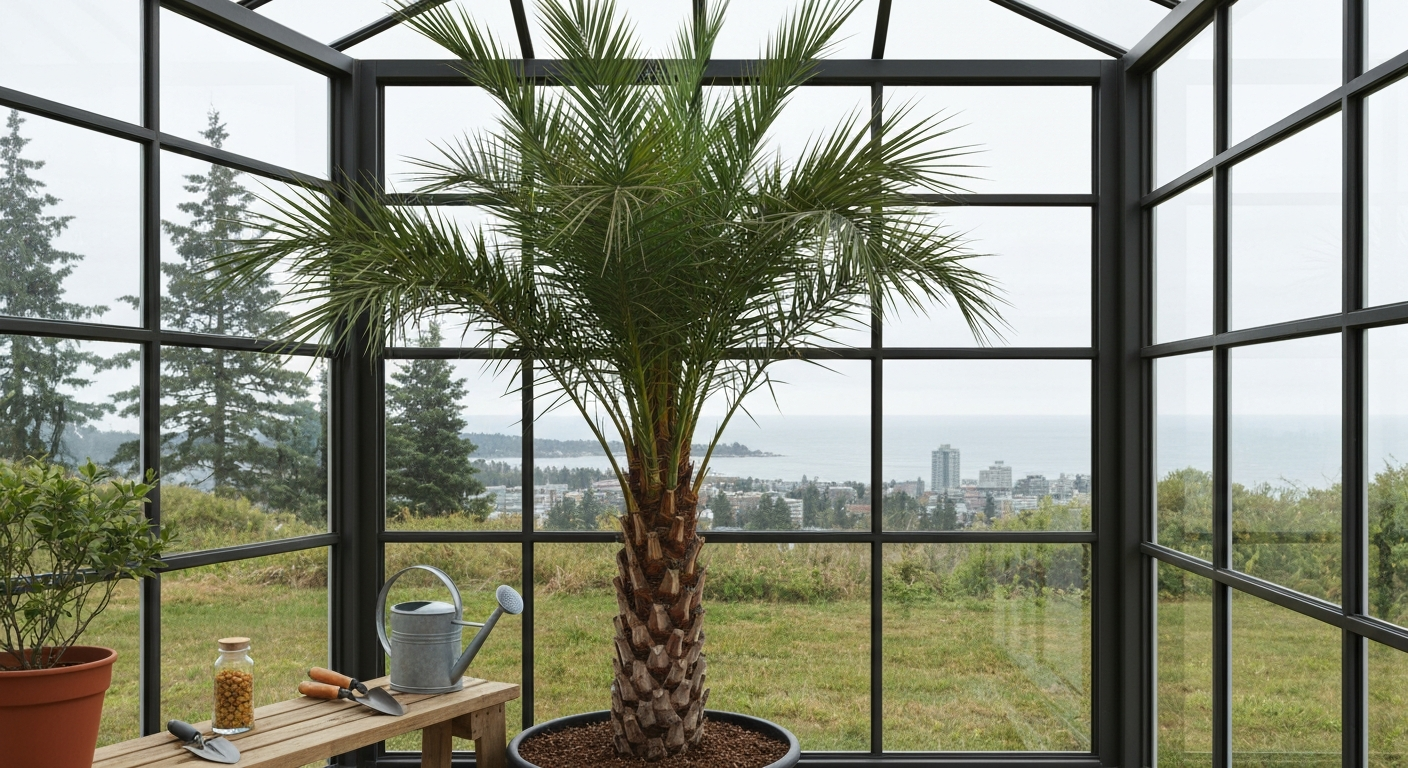
If you are in coastal Queensland, Sydney, or Perth's coastal strip and want to grow a date palm, containers are an option worth understanding clearly. A date palm in a large container (200 litres or more) can be grown on a hot paved courtyard in full sun and moved under cover during wet or cold periods. You will get a healthy, attractive palm this way, but fruiting is unlikely to be reliable without exceptional heat accumulation and very careful hand pollination. In humid coastal climates, even if you get fruit to set, ripening to full tamr quality is the challenge. Barhee eaten at the khalal stage is the most realistic fruit you can expect in these conditions.
A heated greenhouse solves the humidity and heat-accumulation problem in theory, but the infrastructure cost for a crop that takes five or more years to produce makes this uneconomical for most home growers. If you genuinely want to trial dates in a marginal climate, a large unheated glass or polycarbonate structure in a Melbourne or Sydney garden will extend the effective heat season and protect fruit from rain, which is the most practical greenhouse approach.
How Australia compares to other date-growing regions
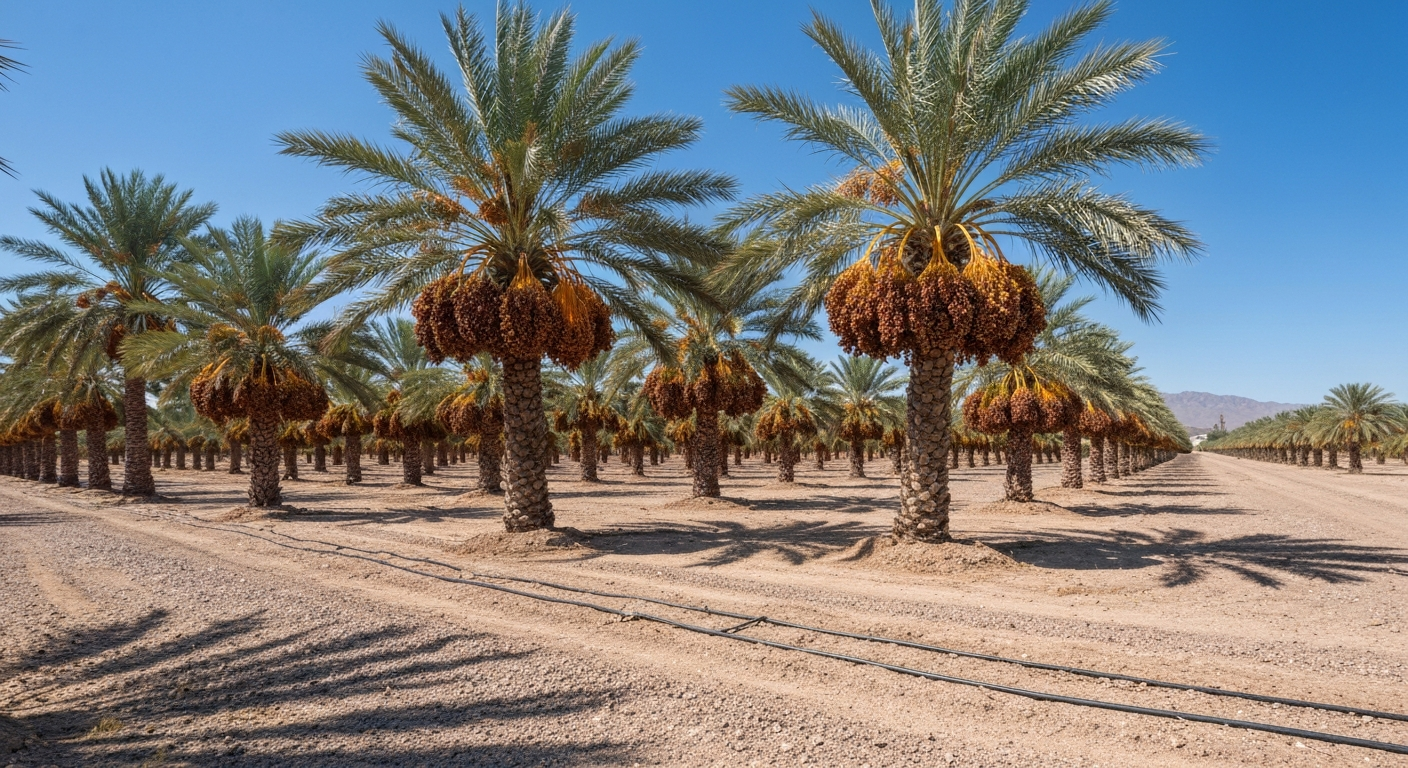
Australia's best date country, the Riverland and Central Australia, is climatically comparable to the productive date regions of the southwestern United States. Growing conditions in places like Arizona are arguably the closest parallel: hot desert summers, reliable low humidity, deep well-drained soils, and dependable irrigation water. For readers asking "can you grow dates in Arizona", yes, Arizona's hot, dry summers and low humidity make it one of the closest parallels to Australia's Riverland for successful date production. Oklahoma sits at the more marginal northern edge of US date feasibility, similar to how the Sunraysia is at the cool limit of Australian date country. Canada, like southern Australia and Tasmania, is effectively ruled out for outdoor fruiting except in the very warmest pockets of British Columbia, and even then it is marginal at best. For a Canada-focused discussion, see can you grow dates in Canada for details on the marginal pockets of British Columbia where outdoor fruiting might be possible. Ghana and tropical West Africa have the heat but struggle with the humidity and wet season timing in the same way that Darwin does. Australia's inland arid zones genuinely compete on climate, and the existing commercial infrastructure in the Riverland gives serious growers real support networks and local nursery stock.
Harvest expectations and post-harvest handling
A young date palm planted from tissue culture typically begins producing harvestable bunches from around year five to eight, with yields increasing significantly through the first 10 to 15 years. A mature productive palm can yield anywhere from 40 to 150 kilograms of fruit per season depending on variety, care, and climate. Fruit is harvested in autumn in Australian conditions, typically between March and June depending on variety and location. Soft varieties like Medjool need to be picked when they reach full tamr ripeness and are highly perishable without refrigeration. Semi-dry varieties like Deglet Noor and Zahidi are more forgiving post-harvest and can be air-dried and stored at room temperature.
Sourcing plants and navigating quarantine rules
Buy tissue-culture palms from a reputable Australian nursery rather than imported suckers or seed-grown stock. Seed-grown date palms are genetically variable, meaning around half will be male and the females will produce unpredictable fruit quality. Tissue-culture plants are true-to-type, disease-screened, and sexed before sale. Gurra Downs in the Riverland is the most established Australian tissue-culture nursery for date palms, offering both female varieties (Medjool, Deglet Noor, Barhee, Zahidi, Khalas, Khadrawy) and male pollinators (Oliver, Fard, Jarvis).
If you are in South Australia, be aware of PIRSA's plant health rules around importing date palm material from the NT due to Parlatoria date scale. Purchase from nurseries that can supply a phytosanitary certificate or equivalent certification. Federal biosecurity rules also govern the importation of date material from overseas, and fresh date imports carry strict post-harvest treatment requirements. Stick to certified Australian-sourced nursery stock and you avoid the compliance headache entirely.
For further guidance, AgriFutures Australia has published a Date Palm RD&E Plan (2023–2028) that outlines the industry's development priorities and lists contact points for regional extension services. State departments of primary industries in SA, VIC, NSW, and the NT all have horticultural extension contacts who can advise on local conditions and current trial results. If you are serious about small-scale commercial production, connecting with the existing Riverland or Sunraysia grower network before you plant is the single most useful thing you can do.
FAQ
Can you grow date palms (Phoenix dactylifera) in Australia for home gardeners or small-scale farmers?
Yes — Phoenix dactylifera can be grown successfully in parts of Australia. Commercial and trial plantings are established in hot, dry regions such as the Riverland (South Australia), Sunraysia/Mildura (NSW/VIC border), parts of Central Australia (NT) and historic plantings in WA. Success depends on matching the species’ need for long, hot, dry summers, adequate irrigation management, suitable soils and managed pollination. In cooler or humid areas outdoor fruit production is unlikely without protected or container/greenhouse culture.
Which Australian regions are most suitable for growing dates?
Best-suited regions have long hot, dry summers and mild winters: Riverland (SA), Sunraysia/Mildura (NSW/VIC), parts of inland WA (Carnarvon/Pilbara historically), and Central Australia (Alice Springs) where trials exist. Coastal, cool temperate or humid tropical regions are generally unsuitable for reliable outdoor fruiting.
What are the key climate requirements for Phoenix dactylifera?
Dates need a long, hot, dry summer with daytime fruit‑ripening temperatures typically above ~25°C and flowering that follows warm conditions exceeding ~18°C. Vegetative growth slows below ~10°C. Successful varieties also require substantial heat accumulation (FAO heat‑unit estimates; some varieties need ~5,100 °C accumulated heat units to fully ripen).
What soil and water conditions do date palms need?
Dates tolerate a wide range of soils including sandy to loamy types and are relatively salt‑tolerant compared with many fruit trees. They require deep, well‑drained soils for rooting; heavy waterlogging is harmful. Irrigation needs are substantial: seasonal crop evapotranspiration is commonly in the order of ~1,500–2,500 mm/yr at mature orchard scale (practical commercial ranges often equate to ~10,000–15,000 m3/ha/yr). Per‑tree seasonal irrigation for established palms typically ranges ~60–200 m3/tree/yr depending on climate, age and spacing.
Do date palms need pollination and how is it done?
Yes — Phoenix dactylifera is dioecious (separate male and female palms). Commercial producers and backyard growers use hand pollination because natural pollination is unreliable for consistent yields. Methods include collecting male spathes or pollen, drying or suspending pollen, and applying it to receptive female spikelets by hand-dusting, brush or spray. Only a few male plants are required when managed carefully (one male can supply pollen for many females depending on technique).
Which date varieties are most appropriate for Australian growers?
Varieties trialled and used in Australia include Medjool, Deglet Noor, Zahidi, Barhee, Khalas and Khadrawy, among others. Choice depends on climate, intended use (fresh versus dry), and local availability. Medjool is popular for fresh fruit but needs very hot ripening conditions and good irrigation; Deglet Noor is more adaptable for drier processing markets. Local trial results and nursery availability should guide selection.
Next Articles
Can You Grow Dates in Canada? Feasibility, Methods & Tips
Can you grow dates in Canada? Practical verdict, zone-by-province guidance, greenhouse & container methods.
Can You Grow Dates in Arizona? Practical Guide & Tips
Yes - grow date palms in Arizona: region-specific varieties, planting calendar, pollination, care & harvest tips.
Can You Grow Dates in Oklahoma? Cold-Hardy Options
Learn if you can grow date palms in Oklahoma and get tips for cold-hardy container success and fruit set.