
You can grow a date palm in Oklahoma, but producing actual dates is a long shot, and keeping the tree alive through winter takes real planning. The honest version: date palms are marginally hardy in Oklahoma's climate, container growing gives you the most control but comes with serious trade-offs, and anyone expecting a backyard harvest in a few years will likely be disappointed. That said, if you go in with realistic expectations and a solid winter-protection plan, growing one as an ornamental curiosity with a slim chance at fruit is absolutely something you can try.
Can You Grow Dates in Oklahoma? Cold-Hardy Options
Marcus Holloway
11 Jun 2026
Oklahoma's climate and whether dates can survive here
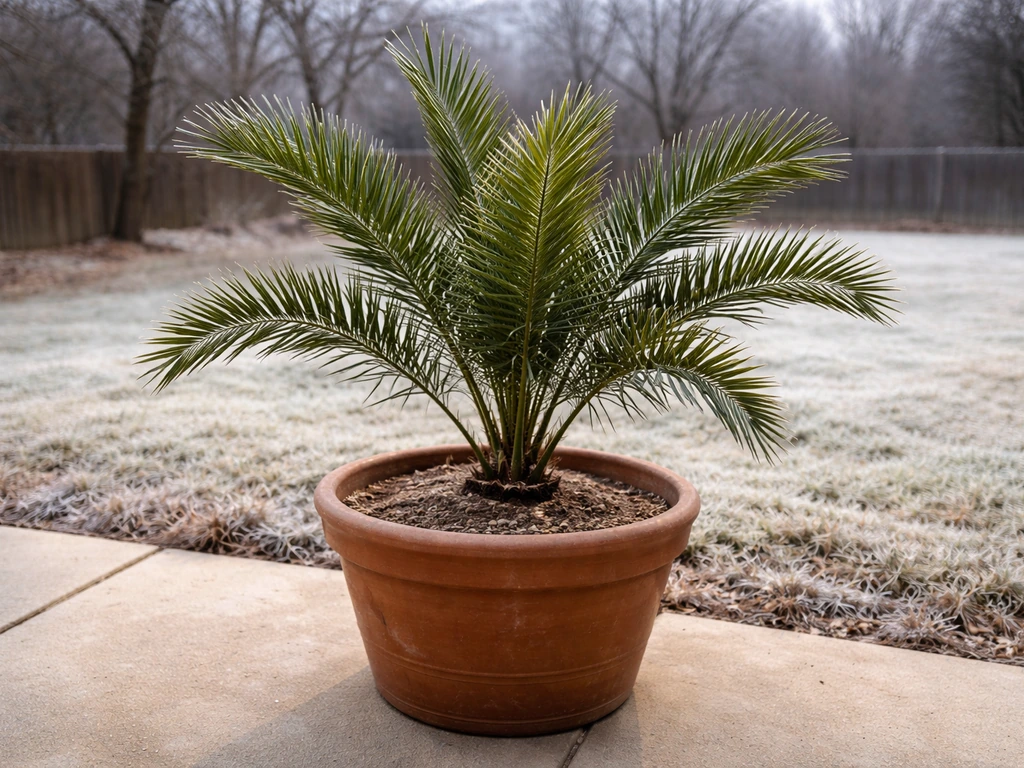
Oklahoma sits in USDA hardiness zones 6a through 8a, depending on where you are. The southern tier near Ardmore and Idabel skews warmer, while the panhandle and northeastern corners see the harshest winters. The core problem for date palms isn't just winter cold, it's the combination of cold nights, hard freezes, and the occasional catastrophic deep freeze that defines this region.
Date palms (Phoenix dactylifera) grow best where temperatures stay above 20°F, and UF/IFAS notes they're really best suited where temperatures don't fall below 15°F. Oklahoma City's all-time record low is a brutal -17°F, and even in a normal year the metro sees multiple hard freezes below 28°F, with the mean last hard freeze landing around March 17 and the first one returning by November 14.
Oklahoma Climatological Survey's Oklahoma Weather Timeline documents historic cold snaps in Oklahoma City that include the earliest first-freeze date of October 8 and multiple multi-day periods below freezing, illustrating the state's freeze risk for palms Oklahoma City's record low of -17°F. That's a tight window.
In southern Oklahoma you get a bit more margin, but nowhere in the state is reliably warm enough to treat a date palm as a low-maintenance outdoor plant. If you are wondering can dates grow in ghana, the answer also depends heavily on winter temperatures and overall growing conditions, which is why climate matters as much as technique.
The summer heat is actually in your favor. Date palms thrive in high heat, and Oklahoma's scorching July and August temperatures are close to ideal for growth and fruit ripening. The FAO puts the optimal growth temperature around 32°C (roughly 90°F), which Oklahoma delivers reliably. The problem is you have to get through winter first, every single year.
Which date palm varieties give you the best shot
Phoenix dactylifera is the true fruiting date palm, and cold tolerance among named varieties varies somewhat, but none of them were bred for freezing winters. MSU Extension notes that date palms are reportedly hardy down to about 12°F, but leaf damage starts at 20°F and plants can be killed outright at 10°F. Oklahoma regularly hits both thresholds, sometimes for multiple days in a row, which is where the real danger lies.
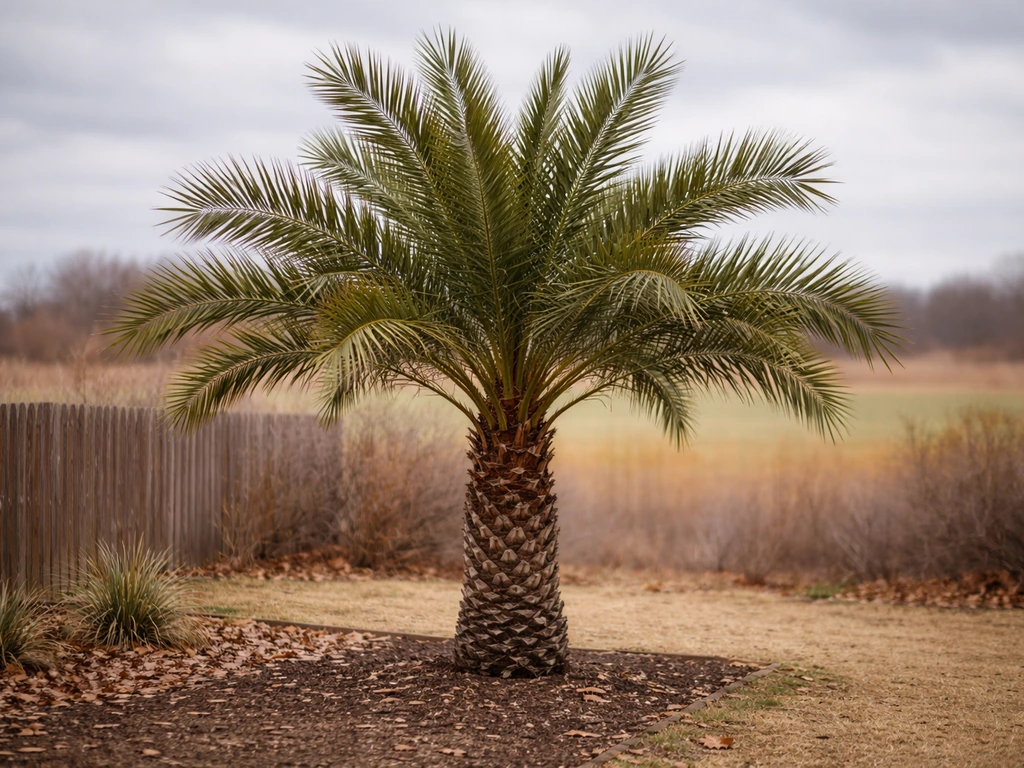
In practical terms, the varieties most often cited for marginal-climate trials include Medjool (popular, relatively vigorous), Deglet Noor (the standard commercial variety, somewhat heat-demanding), and Zahidi (considered one of the more drought and cold-tolerant types). For Oklahoma specifically, Zahidi is worth considering if you want a fruiting type, though none of these will survive an unprotected Oklahoma winter without help. The Canary Island date palm (Phoenix canariensis) is hardier, but it doesn't produce edible fruit worth eating and NCSU Extension notes it's still intolerant of temperatures below 20°F.
If your primary goal is fruit, stick with Phoenix dactylifera. If you just want the look of a date palm and slightly better survival odds, a more cold-tolerant ornamental palm might serve you better, but that's a different plant for a different goal.
Container growing vs planting in the ground
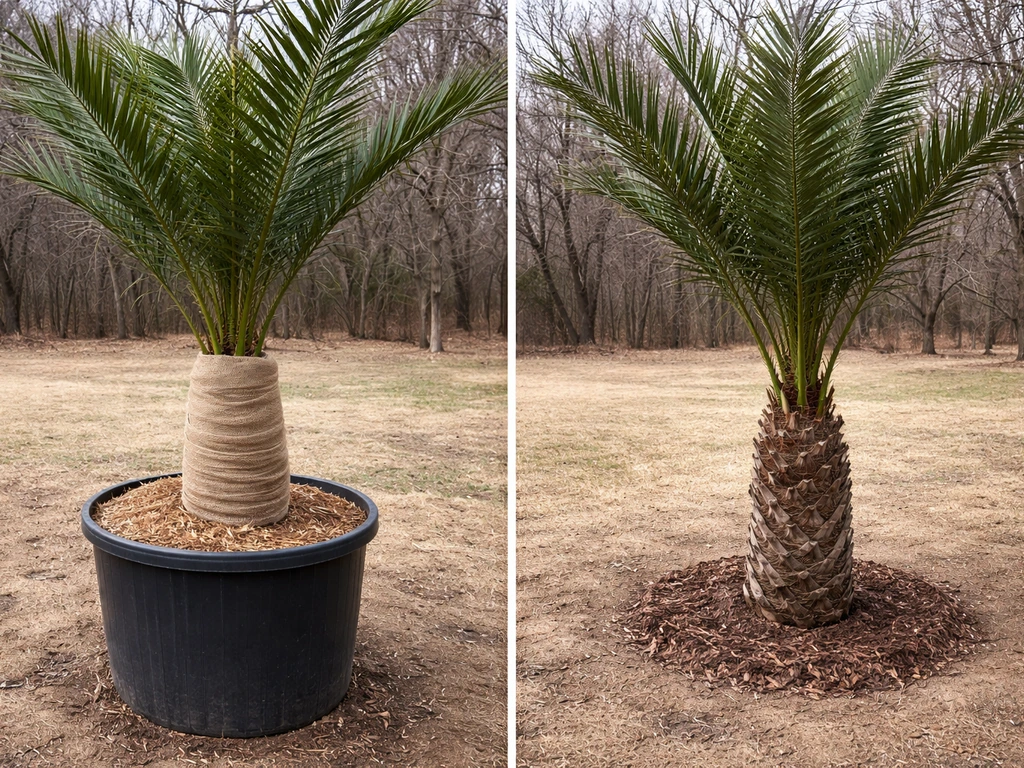
This is the central decision for Oklahoma growers, and both approaches have significant drawbacks. Here's how they compare honestly.
| Factor | Container Growing | In-Ground Planting |
|---|---|---|
| Winter control | Can be moved indoors or into a garage | Exposed unless heavily mulched and wrapped |
| Root cold exposure | Roots exposed to air temps, high freeze risk | Soil buffers roots from the worst cold |
| Long-term growth | Root-bound limits size and health over time | Palm can reach full size eventually |
| Fruiting potential | Very low; deep soils needed for best growth | Slightly better long-term, still risky |
| Effort required | Annual move, repotting, careful watering | Winter wrapping, mulching, monitoring |
| Best for | Northern/central OK, zones 6–7 | Southern OK, zone 8a microclimates |
Container growing gives you the ability to protect the plant by bringing it inside during the worst cold snaps, and for most of Oklahoma that's the more reliable survival method. The catch is that roots in containers are fully exposed to air temperature, which can drop well below zero during an Oklahoma ice storm. The Chicago Botanic Garden points out that container roots experience temperatures as extreme as the surrounding air, unlike in-ground roots that benefit from soil's thermal mass. Penn State Extension recommends wrapping pots in bubble wrap and plastic for insulation if you're overwintering them in an unheated space.
For in-ground planting, southern Oklahoma (zones 7b and 8a) in a well-chosen microclimate is the most reasonable option. Even then, the University of Nevada Reno notes that date palms want deep sandy soils 3 to 5 feet down with reliable subsurface moisture, which isn't the typical Oklahoma soil profile. You'll need to amend heavily and commit to serious winter protection every year.
My recommendation: if you're in Tulsa or Oklahoma City or anywhere north of I-40, grow in a container and plan to move it into a frost-free garage or shed by late October. If you're in the far southwest corner of the state with well-drained soil and a south-facing wall to put it against, in-ground with protection is worth a try.
Setting up the right site: sun, heat, soil, and water
Date palms need full sun, period. At least 8 hours of direct sun per day, ideally on a south or southwest-facing exposure. In Oklahoma that's not hard to find in summer, but placing your palm against a south-facing masonry wall or a light-colored fence can meaningfully raise the ambient temperature around the plant and extend your safe growing window by a few weeks in fall.
Soil drainage is critical. Date palms do not tolerate wet feet, and Oklahoma's clay-heavy soils in many parts of the state are a real problem. If planting in ground, build a raised bed or berm with sandy loam mixed with coarse sand and some organic matter. The FAO recommends at least 3 feet of well-drained sandy material for optimal growth. In containers, use a cactus or palm-specific mix with added perlite to ensure drainage.
Irrigation matters more than most people expect. Date palms like deep, infrequent watering rather than shallow frequent moisture. During Oklahoma's summer heat, a mature in-ground palm may need significant weekly deep watering, especially in sandy amended soil that drains fast. Container plants dry out quickly in triple-digit heat, so check moisture levels every few days in July and August. Back off on water significantly in winter, as overwatering a cold, dormant palm is a fast track to root rot.
Pollination: what you need to know before expecting fruit
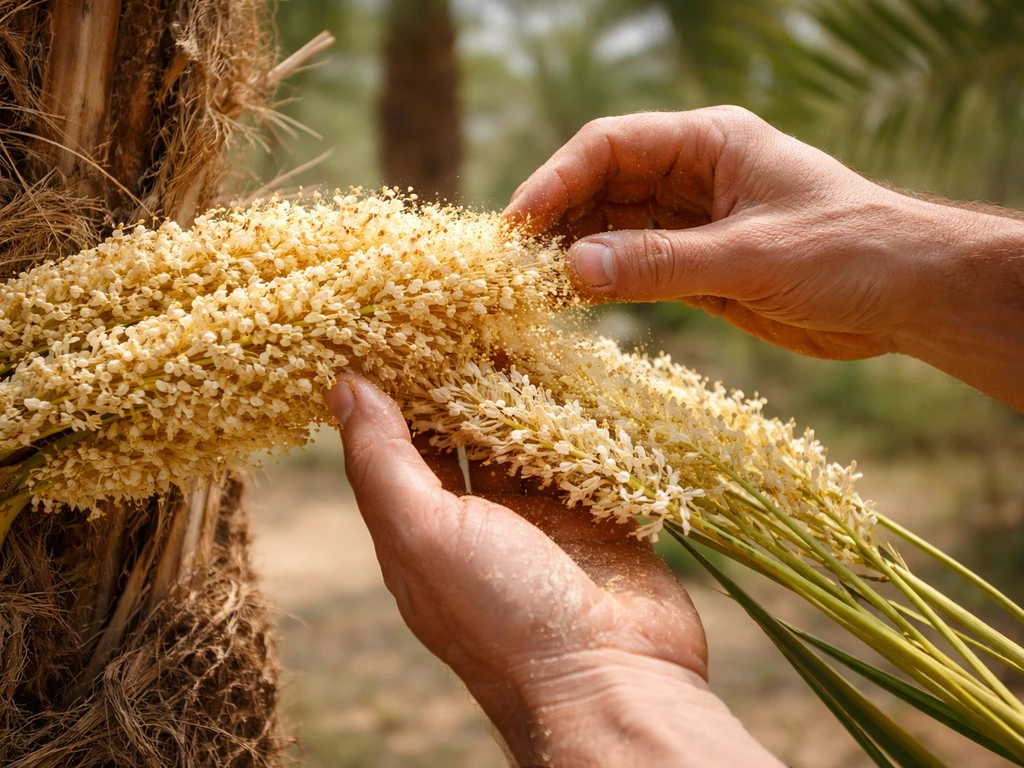
Date palms are dioecious, meaning male and female flowers grow on separate plants. You cannot get fruit from a single palm. You need at least one male and one female, and the female is the one that produces dates. In commercial orchards, one male can pollinate many females, but for a home grower managing one or two plants, you'll need to buy or source both sexes and hand pollinate.
Hand pollination is straightforward in practice: when the male inflorescence (flower spike) opens and releases pollen, you cut strands of it and physically insert them into the female inflorescence. Wind can carry some pollen naturally, but relying on wind in a home garden setting is unreliable. Timing is critical since male and female inflorescences don't always open at exactly the same time, so some growers collect and refrigerate male pollen for a short period. For an Oklahoma hobbyist, this is entirely doable if you have both plants, but it adds another layer of planning to an already complex situation.
One more thing: you usually can't tell male from female palms until they're old enough to flower, which can take years. When buying plants, ask the nursery or seller to confirm the sex if the plant is old enough to have flowered before.
Realistic timeline: how long until anything happens
This is where expectations often hit a wall. Date palms are famously slow. Seed-grown palms can take 8 to 15 years before their first fruit. Offshoots (divisions from a mature mother plant) are faster, typically 3 to 5 years to a small initial crop under good conditions. Under Oklahoma's stress, add time to both of those estimates.
FAO production data shows that transplanted offshoots often take 4 to 6 years just to establish well, with meaningful yields not coming until 14 to 20 years into the plant's life. For an Oklahoma grower who loses ground every hard winter, that clock resets partially with each significant cold damage event.
Here's a rough honest timeline for an Oklahoma container grower starting with an offshoot this year: years 1 to 2 are about survival and acclimation, years 3 to 5 you might see the plant reach a few feet of trunk with healthy fronds if winters go reasonably well, and year 5 or beyond is when fruit becomes a remote possibility if you have both sexes, hand pollinate, and the summer is long and hot enough for fruit to ripen. Fruiting requires about 7 months of high heat after pollination. Oklahoma summers are hot enough in theory, but consistent multi-year success is unlikely without a warm microclimate or some degree of protected outdoor growing.
Winter protection and common failure points
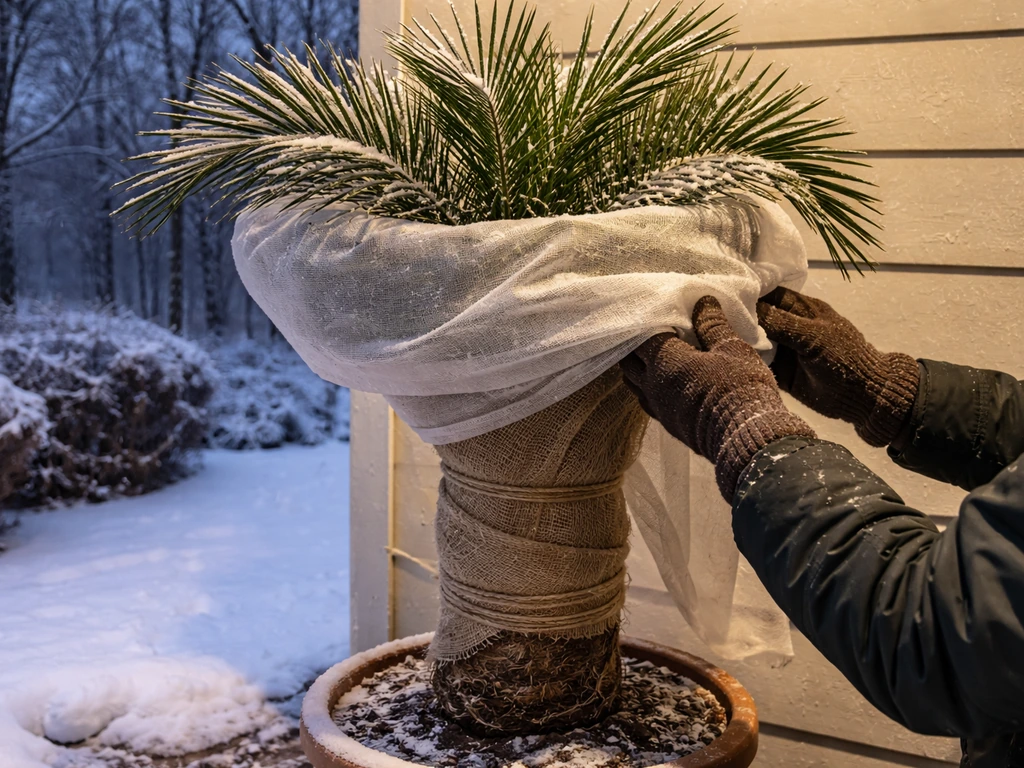
Cold damage and winterkill
The single biggest killer of date palms in Oklahoma is the meristem (the growing bud at the top of the trunk) freezing. Once that's gone, the palm is dead. Even if the leaves get damaged, the plant can recover from leaf damage as long as the central bud survives. Protecting the crown is your top priority. In fall before hard freezes arrive (think late October in central Oklahoma, early November at the latest), wrap the crown and upper trunk in frost cloth, burlap, or old blankets secured with twine. For container plants, bring them into a garage or shed when overnight temps are expected below 25°F.
Root freezing in containers
If you're overwintering a container palm in an unheated space, wrap the pot itself in multiple layers of bubble wrap covered with burlap or plastic sheeting. The roots are the most vulnerable part in a container since they have no soil mass insulating them. Keep the soil barely moist during this period, not dry and not wet. Overwatering a cold palm accelerates root rot significantly.
Slow growth and container limitations
Even with perfect winter survival, a container-grown date palm eventually hits its limits. Root-bound conditions stunt growth, and date palms want deep soils to really thrive. Plan to step up to a larger container every 2 to 3 years, aiming for a 25 to 30-gallon pot by year 4 or 5. Moving that around for winter becomes its own challenge.
Disease: lethal yellowing
UF/IFAS flags lethal yellowing (LY) as a serious disease concern for Phoenix dactylifera. While it's more prevalent in Florida and coastal Gulf states, it's worth knowing about. If you're sourcing plants, buy from reputable nurseries with clean stock. There's no cure for lethal yellowing once a palm is infected.
Other common problems
- Spider mites in hot, dry conditions, especially on container plants indoors during winter
- Root rot from poor drainage or overwatering during dormancy
- Sunscald when moving a palm from indoor overwintering to full outdoor sun too quickly in spring (harden it off gradually)
- Frost damage to fronds in spring if you move the plant outside too early before the last hard freeze date passes
Your next steps if you want to try this year
June is actually a decent time to start planning and sourcing a date palm for Oklahoma. You have the full summer growing season ahead for establishment, and you're not rushing into winter protection decisions yet. Here's how to approach it practically.
- Source an offshoot rather than a seed-grown palm to cut years off your timeline. Look for a reputable palm nursery online or a local nursery in zone 8 or warmer that carries Phoenix dactylifera specifically. Ask about variety (Zahidi or Medjool are good starting points) and whether it has flowered before if sex matters to you.
- Decide on container or in-ground based on your location: container if you're in Tulsa, OKC, or anywhere zone 7 or colder; in-ground only if you're in zone 8a southern Oklahoma with a south-facing, wind-protected microclimate.
- Set up your site now: choose the hottest, sunniest spot you have, ideally with a south or southwest-facing wall nearby. Prepare well-draining sandy loam soil or a large container (at least 15-gallon to start) with quality palm mix and added perlite.
- Plant or pot up by late June or early July so the palm has 3 to 4 months of warm growth before you need to think about winter protection.
- Mark your calendar for late October as your winter-prep deadline. Have frost cloth, burlap, and pot-wrapping materials ready before the first freeze forecast appears.
- If you want fruit long-term, plan to acquire both a male and a female plant. Keep them together all summer and research hand pollination timing so you're ready when they eventually flower.
- Keep watering deep and infrequent through summer, ease off dramatically in fall, and almost stop in winter (just enough to prevent the root ball from completely desiccating).
Growing dates in Oklahoma is genuinely doable as a project, just not as a reliable food crop. If you're wondering about the same idea in the desert, can you grow dates in Arizona depends on heat, cold protection, and choosing the right date palm variety. Think of it more like a long-term experiment with great summer growing conditions and a challenging winter obstacle course.
In general, you can grow dates in Canada only with heavy winter protection and a long, hot season (often in containers) can you grow dates in canada. Gardeners in places like Arizona have a much easier path to actual harvests, and even growers in warmer parts of Australia or southern climates elsewhere face fewer cold-related hurdles.
Oklahoma's appeal is that blazing summer heat: if you can solve the winter problem year after year, the summer end of the equation is exactly what a date palm wants. That's a real foundation to build on. If you mean can date palms grow and actually make dates in Ghana, the climate there is generally much more supportive than in cold regions can dates grow in Ghana. Yes, but can you grow dates in Australia depends heavily on local winter cold and how much protection you can provide can date palms grow and actually make dates in Ghana.
FAQ
Can you grow date palms outdoors year-round in Oklahoma without bringing them inside?
In most of Oklahoma, no. Even if leaves survive, the growing bud (meristem) is what determines life or death, and deep freezes can kill it. If you want an outdoor-only approach, plan for a real shelter system that holds warm air around the crown during hard freezes, and accept that losses in extreme winters still happen.
Where in Oklahoma has the best chance for real fruit, and does placement really matter?
The far southern tier (around zone 7b to 8a) generally gives the best odds, especially if you can use a south-facing masonry wall or sheltered corner. Microclimates can extend the safe growing window by weeks, but they do not remove the risk of lethal deep freezes, so you still need a crown-protection plan.
Is it easier to grow dates in Oklahoma from seed or from an offshoot?
Offshoots are far faster and more practical. Seed-grown palms can take a decade or more before fruiting, and you still need correct male and female plants. With offshoots, you may get earlier establishment, but Oklahoma winter stress can still push first meaningful yields far beyond typical timelines.
How do I know whether I’m buying a male or female date palm?
Ask the nursery to confirm the sex if the plant is old enough to have produced flowers. Many palms look identical for years, so you can end up with two males (no fruit) if sex isn’t confirmed. If the seller cannot verify, treat the purchase as a long gamble and plan for hand pollination only after you confirm flowering.
Can I hand-pollinate later if I miss the brief flowering moment?
Usually no. The window is short, and male and female inflorescences may not open at the same time. A workaround is to collect pollen as it releases, then refrigerate it briefly, but temperature control and timing still matter, and it is not a casual, last-minute task.
What is the biggest mistake people make with container date palms in Oklahoma?
Overlooking root vulnerability during winter. Above-freezing air temperatures may not be the danger, the pot can expose roots to air temperatures well below zero. Use pot insulation and consider bringing the container into a frost-free garage or shed when nights are expected below about 25°F.
How often should I water a date palm in Oklahoma, especially in summer versus winter?
In summer, aim for deep, infrequent watering, and check container moisture every few days during peak heat. In winter, reduce watering significantly and keep soil barely moist, because a cold, damp root zone increases the risk of rot. If you cannot easily manage irrigation during cold months, container success becomes much harder.
What soil setup works best if I’m trying to plant in the ground?
Expect to amend heavily. Date palms need deep, sandy, well-drained conditions, and Oklahoma clay often does not drain properly. A raised berm or planting mound with sandy loam plus coarse sand and organic matter helps, but you still need annual winter protection.
Do I need full sun every day for a date palm to survive and grow in Oklahoma?
Full sun is strongly recommended, about 8 hours of direct light, because it supports overall energy reserves needed to regrow after winter stress. If you plant in partial shade, growth and resilience usually weaken, which makes surviving marginal winters even less reliable.
Will frost cloth or blankets be enough for the crown, or do I need something more?
Frost cloth and secured blankets help, but success depends on preventing the crown area from dropping too far during hard freezes. Wrap before the first hard-freeze period, insulate consistently, and secure coverings against wind. If your site is exposed, consider additional insulation layers around the upper trunk.
Is Phoenix dactylifera the only date palm worth trying for fruit?
For edible fruit, Phoenix dactylifera is the one to focus on. The canary date palm is generally tougher but it is not a reliable source of edible dates, and it still cannot handle temperatures that drop below about 20°F without major risk.
What diseases should I watch for in Oklahoma when growing date palms?
Lethal yellowing is a key concern for Phoenix dactylifera, and there is no cure once infected. The practical step is prevention, buy clean stock from reputable nurseries, and avoid sourcing unknown or stressed palms.
If my date palm loses most of its fronds, can it recover?
Yes, leaf loss can be survivable, as long as the central growing bud remains alive. The right focus is on crown protection and monitoring after cold snaps. If new growth does not resume and the meristem is damaged, recovery is unlikely.
How big should my container be, and when should I repot?
Plan on stepping up container size every 2 to 3 years because root-bound conditions stunt growth. A common target is around a 25 to 30 gallon pot by about year 4 or 5, but repotting also increases handling stress, so coordinate timing with your winter moving schedule.
Next Articles
Can You Grow Agave in Canada? Zone Guide & Growing Tips
Can you grow agave in Canada? Practical region-by-region guide, hardy species, container tips & winter care.
Can You Grow Okra in Canada? Ontario Guide & Short‑Season Tips
Can you grow okra in Canada? Regional verdict, Ontario-specific steps, varieties, season-extension & harvest tips.
Can You Grow Asparagus in Canada? Planting Guide by Zone
Grow asparagus in Canada by zone: site, hardiness, crowns or seed, planting depth, care, and harvest plus fixes