
Yes, you can grow okra in Canada, but only in certain regions and only if you give it a serious head start. Southern Ontario is your best shot for outdoor success without a greenhouse. Parts of coastal British Columbia, the Niagara Peninsula, Windsor-Essex, and the Greater Toronto Area can pull off a reliable harvest most years. Everywhere else, you are fighting a short frost-free season, cool soils, and temperatures that okra finds genuinely miserable. That does not mean it is impossible further north, but it does mean you need season-extension tools, smart variety choices, and a planting schedule built around soil temperature rather than just calendar dates.
Can You Grow Okra in Canada? Ontario Guide & Short‑Season Tips
Marcus Holloway
22 Jul 2026
How okra actually grows: heat, season length, and temperature needs
Okra (Abelmoschus esculentus) is a tropical and subtropical crop native to West Africa. It evolved for long, hot summers, and it behaves exactly as you would expect from that background: it stalls in cool weather, sulks in cold soil, and absolutely refuses to germinate well unless conditions are warm. Understanding the specific thresholds involved is essential before you commit a garden bed to it.
Soil temperature at seed depth is the first gate. Extension research consistently puts the minimum for germination at around 60°F (15°C), but at that temperature you will get slow, patchy emergence and a poor stand. The recommended minimum is 70°F (21°C), and the optimum germination range runs from about 85°F to 95°F (29 to 35°C). In practical terms, this means planting into cold Canadian spring soil is a waste of seed. For transplanting from indoor-started seedlings, that same 70°F floor applies to outdoor soil before you put plants in the ground.
Air temperature drives the rest of the plant's life cycle. Okra grows actively when daytime highs are consistently above 25°C (77°F) and it produces the best pod set when ambient temperatures hover around 25°C. Pollen viability peaks in that range. Interestingly, sustained heat above 35 to 38°C can actually reduce pod set by damaging pollen, so this is a crop that wants warm, not scorching, conditions. In most of Canada, extreme heat is rarely the problem. The issue is that cool nights and short seasons work against it.
For timing purposes, most short-season okra varieties reach first harvest in 50 to 65 days from transplant (or from direct sow in warm soil). To get a meaningful, consistent harvest, you want closer to 90 to 100 productive days in the field. That is the practical benchmark to match against your local frost-free period.
Will okra mature where you garden? Checking your frost dates, soil temperature, and microclimate
Before you invest in okra, do three quick checks. First, look up your location's frost-free period using blank" rel="noopener noreferrer">Environment and Climate Change Canada's station-level climate normals (1991 to 2020 data is the most current set). You want the number of frost-free days and the average last spring frost date. Canada’s updated Plant Hardiness and frost‑free period maps (Plant Hardiness Zones of Canada, NRCan Open Data) are the authoritative source for local frost‑free days and station normals used in regional feasibility checks Plant Hardiness Zones of Canada — NRCan Open Data. If your frost-free period is under 120 days, you should plan on season-extension tools to make okra work reliably. If it is under 100 days, outdoor okra becomes genuinely speculative.
Second, check your soil temperature. A cheap soil thermometer pushed down to 5 to 8 cm (2 to 3 inches) is one of the most useful tools you can own. In much of southern Ontario, soil at planting depth does not reliably hit 21°C until late May or even early June, which is why transplanting rather than direct seeding is standard practice here. If you are using black plastic mulch or a hoop house, your soil can warm two to three weeks earlier than an uncovered bed.
Third, think about your microclimate. South-facing slopes and beds against brick or stone walls that absorb and re-radiate heat are meaningfully warmer than open ground. Urban areas, especially the GTA core, benefit from heat-island effects. Proximity to the Great Lakes moderates temperatures and extends the frost-free window, which is why the Niagara Peninsula and the north shore of Lake Erie are consistently among the most productive vegetable-growing areas in the country. If you garden in a frost hollow, a low-lying field, or a north-facing property, knock off a week or two from the feasibility calculation.
Feasibility by Canadian region
Canada's climate varies enormously from coast to coast, and okra's feasibility shifts just as dramatically. Here is an honest regional breakdown.
| Region | Avg. Frost-Free Days (approx.) | Okra Feasibility | Notes |
|---|---|---|---|
| Southern Ontario (Niagara, Windsor, GTA) | 140–175+ | Good to Excellent | Best outdoor bet; use short-season varieties and transplants |
| Northern Ontario | 80–110 | Very Difficult | Season too short outdoors; greenhouse or high tunnel needed |
| Southwest British Columbia (Lower Mainland, Victoria) | 150–220 | Good | Sufficient season length; cool summers can limit yield |
| Interior BC (Okanagan) | 130–160 | Moderate to Good | Hot summers help; check local frost dates |
| Quebec (Montreal and south) | 120–140 | Marginal to Possible | Use transplants, black plastic, and short-season varieties |
| Atlantic Provinces (NS, NB, PEI, NL) | 100–140 | Difficult to Marginal | Select earliest varieties; season extension strongly recommended |
| Prairies (AB, SK, MB southern) | 100–120 | Difficult | Hot summers help but season is short and spring is cold |
| Northern Territories (YK, NWT, NU) | 60–90 | Not Feasible Outdoors | Season is far too short; greenhouse-only |
British Columbia's Lower Mainland and Victoria area technically have long frost-free seasons, but summers there are often cool and overcast, which slows okra's heat-dependent growth. The Okanagan, with its hot, dry summers, is a better fit climatically when the season length works out. Quebec's Montreal region sits right at the edge of marginal; it can produce a crop in warm years but is unreliable without protection. The Prairies have the short, hot summer that okra likes, but the season is borderline and spring warms up late. The Atlantic provinces vary significantly by site, but most locations are challenging without dedicated season-extension infrastructure.
Southern Ontario in detail: why it works and which microclimates to target
Southern Ontario is the standout region for okra in Canada. The combination of lake-moderated temperatures, long frost-free periods, and genuinely warm summer days gives it a meaningful advantage over every other part of the country. The Niagara Peninsula and Windsor-Essex area regularly record frost-free periods of 160 to 175 days, which is more than enough for a well-started transplant of a 55 to 65-day variety to hit full production and give you several weeks of regular harvesting.
Average last spring frost dates in these zones typically fall in late April to mid-May, and first fall frosts generally hold off until mid-October. Toronto's climate normals put average last frost in the first half of May and first frost in mid to late October, giving city gardeners roughly 155 to 165 frost-free days in a typical year. The Vineland station in the Niagara region shows similar or slightly better numbers. Windsor consistently performs among the warmest and longest-season sites in Ontario.
Within southern Ontario, the best microclimates to target are south-facing beds along fences or walls (especially light-coloured brick or stone walls that reflect heat back onto plants), raised beds that drain quickly and warm up faster in spring, urban rooftop or patio gardens with reflected heat, and any site within a few kilometres of Lake Ontario or Lake Erie where cold spring nights are buffered. If you are in Hamilton, St. Catharines, Windsor, Leamington, or the GTA east end around Scarborough and Pickering, you are working with genuinely okra-friendly territory.
Gardeners further north in Ontario, around Barrie, Sudbury, or Thunder Bay, can attempt okra in a greenhouse or high tunnel, but expecting reliable outdoor production is not realistic. The OMAFRA specialty crop program and University of Guelph extension resources are worth consulting if you are scaling up in Ontario, since there is local trial data available for variety performance in the province.
Short-season and heat-tolerant varieties worth growing in Canada
Variety selection is not optional for Canadian growers. Choosing a variety rated at 80 or 90 days to maturity in a climate with 140 frost-free days is asking for disappointment. You want varieties with catalog days-to-maturity of 50 to 65 days, compact plant habits that direct energy into pods rather than tall vegetative growth, and demonstrated performance in cool-climate trials where available.
- Clemson Spineless: The classic all-rounder. Catalog days vary by supplier (commonly listed at 55–65 days). Widely available from Canadian suppliers including West Coast Seeds and Veseys. Good disease tolerance and consistent pod production.
- Annie Oakley II: A compact, earlier-maturing hybrid bred for short seasons. Often listed around 52–55 days. Good choice for marginal regions where every week matters.
- Dwarf Lee: A compact plant (around 60–90 cm) that suits containers and small beds. Earlier than full-size types, which helps in cooler climates.
- Jambalaya: An early-bearing hybrid with compact growth. Suited to cooler summers and shorter seasons.
- Burgundy (Red Okra): A visually striking variety with red pods and stems. Similar season length to Clemson Spineless but somewhat more cold-tolerant in early growth stages. Pods turn green when cooked.
- Cajun Delight: Often listed at around 55 days; compact plant habit makes it useful in tighter spaces and containers.
When shopping, look specifically for words like 'early,' 'dwarf,' 'compact,' or 'short-season' in variety descriptions. Avoid full-size, late-season varieties bred for the deep American South. Canadian seed suppliers including West Coast Seeds, Veseys, and Gaia Organic Seeds carry okra and ship domestically, which removes the complexity of cross-border seed import rules. Always check the days-to-maturity figure against your actual local frost-free period before buying.
Planting schedule and timeline for Canadian growers
The timing sequence below is calibrated for southern Ontario. If you are in a shorter-season region, shift everything earlier using indoor starts and more aggressive season-extension tools. If you are in the Okanagan or Lower Mainland BC, the logic is similar but your local frost-date check will tell you whether you have a bit more flexibility.
- 6 to 8 weeks before transplant date: Start seeds indoors. For southern Ontario with a target transplant of late May to early June, this means starting seeds indoors in early to mid-April. Use a heat mat to keep the growing medium at 25 to 30°C. Sow seeds 2 to 3 cm deep in individual pots or deep cells (okra develops a taproot and dislikes disturbance). Optionally nick or scarify seeds with sandpaper the night before sowing and soak in warm water for 8 to 12 hours to speed germination.
- Week 1 to 2 indoors: Expect germination in 7 to 14 days at 25°C medium temperature. At lower temperatures germination can take 3 weeks or more. Thin to one plant per cell once seedlings have their first true leaf.
- 3 to 4 weeks before transplant: Reduce heat mat use and move seedlings to bright light (a south-facing window or supplemental grow light). Okra seedlings get leggy fast in low light. Begin hardening off about 10 to 14 days before transplant — start with 1 to 2 hours of outdoor exposure and increase gradually.
- Check soil temperature before transplanting: Use a soil thermometer to confirm planting-depth soil temperature is consistently at or above 21°C (70°F). In southern Ontario this typically happens in late May to early June in uncovered beds. Do not rush this step — transplanting into cold soil stalls growth severely.
- Transplant day: Set transplants out only after last frost risk has passed (use your local ECCC station last-frost data) AND soil is at 21°C or warmer. Handle roots carefully to minimize taproot disturbance. Space plants 45 to 60 cm apart in rows 75 to 90 cm apart. Water in with a dilute balanced fertilizer solution.
- Days 1 to 14 post-transplant: Okra may look unhappy for the first week — some leaf curl and slowness is normal. Keep soil warm with black plastic mulch if not already in place. Protect against unexpected cold snaps with row cover fleece.
- Days 14 to 30: Active vegetative growth should be visible. Begin regular watering and light feeding regime. Plants should be 30 to 60 cm tall and growing fast by this point in southern Ontario's late-May/June warmth.
- Day 50 to 65 from transplant: First pods should be forming. Begin harvesting when pods are 5 to 10 cm (2 to 4 inches) long — every 2 to 3 days in warm weather. Do not let pods go past 12 cm or they become fibrous and tough.
For direct seeding (southern Ontario only, and only in warm years): wait until soil is reliably at 21°C or above, typically the second week of June at the earliest in most southern Ontario locations. Sow 2 to 3 seeds per spot, 2 to 3 cm deep, and thin to one plant. Direct seeding loses you two to three weeks compared to transplanting, which noticeably reduces your harvest window in a Canadian season.
Soil, site, and bed preparation
Okra is not especially fussy about soil type as long as a few key conditions are met. Getting these right, especially in Canada's shorter growing season, makes a real difference to how fast the crop gets productive.
Sun and drainage
Full sun is non-negotiable. Okra needs at least 8 hours of direct sun per day, and in Canada where summer sun intensity is lower than in the American South, 8 hours is a minimum, not a target. Avoid any site with afternoon shade. Drainage is equally important: okra cannot tolerate waterlogged roots and will stall or rot in poorly drained soil. Raised beds are excellent for Canadian okra production because they drain freely and warm up faster in spring, which addresses two of the biggest local challenges at once.
Soil pH and fertility
Okra prefers a slightly acidic to neutral pH of 6.0 to 6.8. A soil test before planting tells you where you stand and prevents guessing on amendments. For fertility, okra is a moderately heavy feeder. Work in well-composted organic matter (about 5 to 7 cm of compost worked into the top 20 to 30 cm) before planting. A balanced granular fertilizer (something in the 10-10-10 or similar range) incorporated at planting time gives the crop a good start. Once plants begin flowering, switch to a lower-nitrogen feed to avoid pushing excessive leaf growth at the expense of pod production. Excess nitrogen is a common mistake that delays flowering.
Warming the soil faster
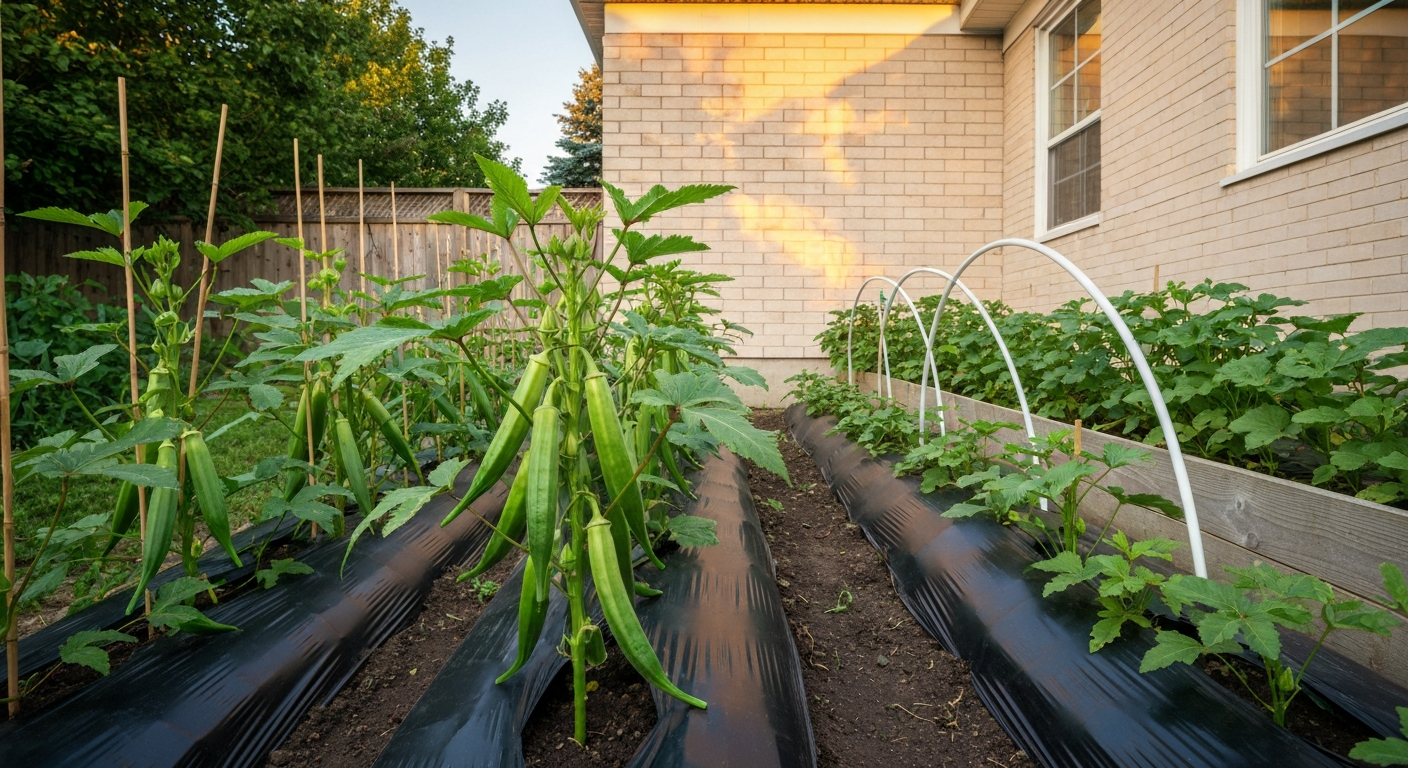
Laying black plastic mulch over the prepared bed two to three weeks before transplanting is one of the most effective things you can do for okra in Canada. It warms the soil 3 to 5°C deeper than an uncovered bed, suppresses weeds, and retains moisture. Cut X-shaped slits in the plastic to transplant through. Straw or wood chip mulch goes on after transplanting to retain moisture and moderate soil temperature, but it should not be applied before transplanting because it insulates the soil and prevents warming.
Red plastic mulch is worth mentioning if you can find it. Some studies suggest it reflects specific light wavelengths back onto plants in a way that modestly boosts growth compared to black plastic. It is less commonly available but Canadian specialty suppliers sometimes carry it.
Season-extension tools that make a real difference
Season extension is not a nice extra for Canadian okra growers, in many regions it is what separates a successful crop from a failure. These are the methods most worth the effort.
- Row cover fleece (floating row cover): A lightweight spunbonded fabric draped directly over plants or supported on wire hoops adds 2 to 4°C of frost protection and retains daytime heat. Use it from transplanting until nighttime lows are consistently above 15°C, then remove it to allow pollinator access. Keep it on hand for unexpected cold snaps in May and June.
- Low tunnel or hoop house: Wire or PVC hoops covered with clear plastic or row cover fabric create a mini greenhouse effect over a bed. Soil under a hoop house can reach transplant-ready temperatures two to three weeks earlier than uncovered ground. Ventilate on warm days to prevent overheating.
- Black plastic mulch: Already described under soil prep, but worth repeating — it is arguably the single most effective season-extension tool for a heat-loving crop in Canada.
- Cold frames: Useful for hardening off transplants and protecting young plants early in the season. Less practical for full-grown okra plants which get tall, but excellent for the seedling stage.
- Greenhouse or high tunnel: The most reliable option for growers north of the reliable outdoor okra zone (northern Ontario, most of the Prairies, Atlantic Canada). A greenhouse lets you grow okra almost anywhere in Canada with enough sun. Even an unheated high tunnel extends the season by four to six weeks in many regions.
- Containers against south-facing walls: Growing okra in large containers (minimum 30 to 40 litres per plant) placed against a heat-reflective south wall combines container mobility with passive heat gain. You can move containers indoors if a late frost threatens or to a warmer spot if a cold spell moves in.
Watering, feeding, and spacing through the season
Okra is more drought-tolerant than many vegetables once established, but in Canada's variable summer weather consistent moisture is important for pod production. Water deeply once or twice a week rather than lightly every day, this encourages deep rooting and more drought resilience. Aim for about 2.5 cm (1 inch) of water per week including rainfall. Inconsistent watering during pod development leads to tough, deformed pods.
For in-season feeding, a side-dressing of compost tea or a balanced liquid fertilizer every three to four weeks keeps the plants productive. Once flowering begins, shift to a lower-nitrogen, higher-potassium and phosphorus formula to support pod set. Over-fertilizing with nitrogen at this stage is a very common mistake, you get beautiful, tall, leafy plants with almost no pods.
For spacing, plant at 45 to 60 cm between plants within rows and 75 to 90 cm between rows for full-size varieties. Compact varieties like Dwarf Lee or Annie Oakley II can be spaced a bit closer, around 40 to 50 cm between plants. Good airflow reduces fungal disease pressure, which matters more in humid Ontario summers than it does in the drier American South where most okra production advice originates.
Common pests and diseases: what to watch for in Canada
Okra in Canada tends to face fewer pest and disease issues than it does in long-season, high-humidity regions of the American South, mainly because the season is shorter and the summers are cooler. That said, there are several problems you should expect and prepare for.
- Aphids: The most common okra pest in Canadian gardens. They cluster on new growth and undersides of leaves. Control with a strong water spray, insecticidal soap, or by encouraging aphid predators (ladybugs, lacewings). Check plants at least weekly once flowering starts.
- Flea beetles: Small, jumping beetles that chew tiny holes in leaves. Most damaging on seedlings and young transplants. Row cover protects young plants; diatomaceous earth around the base of plants provides some deterrence.
- Corn earworm / caterpillars: Occasionally feed on pods and leaves. Hand-pick if numbers are low; Bt (Bacillus thuringiensis) spray is effective and organically approved.
- Powdery mildew: A common late-season issue, especially in Ontario's August humidity. Improve air circulation through correct spacing, avoid overhead watering, and remove affected leaves promptly. Resistant varieties help.
- Root rot / damping off: Occurs in cold, wet, poorly drained soils. The best prevention is starting with warm, well-drained soil and not transplanting too early. If transplants collapse at the base, this is likely the cause.
- Verticillium or Fusarium wilt: Soil-borne fungal diseases that cause wilting and plant death. Crop rotation (do not plant okra or related crops in the same spot each year), good drainage, and resistant varieties are the main defences.
One practical note specific to Canada: okra grown under row cover to extend the season does not get pollinator access until the cover is removed. Okra is largely self-pollinating and wind-assisted, so lack of pollinators is usually not a problem, but if you are keeping the cover on long into the flowering period, pop it off on warm, calm days periodically.
Harvesting and storing your crop
Harvesting okra at the right size is one of the most important things you can do for yield. Pods grow very quickly in warm weather, they can go from perfect to fibrous and tough in two to three days. The ideal harvest window is when pods are 5 to 10 cm (about 2 to 4 inches) long and still tender when you snap the tip. If a pod resists snapping and bends rather than breaking cleanly, it is past its prime for eating fresh, though it can still be used dried or for seed saving.
Check your plants every two to three days once production starts. In the warm weeks of southern Ontario's July and August, you may need to harvest daily. Wear gloves and long sleeves, okra leaves and pods have fine spine-like hairs that irritate skin, especially on full-size varieties. Compact varieties like Dwarf Lee tend to be less spiny.
For storage, fresh okra holds for three to five days in the refrigerator in a loosely closed bag. Do not store it in a sealed airtight bag, moisture buildup causes quick decay. For longer storage, blanch for 3 minutes, pat dry, and freeze in a single layer before transferring to freezer bags. Frozen okra works well in cooked dishes. Dehydrating is another option if you have a high yield.
Realistic expectations: yield and what can go wrong in Canadian conditions
Set honest expectations before you plant. In southern Ontario, a healthy okra plant at peak production in a warm July can produce 3 to 5 pods every two to three days. Over a six to eight week harvest window, a single plant might yield 30 to 60 pods total under good conditions. That is a decent but modest return compared to what growers in Georgia or Mississippi see from the same plant over a four-month season.
A cool, wet summer, which Ontario certainly delivers in some years, will cut that significantly. Cold nights below 15°C slow pod development and can cause pods to yellow or drop before reaching harvest size. A cold snap after transplanting sets plants back by two to three weeks of growth. Late blight or a heavy aphid infestation can defoliate plants mid-season. All of these risks are manageable with the right tools, but they are real, and Canadian okra growing rewards preparation over optimism.
If you want to experiment with other heat-loving crops alongside your okra, it is worth knowing that similar calculus applies to plants like cassava (which is even more tropical and even less suited to most of Canada) and agave. Even asparagus, which is far more cold-hardy, benefits from the same attention to soil drainage and site selection that okra demands. For related guidance on cold-hardy perennials and site selection, see can you grow asparagus in Canada. If you’re curious about other warm-season succulents, see our guide on growing aloe vera in Canada for tips on indoor overwintering and microclimate needs. The common thread for warm-season and heat-loving crops in Canada is that microclimate and soil temperature management matter as much as regional climate. If you're curious about other tropical crops, see our guide on whether you can grow cassava in Canada for similar season-extension and microclimate advice can you grow cassava in Canada.
Bottom line: okra is genuinely achievable in southern Ontario and a few other warm pockets of Canada, but it is not a plant you can treat casually in this climate. Use transplants, warm your soil before planting, pick a short-season variety, and deploy at least one or two season-extension tools. Do that, and you will get a real harvest most years.
FAQ
Can you grow okra in Canada?
Yes — but only reliably in the warmest parts of the country without season extension. Southern Ontario (GTA, Niagara, Windsor–Essex, Lake Ontario shore microclimates) and some sheltered inland pockets can reach soil and air temperatures that let okra germinate, grow and fruit. In cooler regions you can still grow okra using containers, greenhouses or season‑extension (row covers, black plastic, hoop houses), or treat it as a short‑season crop for limited harvests.
How do I decide if okra will mature where I live?
Compare variety days‑to‑first‑harvest (catalog values, often 50–65 days for many types) and expected productive window (conservatively 90–120 days to get repeated harvests) to your local frost‑free period from Environment and Climate Change Canada. Also check soil‑temperature normals: okra needs warm soil to germinate (see next Q). Use NRCan plant hardiness and ECCC climate normals for local data.
What soil temperature do okra seeds need and when should I plant/transplant?
Wait until soil at seed depth is consistently around 70°F (≈21°C) or warmer for reliable germination. Many sources list a minimum near 65°F (18°C) and an optimum 70–95°F (21–35°C). Start seeds indoors 4–6 weeks before your planned transplant when you expect those soil temps; transplant only after nighttime air temps are reliably mild and soil ≥21°C, or transplant earlier if using season extension/heated beds.
Which okra varieties work best in Canada or short seasons (Ontario focus)?
Choose early, heat‑tolerant and compact types: Clemson Spineless (widely available), Dwarf Lee and ‘Annie Oakley II’ (compact/early), Jambalaya/Jade (earlier hybrids), and dwarf/container cultivars. Look for listed days‑to‑maturity and pick the shortest/more compact types for cooler Ontario sites. Canadian seed suppliers and major catalogs commonly carry these varieties.
What planting schedule should Ontario home gardeners follow?
Southern Ontario (example): check last‑frost date for your station. Start seeds indoors 4–6 weeks before your target transplant date. Target outdoor transplant when soil ≥21°C and at/after last frost—often late May to mid/late June in cooler parts, earlier in Windsor–Essex and Niagara. For containers/hoop houses you can transplant earlier if you can keep soil warm (black pots, heat mats, covered beds). Always use local ECCC normals to refine dates.
What site, soil and fertility requirements does okra need?
Full sun (6–8+ hours), well‑drained loamy soil with good organic matter. pH 6.5–7.5 preferred. Work in compost or balanced fertilizer before planting; sidedress with nitrogen once plants are established if growth is slow. Mulch to conserve moisture and warm soils (black plastic mulch can speed soil warming).
Next Articles
Can You Grow Asparagus in Canada? Planting Guide by Zone
Grow asparagus in Canada by zone: site, hardiness, crowns or seed, planting depth, care, and harvest plus fixes
Can You Grow Cassava in Canada? Feasibility and Steps
Learn if you can grow cassava in Canada, where it works, and step-by-step greenhouse or container growing for harvest.
Can You Grow Kumquats in Canada? Regions, Methods & Tips
Can you grow kumquats in Canada? Region-by-region guide, practical steps, cultivars, and winter protection.