
Yes, you can grow agave in Canada, but only the right species, in the right spot, with drainage that borders on obsessive. Most of Canada sits in USDA zones 3 to 6 (Canadian PHZ equivalents range similarly cold), which rules out tender species like Agave americana outdoors almost everywhere. However, genuinely cold-hardy agaves such as Agave parryi, Agave utahensis, and Agave neomexicana survive down to roughly −18 to −25 °C in dry conditions, which puts outdoor cultivation within reach for gardeners in southern British Columbia, the Okanagan, parts of Ontario's Golden Horseshoe, and select microclimates along Canada's southern fringe. Everywhere else, container growing with a sheltered overwintering spot is the practical path.
Can You Grow Agave in Canada? Zone Guide & Growing Tips
Marcus Holloway
7 Aug 2026
Who this guide is for
This guide is written for home gardeners curious about growing something a little unexpected, small-scale growers experimenting with drought-tolerant landscaping, and hobbyists who already grow succulents indoors and want to push the limits outdoors. If you've ever looked at a spiky agave rosette at a nursery and wondered whether it could survive a Canadian winter, this article gives you a direct, zone-by-zone answer instead of a vague 'it depends.' It's also relevant if you're already growing other borderline plants like aloe vera in Canadian conditions and want to understand where agave fits on the cold-hardiness spectrum.
Canadian hardiness zones and what they mean for agave
Canada uses its own Plant Hardiness Zone (PHZ) system, published by Natural Resources Canada and based on 1991–2020 climate normals including average extreme minimum winter temperatures. The Canadian zones don't map one-to-one with USDA zones, but for practical agave growing the key number is the recorded extreme minimum in degrees Celsius at your location. If your coldest winters routinely drop below −25 °C, even the hardiest agaves are a stretch outdoors without significant protection. If your extreme minimum stays above about −18 °C and your winters are relatively dry, several species become genuinely viable.
Province-by-province feasibility at a glance
| Province / Region | Approx. USDA Zone Equivalent | Extreme Min (°C, typical) | Outdoor Feasibility | Best Approach |
|---|---|---|---|---|
| Southern BC (Lower Mainland, Vancouver Island coast) | 7–8 | −12 to −7 | Good for hardy species | Outdoor with drainage prep |
| BC Okanagan / Interior | 5b–6b | −26 to −18 | Marginal; dry winters help | Hardy species + microclimate |
| Alberta (Calgary south) | 4a–5a | −34 to −28 | Very difficult outdoors | Container + overwintering indoors |
| Alberta (Lethbridge area) | 5a–5b | −29 to −23 | Marginal in sheltered spots | Hardy species + raised bed + cover |
| Saskatchewan / Manitoba | 2b–4b | −45 to −29 | Not feasible outdoors | Container growing only |
| Southern Ontario (Windsor–Hamilton–Toronto) | 6a–7a | −23 to −15 | Possible for hardiest species | Agave parryi + dry microclimate |
| Eastern Ontario / Ottawa | 5a–5b | −29 to −26 | Very marginal | Container or overwintered indoors |
| Quebec (Montreal area) | 5a–5b | −29 to −26 | Very marginal | Container or overwintered indoors |
| Quebec (Quebec City and north) | 3–4b | −40 to −29 | Not feasible outdoors | Container growing only |
| Atlantic provinces (Halifax) | 6a | −23 to −20 | Marginal; wet winters problematic | Hardy species + very sharp drainage |
| Atlantic provinces (interior NB, PEI, NFLD) | 3b–5a | −40 to −29 | Not feasible outdoors | Container growing only |
| BC North / Territories | 1–3 | Below −40 | Not feasible outdoors | Container growing only |
The Atlantic provinces present a particular challenge that isn't obvious from zone numbers alone. Halifax sits near USDA zone 6a on paper, which suggests hardy agaves might survive, but Atlantic winters combine cold with significant moisture and poor drying conditions. Wet cold kills agaves faster than dry cold at the same temperature, so Atlantic growers need truly exceptional drainage and ideally some overhead shelter from winter precipitation.
Outdoor survivors vs container-only species
Not all agaves are created equal when it comes to cold. The species commonly sold at garden centres, Agave americana (the classic blue-grey one with the enormous flower spike), is really only cold-hardy to about −9 to −10 °C before tissue damage sets in. That rules it out for outdoor planting almost everywhere in Canada except the mildest coastal BC spots. The cold-hardy species worth knowing are from high-elevation areas of Arizona, Utah, New Mexico, and northern Mexico, and they've evolved to handle genuine winter cold as long as the soil is dry.
| Species | Cold Hardiness (°C) | Suitable for Outdoor Canada? | Notes |
|---|---|---|---|
| Agave parryi | −18 to −25 (dry) | Yes, southern ON, BC coast, Okanagan microclimates | Most reliable hardy agave; compact rosette to ~60 cm |
| Agave utahensis | −15 to −23 (dry) | Yes, BC coast, southern ON with protection | Smaller, slow-growing; very sharp drainage essential |
| Agave neomexicana | −15 to −23 | Marginal in warmest Canadian zones | Similar to parryi; good provenance matters |
| Agave montana | −15 to −20 | Marginal in BC and southern ON | Larger rosette; from high-elevation Mexico |
| Agave ovatifolia | −10 to −12 | Only mildest BC spots | Attractive but not reliably cold-hardy in Canada |
| Agave americana | −9 to −10 | Container only across most of Canada | Very tender; classic ornamental, not an outdoor plant here |
| Agave attenuata | −2 to −4 | Container only | Soft-leaved; strictly indoor/greenhouse in Canada |
The Missouri Botanical Garden notes that Agave parryi has survived recorded temperatures as low as −29 °C when the cold is dry rather than wet. That's a remarkable figure, and while I wouldn't bank your whole planting on it, it illustrates why provenance and drainage matter as much as the zone number itself. A parryi from a high-elevation, cold-adapted seed source in a perfectly drained raised bed in Lethbridge has a realistic shot. The same species in a clay-heavy border in Fredericton probably won't make it.
Best agave species by Canadian region
Southern BC and Vancouver Island coast
This is Canada's best outdoor agave territory. Agave parryi, A. utahensis, and A. ovatifolia are all worth trying here. The Lower Mainland rarely drops below −10 °C, so even less-hardy species like A. ovatifolia are realistic. Choose a south-facing wall planting, keep drainage sharp, and most hardy species will sail through winter. Agave americana is even possible in the mildest Victoria microclimates, though a wet winter can still do damage.
BC Okanagan and Interior
The Okanagan is a fascinating case. It can get legitimately cold (−25 °C or lower in bad winters), but the winters are substantially drier than coastal BC, which is exactly what hardy agaves need. Stick with Agave parryi and A. neomexicana from cold-adapted provenances. Site them against a south-facing stone wall or on a well-drained slope, and they have a genuine chance. Don't push it with A. americana or A. ovatifolia here.
Southern Ontario (Windsor, Hamilton, Niagara)
The southern Ontario lakeshore zone runs USDA 6a to 7a, which is marginal but workable for Agave parryi. Windsor and the Niagara Peninsula are the warmest pockets. Use a raised bed with extremely gritty soil against a south-facing wall, and consider a temporary shelter or cold frame during deep cold snaps. Agave utahensis is also worth trialing here. Toronto is a tougher ask but not impossible in a sheltered microclimate.
Everywhere else
For Alberta, Saskatchewan, Manitoba, Quebec, eastern Ontario, and the Atlantic interior, container growing is the honest recommendation. You can still grow beautiful, large agaves in pots and bring them outdoors for the warm months (May through September). They'll look spectacular on a patio or deck. The work is in overwintering them somewhere frost-free or frost-limited, which I'll cover in detail below.
Outdoor planting vs container culture: how to decide
Before you commit to either approach, run through this checklist honestly. It'll save you from a frustrating loss or from unnecessarily limiting yourself to a pot when outdoor planting is perfectly viable.
- Look up your location's recorded extreme minimum temperature using ECCC's Canadian Climate Normals (1991–2020) for your nearest weather station. This is the actual coldest temperature your site is likely to see over decades.
- Compare that number to the cold-hardiness rating of the species you want: A. parryi handles roughly −18 to −25 °C dry; A. utahensis to about −15 to −23 °C; A. americana only to about −9 °C.
- Assess your winter moisture. Wet winters (Atlantic Canada, coastal BC interior areas with rain-on-frost events) add significant risk even when temperatures are technically within range.
- Check whether you have a genuinely south-facing, sheltered microclimate: against a masonry wall, on a slight slope with good air drainage, or in a spot that gets significantly more heat and sun than your open garden.
- If your extreme minimum is more than 3 to 5 °C colder than the species' rated limit, go container. The buffer is too thin for outdoor reliability.
- If you can achieve extremely sharp drainage (raised bed, gritty soil, no clay), add 2 to 3 °C of effective cold tolerance to your feasibility estimate.
- If outdoor conditions are marginal but you can rig up a simple temporary cold frame or remove a pot-grown specimen before hard frosts, container culture is easier and more flexible.
- If outdoor conditions are genuinely suitable (southern BC, Okanagan with dry winters, warmest southern Ontario pockets), go ahead with outdoor planting using the soil and site guidance below.
Picking the right spot outdoors
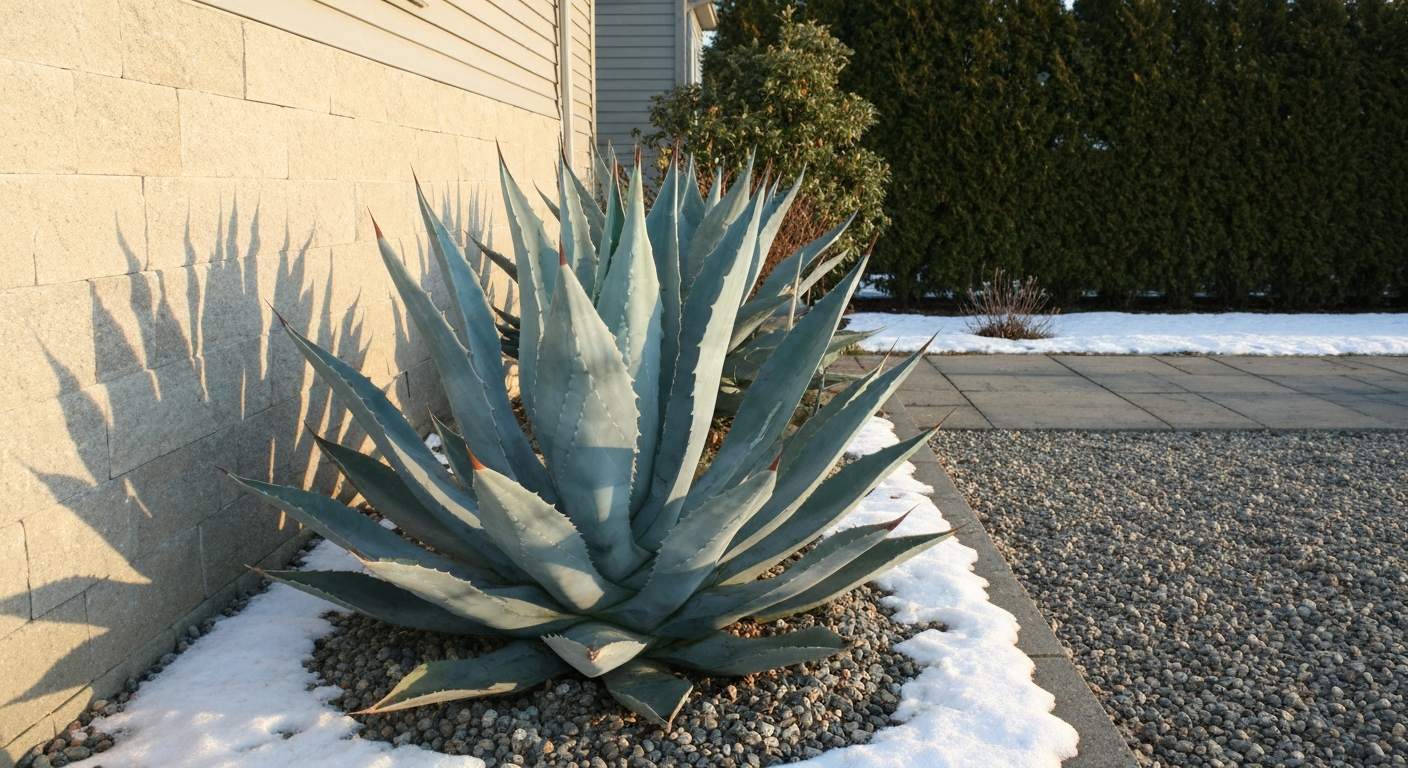
Site selection is where most Canadian agave growers either win or lose. Agave needs full sun, at least 6 to 8 hours of direct sunlight daily, and the hotter the better. In Canada, this means south or southwest exposure. A south-facing wall is worth roughly 2 to 4 °C of additional warmth compared to an open garden bed because masonry absorbs solar heat during the day and re-radiates it at night. That thermal mass can be the difference between survival and loss in a borderline zone.
Wind protection matters almost as much as temperature. Cold winter winds accelerate desiccation and drive temperatures below what a sheltered spot experiences. Plant on the lee side of a wall, fence, or evergreen hedge. Avoid frost pockets, which are low-lying areas where cold air pools on still nights. A slight elevation, even just a raised bed or gentle slope, improves air drainage significantly.
- South or southwest facing exposure is essential: north or east exposures are not suitable for outdoor agave in Canada
- Masonry walls (brick, stone, concrete block) as a backdrop provide heat storage and radiant warmth overnight
- Paved or gravel surfaces nearby increase ambient heat and reduce soil moisture
- Avoid areas where snow piles or pools in spring: prolonged wet conditions during freeze-thaw cycles are destructive
- Slightly elevated or sloped sites drain cold air away and prevent frost pockets
- Overhang from an eave or porch roof can reduce winter precipitation landing directly on the plant, which helps enormously
Soil and drainage: this is non-negotiable
If there is one single factor that determines whether an outdoor agave survives a Canadian winter, it is drainage. Root rot caused by saturated, cold soil kills far more agaves than low temperatures alone. Every extension resource and horticultural authority on succulent culture says the same thing: gritty, mineral, fast-draining soil is not optional. It is the baseline. Succulents, University of California Agriculture & Natural Resources (UC ANR) recommends very well-drained, gritty/mineral soils and a dry winter rest for agaves and other succulents to prevent root rot and freeze-related tissue-rot blank" rel="noopener noreferrer">Succulents — University of California Agriculture & Natural Resources (UC ANR). See Succulents, UF/IFAS Extension publications (succulent/agave guidance) for recommendations to use cactus/succulent mixes, limit winter irrigation, and apply cultural practices to avoid saturated soils blank" rel="noopener noreferrer">Succulents — UF/IFAS Extension publications (succulent/agave guidance).
Ideal soil mix for outdoor planting
Aim for a mix where roughly 50 to 60 percent of the volume is inorganic material. A practical outdoor blend: one part native soil (if it's sandy or loamy; skip it entirely if it's clay), one part coarse horticultural grit or pea gravel (3 to 6 mm particle size), and one part perlite or pumice. Avoid fine sand, which can compact and reduce drainage over time. Pumice is ideal if you can source it because it improves drainage without adding weight.
Raised beds and mounding
In any Canadian climate with significant winter moisture, a raised bed is strongly recommended over a flat in-ground planting. Raise the planting area 20 to 30 cm above the surrounding grade using a frame of treated timber, stone, or concrete blocks. Fill with your gritty mix. Even a modest raised planting ensures water moves away from the root zone during wet periods. You can also create a raised mound in an open border: pile your amended mix into a slight dome and plant on the crown so water sheds away naturally.
Amendments and what to avoid
- Do add: coarse perlite, pumice, horticultural grit, decomposed granite, or crushed granite chips
- Do add: a small amount of finished compost (no more than 10 to 15% of mix volume) for trace nutrients
- Avoid: peat moss or coir (retains too much moisture)
- Avoid: heavy clay soil or any unammended garden soil without testing drainage first
- Avoid: water-retentive polymer crystals or moisture-retention additives
- Top-dress with 3 to 5 cm of coarse gravel around the base to keep the crown dry and prevent crown rot
Container growing and overwintering strategies
For most Canadian gardeners outside southern BC and the warmest southern Ontario spots, containers are the practical reality for agave, and there's nothing wrong with that. A large agave in a handsome terracotta or concrete pot makes a genuine statement on a summer patio. The key is choosing the right container setup and having a clear overwintering plan before you buy the plant.
Container setup
- Choose a heavy, frost-rated container with multiple drainage holes: terracotta, concrete, or thick-walled fiberglass all work; avoid glazed ceramic in climates with freeze-thaw cycles as it can crack
- Use a cactus and succulent potting mix, or make your own: 50% bagged cactus mix plus 50% perlite or pumice
- Pot size should be only slightly larger than the root ball: agaves don't like a lot of excess moist soil around the roots
- Elevate pots on feet or stands to ensure free drainage from the bottom holes
- In summer, place in the hottest, sunniest spot you have, preferably against a south-facing wall
Overwintering in containers
Bring container agaves indoors before the first hard frost, typically when overnight temperatures consistently approach 0 °C. They don't need warmth over winter, just frost protection. A cool, bright garage, unheated sunroom, or basement with a south-facing window works well. The target temperature range is roughly 4 to 10 °C. At these temperatures the plant goes into a near-dormant state, which is exactly what you want.
During winter storage, water is the enemy. University of Minnesota Extension guidance for succulents in cool winter storage is clear: water only enough to prevent the leaves from shrivelling and desiccating. In practice, for most medium-sized agaves in cool storage, this means watering once every 4 to 6 weeks with a small amount of water, maybe 200 to 400 ml for a pot in the 30 to 40 cm diameter range. Do not water on a regular schedule; check the soil and the plant's appearance instead. Resume normal watering gradually in March and April as you transition the plant back outdoors.
Watering and seasonal care
During the growing season (May through September in most of Canada), agaves need much less water than most garden plants but are not completely drought-immune in containers. Water deeply but infrequently: let the soil dry out completely between waterings. For outdoor in-ground plantings, established agaves often need no supplemental irrigation at all once rooted in, except during extended drought. For containers, water every 1 to 2 weeks in summer depending on heat and pot size, and always check that water drains freely from the bottom.
Fertiliser needs are minimal. A single application of a low-nitrogen, cactus-specific fertiliser in late spring is sufficient for container plants. Outdoor in-ground agaves generally don't need fertilising at all once established in reasonable soil.
Planting and propagation
Plant outdoor agaves in late spring once soil has warmed and frost risk has passed, typically late May or early June across most of Canada. Avoid fall planting: agaves need a full growing season to establish roots before their first Canadian winter, and a fall-planted specimen simply won't have the root system to resist freeze-thaw soil movement.
Agaves propagate readily from offsets (called pups) that emerge at the base of the mother plant. These are the easiest way to get new plants: separate them when they're about one-quarter the size of the mother, let the cut end callous for a day or two, then pot into dry mix. Wait two weeks before watering. Agaves also produce bulbils on their flower spikes after blooming, but since agave plants die after flowering (they're monocarpic), collecting pups before the plant blooms is the standard propagation method.
Winter protection for borderline outdoor plantings
For outdoor plantings in marginal zones (Okanagan, southern Ontario, warmest Atlantic spots), some winter protection makes the difference between losing a plant and keeping it. The key principles are: protect from moisture more than from cold, and don't insulate too early or too thickly or you'll trap humidity around the crown.
- After the ground freezes in late November or December, apply a 10 to 15 cm layer of coarse gravel or dry bark mulch around (not over) the base of the plant to prevent freeze-thaw heaving
- Build a simple teepee of burlap or frost cloth over the plant to break winter wind and reduce precipitation landing directly on the crown; don't seal it airtight
- If you have an overhang or eave nearby, redirect the planting to benefit from it in future years
- Tie the leaves loosely upward with soft twine to reduce wind damage and make covering easier
- Remove covers in early March on mild, sunny days to allow air circulation; replace at night if late frosts are forecast
- Do not mulch with organic material that holds moisture against the crown; coarse, fast-draining materials only
Common pests, diseases, and problems
Agaves are genuinely tough plants with few serious pest issues when grown in appropriate conditions. The problems that do appear in Canadian growing situations are almost always related to moisture rather than insects.
- Crown rot: the most common cause of loss; caused by water pooling in the centre of the rosette or by saturated winter soil; prevent by improving drainage and keeping the crown dry, especially in winter
- Root rot: closely related to crown rot; caused by overwatering or poorly drained soil; plants show yellowing, softening at the base, and eventual collapse; affected plants usually can't be saved but pups from the base often survive
- Agave snout weevil (Scyphophorus acupunctatus): the most serious insect pest; the adult beetle bores into the base and lays eggs; larvae destroy the core of the plant; look for wilting leaves and inspect the base; there is no easy cure once infestation is advanced, but systemic insecticides applied preventively in spring can help in areas where the weevil is known
- Mealybugs: appear as white cottony masses, especially in the leaf axils; treat with isopropyl alcohol applied with a cotton swab or a diluted neem oil spray
- Scale insects: occasional on container plants; treat similarly to mealybugs
- Freeze damage: leaf tips and margins turn translucent, then brown and mushy after a hard frost; if the crown centre is firm, the plant often recovers; if the crown is mushy, the plant is lost
Where to source agave plants and seeds in Canada
Sourcing the right species is genuinely important. Most mainstream Canadian garden centres carry Agave americana and A. attenuata because they look impressive and sell well, but neither is suitable for outdoor planting in most of Canada. For the cold-hardy species that actually matter here (A. parryi, A. utahensis, A. neomexicana), you'll need to look further.
- Specialty succulent and cactus nurseries in BC (particularly in the Lower Mainland and Okanagan) are the most reliable Canadian source for cold-hardy agave species
- Online specialty nurseries in the US that ship to Canada can provide cold-hardy species and named varieties, though import regulations and phytosanitary requirements apply; check CFIA requirements before ordering
- Canadian Cactus and Succulent Society (CCSS) and regional cactus clubs often run seed and plant sales where cold-hardy species from proven Canadian-grown parent plants are available; these are particularly valuable because the plants have already adapted to Canadian conditions
- Seed-grown plants are cheaper and sometimes available from specialist seed sellers, but agaves grow slowly from seed and you'll wait several years for a display-worthy plant
- Ask any vendor specifically about cold-hardiness ratings and provenance, especially for A. parryi: there's meaningful variation between cultivars, and some are more cold-adapted than others
The bottom line
Growing agave in Canada is entirely doable, but it requires honest zone assessment, the right species selection, and a genuine commitment to drainage. In southern BC and the warmest corners of southern Ontario, cold-hardy agaves like Agave parryi and A. utahensis are legitimate outdoor plants that will thrive with minimal care once established in a well-drained, south-facing site. For the vast majority of Canadian gardeners in colder or wetter regions, containers with a planned overwintering routine are the reliable route. The payoff in both cases is a striking, extremely low-maintenance plant that looks unlike anything else in a Canadian garden. If you're already experimenting with other borderline plants, agave fits naturally into that same mindset of pushing climate limits with the right tools and realistic expectations. If you're curious about warm-season crops, see our guide on can you grow okra in Canada for region-specific advice on climate and care. If you're curious about other marginal crops and how to assess them in Canadian conditions, see can you grow cassava in Canada for a similar discussion. For related advice on an edible perennial with similar zone considerations, see our guide on can you grow asparagus in Canada.
FAQ
SEO title and meta description for this article?
Title: Can You Grow Agave in Canada? Practical Zone-by-Zone Guidance Meta description: Can you grow agave in Canada? Zone-by-zone guidance, hardy species, container tips, and winter protection (≤160 chars).
Core answer — Can you grow agave in Canada?
Yes — but with qualifications. Cold-hardy agaves can be grown outdoors in the warmer/drier Canadian regions (southern BC, parts of southern Alberta, inland southern Ontario and Nova Scotia microclimates) or in well-drained sheltered sites. Many agave species are not reliably hardy in most of Canada and are best grown in containers/greenhouses and overwintered indoors or under protection.
How should I translate 'hardiness' into Canadian regions?
Use Canada’s Plant Hardiness Zones (PHZ) or Environment and Climate Change Canada station 'extreme minimum' data. Convert USDA-zone-equivalents to °C: Zone 5 ≈ −29 to −23 °C; Zone 6 ≈ −23 to −18 °C; Zone 7 ≈ −18 to −12 °C; Zone 8 ≈ −12 to −7 °C; Zone 9 ≈ −7 to −1 °C. Match an agave species’ minimum °C tolerance to local PHZ/Extreme Minimum values to assess feasibility.
Region-by-region feasibility summary (quick guide)?
Southern British Columbia (lower mainland, Vancouver Island): best chance for marginal/hardy agaves in sheltered, drained sites (many microclimates reach PHZ 8–9). Southern Alberta (Calgary/medicinal zone pockets): some cold-hardy inland species may survive in PHZ 4–6 microclimates but need very dry, sunny sites and excellent drainage. Southern Ontario (Niagara, southwestern Ontario): limited; sheltered, raised, very well-drained sites or containers recommended (PHZ 5–7 pockets). Maritime provinces (south coastal Nova Scotia/New Brunswick): coastal microclimates can work for borderline-hardy species with drainage and shelter; elsewhere container/greenhouse. Northern and central Canada: outdoor growth not recommended; container/greenhouse only.
Which agave species are realistic outdoors in parts of Canada?
Most realistic outdoors (cold-hardy): Agave parryi (and varieties) — tolerated down to about −18 to −25 °C in dry sites; Agave utahensis — hardy to roughly −15 to −23 °C; Agave neomexicana / A. montana — roughly −15 to −23 °C. Borderline/outdoor in mild microclimates: Agave americana and A. ovatifolia (≈ −9 to −12 °C) — only in warm sheltered coastal or urban heat-island sites with very good drainage and winter protection.
Which agave species should be container-grown or greenhouse-kept in Canada?
Tender species such as most cultivated Agave americana cultivars, A. sisalana, A. attenuata, many hybrids and variegated cultivars (and any species rated warmer than ≈ −10 °C) should be container-grown and overwintered indoors/greenhouse in most of Canada.
Next Articles
Can You Grow Okra in Canada? Ontario Guide & Short‑Season Tips
Can you grow okra in Canada? Regional verdict, Ontario-specific steps, varieties, season-extension & harvest tips.
Can You Grow Asparagus in Canada? Planting Guide by Zone
Grow asparagus in Canada by zone: site, hardiness, crowns or seed, planting depth, care, and harvest plus fixes
Can You Grow Cassava in Canada? Feasibility and Steps
Learn if you can grow cassava in Canada, where it works, and step-by-step greenhouse or container growing for harvest.