
You can grow a date palm in Canada, but fruiting outdoors is not realistically achievable in any Canadian province under normal conditions. True date palms (Phoenix dactylifera) need mean annual temperatures above roughly 16 °C, thousands of heat degree-days to ripen fruit, and a crown that can survive winter without freezing. Canada simply does not deliver those conditions anywhere outside of a greenhouse. That said, growing date palms as container specimens or greenhouse plants is absolutely doable, and a small number of highly sheltered coastal microclimates in British Columbia offer the mildest conditions in the country, enough for a tree to survive but still not enough to ripen commercial-quality fruit.
Can You Grow Dates in Canada? Feasibility, Methods & Tips
Marcus Holloway
4 Aug 2026
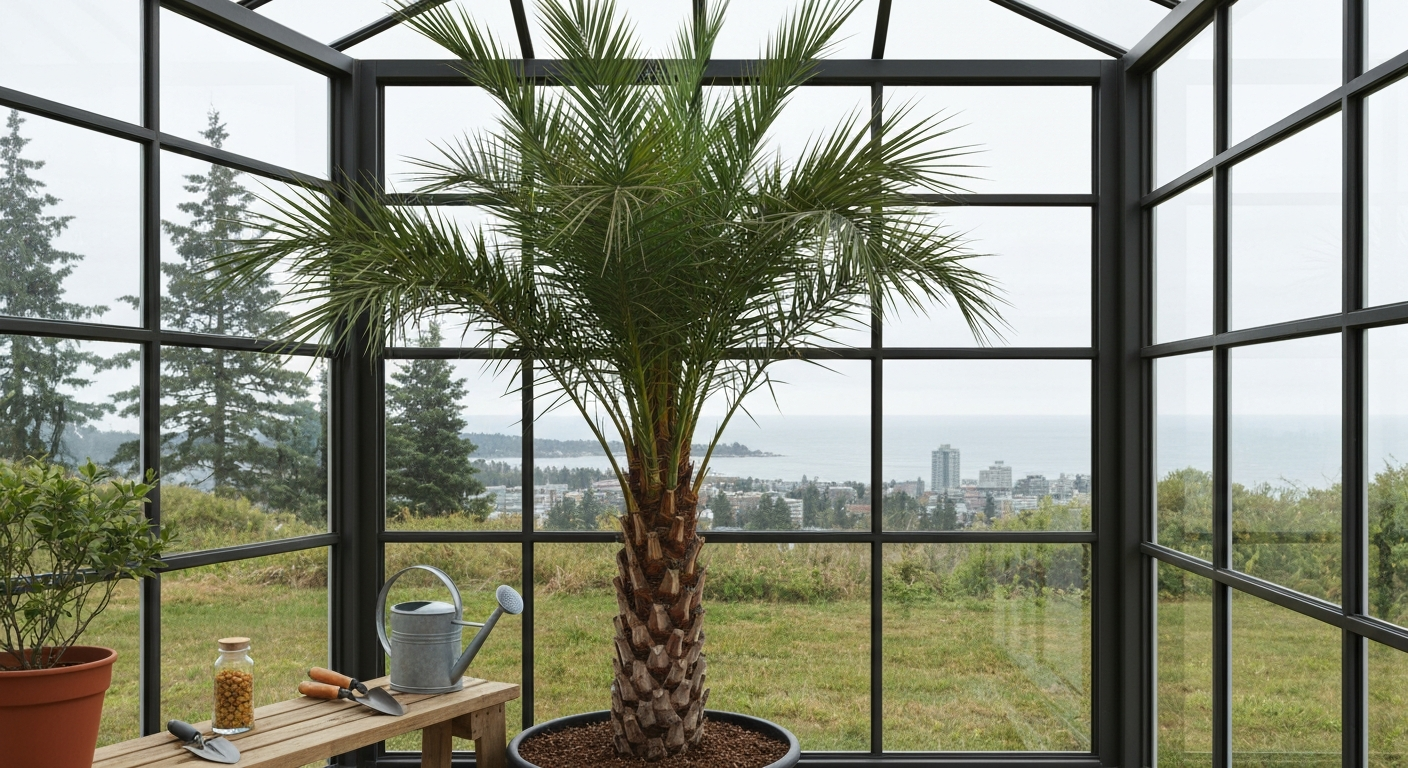
Zone and province feasibility at a glance
| Province / Region | Hardiness Zone Range | Outdoor Survival | Outdoor Fruiting | Best Practical Option |
|---|---|---|---|---|
| British Columbia (coastal SW) | 7b–8b | Possible in sheltered spots | Extremely unlikely | Container or greenhouse |
| British Columbia (interior/north) | 2a–6b | No | No | Greenhouse only |
| Ontario (southwestern) | 6a–7a | Marginal / high risk | No | Container or greenhouse |
| Ontario (rest) | 3b–5b | No | No | Greenhouse only |
| Quebec (Montreal area) | 5a–6a | No | No | Greenhouse only |
| Quebec (north/east) | 2a–4b | No | No | Greenhouse only |
| Alberta | 2a–4a | No | No | Greenhouse only |
| Saskatchewan | 1b–3b | No | No | Greenhouse only |
| Manitoba | 1b–3b | No | No | Greenhouse only |
| Atlantic provinces | 5a–7a (coastal NS) | No | No | Greenhouse only |
| Territories (YT, NWT, NU) | 0a–2a | Absolutely not | No | Greenhouse only (limited) |
Hardiness zones in this table follow Natural Resources Canada's Plant Hardiness Zone system. Even the warmest zones (7b–8b in the Fraser Valley and Greater Victoria) are only a starting point, the bigger barrier than winter low temperatures is summer heat accumulation, which is discussed in detail below.
Why true date palms struggle in Canada
The cold tolerance problem
Phoenix dactylifera is frost-sensitive in ways that catch people off guard. The fronds and outer tissues start showing freeze injury around -4 to -6 °C. The real killer is the apical meristem, the crown growing point. Once that freezes, the tree is gone. Research and field experience put the threshold for serious crown damage at around -7 to -10 °C, even for brief exposures. Most of Canada routinely sees temperatures well below those thresholds for extended periods every winter. Even Zone 7b areas in coastal BC can hit -10 °C in a hard winter. The tree is not built for a Canadian winter, plain and simple.
The heat accumulation problem
This is the constraint that even enthusiastic Canadian growers tend to underestimate. Date palms need massive growing degree-day (GDD) accumulations to bring fruit from flowering to ripe edibility. Published studies put the total cumulative heat requirement at roughly 2,100 to 4,700 degree-days above a base temperature of 12–18 °C, depending on cultivar group. Early-ripening cultivars sit at the lower end; late/soft types like Medjool are at the upper end. Canada's cool summers, even in its warmest spots, simply do not stack up enough heat. To put it in context: Phoenix, Arizona regularly accumulates well over 3,000 GDD above 18 °C in a growing season. Vancouver might accumulate 400–600 GDD above 18 °C in a good summer. The gap is enormous.
Pollination requirements
Date palms are dioecious, you need both male and female trees to get fruit. Commercial growers worldwide rely entirely on hand pollination because natural wind or insect transfer is too unreliable. The correct technique involves collecting pollen from a male tree at anthesis, drying it, and dusting it directly onto receptive female spikelets during a narrow 0–3 day window when stigmas are turgid and receptive, usually mid-morning. For a Canadian greenhouse or container grower attempting fruit, this is manageable but requires planning: you need at least one male plant or a supply of stored pollen (dried pollen holds viability well at 4 °C for months; cryopreserved pollen lasts years). One male can service roughly 8 to 50 female trees depending on pollen availability and application method.
How Canada compares to places where dates actually grow
It helps to look at where dates do fruit commercially and compare those conditions directly to Canada. For a comparison to climates where dates are grown outdoors, see guidance on can you grow dates in Australia. Arizona is the benchmark for North American date production, the Coachella Valley and Yuma areas are essentially ideal date climates. Oklahoma sits at the northern edge of plausible outdoor date cultivation in the US, making it an interesting comparison for understanding marginal conditions. Australia produces dates commercially in its arid interior. Ghana, in tropical West Africa, offers a humid equatorial baseline. For more on Ghana's growing conditions and whether dates can be cultivated there, see our guide on can dates grow in Ghana. None of these conditions resemble anything in Canada.
| Location | Mean Annual Temp (approx.) | Summer GDD above 18 °C (approx.) | Winter Low (typical) | Annual Rainfall / Irrigation Need | Outdoor Date Fruiting |
|---|---|---|---|---|---|
| Phoenix, Arizona (US) | ~24 °C | >3,500 GDD | Rarely below -5 °C | ~200 mm + heavy irrigation | Yes, commercially |
| Southern Oklahoma (US) | ~17–18 °C | ~1,800–2,200 GDD | -10 to -15 °C possible | ~800–1,000 mm | Marginal; rare fruiting |
| Alice Springs, Australia | ~21 °C | ~2,500–3,000 GDD | Rarely below -5 °C | ~250 mm + irrigation | Yes, commercially |
| Northern Ghana | ~28–30 °C | >4,000 GDD | Never freezes | ~900–1,100 mm | Yes (wild/subsistence) |
| Vancouver, BC (Canada) | ~11–12 °C | ~400–600 GDD | -5 to -10 °C in hard winters | ~1,150 mm | No |
| Toronto, ON (Canada) | ~9–10 °C | ~300–500 GDD | -15 to -25 °C | ~800 mm | No |
| Calgary, AB (Canada) | ~4–5 °C | <200 GDD | -30 to -40 °C | ~400 mm | No |
The GDD gap between even the mildest Canadian city and Arizona or Australia is stark. Oklahoma is the closest parallel to the absolute northern edge of viability in North America, and even there outdoor fruiting is marginal at best. Canada is several climate zones beyond Oklahoma's limitations. If you want to explore what growing dates looks like just across the border in a genuinely warm region, the Arizona situation is the most instructive comparison point for understanding how far Canada falls short.
Province-by-province feasibility for Phoenix dactylifera
British Columbia
BC is the only province where anyone should even consider an outdoor trial of Phoenix dactylifera, and that's limited to the mildest pockets of the Lower Mainland, Greater Victoria, and parts of the Saanich Peninsula (Zones 7b–8b). Winter temperatures here occasionally allow a well-protected tree to survive several years. But summer heat is insufficient to ripen fruit, Vancouver's average July high is around 22 °C, which barely moves the GDD needle. Interior BC (Zones 3–6) and northern BC are firmly out of contention.
Ontario
Southwestern Ontario (Windsor, Leamington area, Zone 6b–7a) has the warmest summers in eastern Canada, but winter lows routinely reach -15 to -20 °C, which is well beyond what the date palm crown can tolerate unprotected. Summer GDD accumulation is also well below the minimum required for fruiting. Greenhouse cultivation is the only sensible path for Ontario growers.
Quebec, Prairie Provinces, and Atlantic Canada
There is nothing encouraging to say for outdoor date palm survival in Quebec, Alberta, Saskatchewan, Manitoba, or the Atlantic provinces. Winter lows in these regions range from roughly -15 °C in the warmest Atlantic coastal areas to -40 °C and below on the Prairies. These temperatures are lethal to a date palm within hours. Greenhouse growing is the only workable approach, and the economics of heating a greenhouse through a Prairie winter need to be weighed honestly against the outcome.
Territories
Yukon, the Northwest Territories, and Nunavut fall entirely outside any meaningful feasibility discussion for Phoenix dactylifera outdoors. A heavily heated greenhouse could sustain a containerized plant as a curiosity, but the energy costs would be extraordinary.
Outdoor exceptions and protected microclimates
There are real microclimates in Canada, south-facing walls of masonry buildings in coastal BC, sheltered urban courtyards in Vancouver or Victoria, and thermal pockets near large water bodies, that can push local conditions a zone or even two warmer than the surrounding area. In these spots, a well-hardened date palm planted in a warm, sheltered position with excellent drainage has the best chance of surviving Canadian winters, sometimes for many years. Date palms are high seasonal water users under irrigation; published field studies report annual ETc values from ~1,700 mm yr−1 (well‑managed Israeli sites) to >2,700 mm yr−1 in some Saudi and Libyan studies, and volumetric per‑tree daily demand averages ~87–297 L/day in Saudi studies (cv‑dependent) blank" rel="noopener noreferrer">Published reviews report that date palms are high seasonal water users; measured ETc for mature Phoenix dactylifera ranges from roughly 1,700 to over 2,700 mm yr−1, with some Saudi studies showing per‑tree daily demands averaging about 87–297 L/day (USDA‑ARS date palm evapotranspiration and water relations (review/PDF)).. A few growers in the Vancouver area and on Vancouver Island have kept Phoenix dactylifera alive outdoors for extended periods this way.
The honest caveat: surviving is not fruiting. Even in a protected Zone 8a microclimate in Victoria, the summer GDD accumulation will not come close to what the palm needs to develop and ripen a fruit crop. If your goal is to produce edible dates, outdoor growing in Canada will not get you there. If your goal is to maintain an ornamental or novelty palm and enjoy the experience of growing the species, a well-chosen outdoor microclimate in coastal BC is a legitimate long-term project.
How to actually grow dates in Canada: practical methods
Greenhouse cultivation (best chance at fruiting)
- Choose a greenhouse with a minimum winter temperature of at least 5–10 °C at night and the capacity to reach 38–45 °C in summer when the sun loads. A passive solar or poly tunnel structure significantly underpowers the summer heat dates need — an actively managed glasshouse is better.
- Use a fast-draining substrate: a mix of roughly 50% coarse sand or perlite, 30% loam, and 20% compost works well. Dates hate waterlogged roots. Raise the bed or use a deep container with large drainage holes.
- Start with an offshoot-derived plant (not a seedling) from a reputable supplier to know the sex of your plant and reduce the time to potential bearing. Female cultivars like Medjool, Barhi, or Zahidi are most common in the North American trade.
- For any chance at fruit, you also need pollen. Either grow a male plant or purchase dried, refrigerated pollen from a date farm supplier (several Californian and Arizonian farms sell pollen). Store it at 4 °C in a sealed container.
- Manage summer temperatures aggressively. Ventilate, use shade cloth sparingly (dates want full sun), and consider supplemental heating to maintain daytime temperatures above 32–38 °C during summer — this is the single biggest limiting factor in a Canadian greenhouse and the hardest to overcome cheaply.
- Water heavily during the growing season. Date palms are high consumers: in hot arid growing regions, mature trees use 87–297 litres per day. In a cooler Canadian greenhouse they will use less, but do not let them drought-stress during summer. Reduce watering significantly in winter.
- Hand-pollinate at anthesis. Watch female flower spikes for receptivity (stigmas appear white, moist, and turgid), typically mid-morning. Dust or spray pollen suspension directly onto spikelets within the first 0–3 days of spike opening.
- Bag developing fruit clusters with breathable mesh or agricultural paper bags after pollination to protect from humidity-related rot, which is a real risk in Canadian greenhouse conditions where summer humidity is higher than in arid date-growing regions.
- Expect a long wait. From flowering to ripe fruit takes roughly one full growing season under good heat conditions — and in a suboptimal Canadian greenhouse environment, maturation may be incomplete or take longer.
Container growing (most flexible approach)
- Use large containers — at minimum a 100-litre pot for an established plant, scaling up to 200–300 litres for a multi-year specimen. Larger root volume buffers temperature swings and supports vigorous growth.
- Use the same fast-draining sandy loam mix described for the greenhouse approach. Dates tolerate moderate salinity (up to around 3–7 dS/m irrigation water), so typical municipal water is fine.
- Spend summer outdoors in the warmest spot available — south-facing walls, paved courtyards, or rooftop terraces in urban environments can push ambient temperatures significantly above surrounding air temperatures.
- Move inside before first frost. In most of Canada this means late September to early October. A minimally heated garage (above 2–5 °C) is sufficient for winter storage of a dormant or semi-dormant plant, though growth will essentially stop.
- Fertilise actively in spring and summer with a balanced palm fertiliser that includes micronutrients (particularly magnesium, manganese, and boron — deficiencies are common in containers).
- Fruit production from a container plant in Canada is possible in theory but very unlikely without greenhouse-level summer heat management.
Outdoor planting in a protected microclimate (coastal BC only)
- Select a south or southwest-facing site backed by a masonry wall or building. Avoid frost pockets and low-lying areas where cold air pools.
- Plant in spring after all frost risk has passed, giving the tree a full growing season to establish before its first winter.
- Amend the planting hole with sharp sand to improve drainage — poorly drained soil during wet BC winters accelerates root rot and cold injury.
- Mulch the root zone heavily (10–15 cm of bark mulch) in autumn but keep mulch away from the trunk base.
- Wrap the crown loosely with frost cloth or burlap when temperatures below -4 °C are forecast. Tie fronds together upright to protect the central growing point. Remove wrapping promptly once temperatures rise to prevent humidity buildup and fungal disease.
- Accept that this is an ornamental and survivalist project, not a fruiting enterprise, in any Canadian outdoor setting.
Propagation, varieties, and what to buy
Offshoot vs. seed: which to choose
For anyone serious about growing dates in Canada, always start with an offshoot-propagated (sucker) plant rather than a seed. Here is why: seed-grown date palms produce trees of unknown sex (you will not know if you have a male or female for years), and they take 6–15+ years to fruit, sometimes longer. Offshoot plants are clonal copies of the mother tree, so sex and cultivar are known, and they typically reach bearing age in 3–7 years after transplanting. Offshoots are safely separated from the mother tree after 3–5 years of attached growth, when they have developed their own root system. Tissue-culture (TC) plantlets from a lab are another option, they are virus-free, sex-identified (from reputable labs), and available at small sizes, though they still need the same multi-year establishment period once planted.
Cultivar options for Canadian conditions
There are no Phoenix dactylifera cultivars that are genuinely cold-hardy enough for safe open-field Canadian winters. That point is important: no peer-reviewed literature documents a date palm cultivar suited to repeated Canadian winter lows. However, some cultivars are worth considering for greenhouse and container use based on heat requirements and fruit quality. Barhi is an early-ripening cultivar with one of the lower GDD requirements and produces fruit that can be eaten at the khalal (crunchy/yellow) stage rather than waiting for full tamar ripeness, this is a practical advantage in a heat-limited Canadian greenhouse. Deglet Nour and Zahidi are semi-dry types that are more forgiving in lower-humidity environments than Medjool (Medjool's large soft fruit is susceptible to fungal issues in Canada's wetter climate, even in greenhouses). Khadrawy is another soft, early-to-mid-season cultivar worth considering.
| Cultivar | Type | Ripening Speed | Approx. GDD Need | Notes for Canadian Growers |
|---|---|---|---|---|
| Barhi | Soft | Early | Lower end (~2,100–2,500) | Can eat at khalal stage; best bet for greenhouse fruiting |
| Khadrawy | Soft | Early–Mid | Moderate (~2,500–3,000) | Good flavour; manageable humidity sensitivity |
| Deglet Nour | Semi-dry | Mid | Moderate (~2,800–3,200) | Tolerates drier greenhouse conditions well |
| Zahidi | Semi-dry | Mid | Moderate (~2,800–3,200) | Hardy, adaptable; good container candidate |
| Medjool | Soft | Late | Higher (~3,500–4,700) | Prone to humidity/mould issues in Canada; needs very high heat |
Where to source plants in Canada
Sourcing is genuinely challenging from within Canada. Most date palm offshoots and TC plants are produced in the US (California, Arizona, Florida) or imported from the Middle East. Check Canadian Food Inspection Agency (CFIA) import requirements before purchasing from abroad, Rhynchophorus palm weevils and Bayoud disease (Fusarium oxysporum f. sp. albedinis) are both regulated quarantine concerns, and plant material must come with appropriate phytosanitary certification. US-based suppliers in California or Arizona are the most practical source for Canadians wanting established offshoots or TC plantlets, and some ship with the required paperwork.
Pests and diseases to watch for in Canadian settings
Greenhouse and container palms in Canada face a different pest profile than field-grown trees in hot climates. The most common issues are scale insects (particularly California red scale and soft scales), spider mites (which thrive in warm, dry greenhouse conditions), mealybugs, and thrips. Regular inspection of new fronds and the crown is essential. Neem-based sprays and insecticidal soap handle most infestations if caught early. Graphiola leaf spot (Graphiola phoenicis) is a fungal disease that causes small black pustules on fronds, it is largely cosmetic and manageable through removing affected fronds and improving air circulation.
Red Palm Weevil (Rhynchophorus ferrugineus) is the most serious global palm pest and is listed as a regulated organism in Canada under CFIA frameworks. It is not currently established in Canada, and you want to keep it that way, never accept plant material without proper phytosanitary documentation. Bayoud disease is similarly absent from Canada and should stay that way; it is devastating in North Africa and has no cure. These are reasons to buy only from certified clean sources.
Alternatives worth considering: the 'Chinese date' and other options
If your goal is actually growing a productive fruit tree rather than specifically Phoenix dactylifera, the jujube (Ziziphus jujuba), sometimes called the Chinese date, is dramatically better suited to most of Canada. It tolerates winters down to -25 °C or colder in some cultivars, handles a wide range of soils, and produces sweet, date-like fruits reliably in Canadian growing seasons. Cultivars like Li, Lang, and Honey Jar have proven themselves in Zones 4–6 across the country. Jujube is not the same experience as a true date palm, but if you want an edible, date-adjacent fruit from a tree you can actually grow outdoors in Canada, it is a far more honest choice than battling Phoenix dactylifera's climate requirements.
Should you attempt it? A practical checklist
Before committing to a date palm project in Canada, run through these questions honestly:
- Are you in coastal BC (Zone 7b or warmer)? If not, outdoor growing is a non-starter — greenhouse or container is your only route.
- Do you have, or can you build, a greenhouse that reaches sustained daytime temperatures above 35–40 °C in summer? Without this, fruiting is very unlikely.
- Can you source a sex-identified offshoot or tissue-culture plant from a CFIA-compliant supplier? If not, you may wait a decade to find out if you have a male or female.
- Do you have pollen or a male plant? Without it, no fruit regardless of other conditions.
- Are you prepared to hand-pollinate at the right moment (0–3 day window)? This requires attention and timing.
- Are you primarily interested in the ornamental experience of growing this species? If yes, even a container or sheltered outdoor plant in mild BC can be deeply satisfying.
- Is edible fruit production your main goal? If yes, consider whether jujube or other warm-season alternatives meet your actual need more practically.
Growing dates in Canada is a challenge worth taking on with clear eyes. The species is genuinely beautiful, interesting to cultivate, and a rewarding greenhouse project for patient growers. But the climate math is unforgiving: Canada is cold where dates need warmth, and cool where dates need heat. The growers who get the most out of this project in Canada are those who treat it as a long-term horticultural experiment, not an expectation of a date harvest from the backyard.
FAQ
Short answer — can you grow true date palms (Phoenix dactylifera) in Canada?
Definitive verdict: Generally no for reliable outdoor fruit production in most of Canada. True date palms require warm, frost‑free conditions and high seasonal heat accumulation; they are frost‑sensitive and typically need mean annual temperatures and heat sums far above those in most Canadian climates. However, limited success is possible as potted/greenhouse plants, in very protected microclimates in the warmest parts of southern British Columbia, or for experimental/small‑scale fruiting under intensive protection and hand pollination.
Province/zone feasibility summary (quick overview by region)
Summary by broad region: - Southern coastal BC (Vancouver Island, lower mainland, USDA zones ~8–9 / Canadian Plant Hardiness Zones 7–9 microclimates): Best chance for protected outdoor specimens and greenhouse/container fruiting; rare outdoor microclimate successes reported but risky for consistent crops. - Interior BC & southern interior valleys (Okanagan): Possible with greenhouse/container and strong frost protection in warm sites; outdoor fruiting unlikely except microclimates. - Southern Ontario / Windsor/point Pelee region: Marginal — outdoor survival unlikely; greenhouse or container culture with heating is realistic for potted fruiting. - Southern Quebec / Montreal / Ottawa: Mostly unsuitable outdoors; greenhouse/container only. - Prairie provinces & northern Canada: Not feasible outdoors or economically in greenhouses except as ornamental potted specimens with very high inputs. Overall: outdoor field fruiting is only remotely realistic in the warmest coastal BC microclimates; greenhouse or container production is the practical route elsewhere.
Why dates struggle in Canada — climate and physiological limits
Key constraints: - Frost sensitivity: fronds and crown are damaged by short freezes below ≈ −4 to −6 °C; lethal crown damage is likely below about −7 to −10 °C. - Heat requirement: cultivars need high cumulative heat after flowering (published estimates roughly 2,100–4,700 growing degree‑days using base temps 12–18 °C) to ripen fruit to marketable quality. - Water & evapotranspiration: mature date palms have high seasonal water demand under production (ETc often >>1,000 mm/yr in warm climates), requiring irrigation management not typical of Canadian humid summers. - Pollination: dioecious species require male pollen; fruit set is normally achieved by hand pollination in commercial practice. These combined limits make open‑field commercial cropping impractical in most of Canada.
Outdoor exceptions and protected microclimates — when might outdoor fruiting work?
When it might work: - Extremely sheltered, south‑facing slopes or urban heat islands in southern coastal BC where absolute winter minima rarely fall below −5 °C and snow cover insulates roots. - Sites with excellent cold air drainage, stone/rock heat sinks, and winter protection (temporary wraps, heated shelters) reducing crown exposure to damaging freezes. Practical notes: even in these sites success is uncertain — fruit quality and consistency are limited by insufficient summer heat and occasional freezes. Expect high risks of crown loss and multi‑year crop failures.
Greenhouse cultivation — feasibility and design essentials
Greenhouse approach: Feasible and the most reliable way to get fruit in Canada if you can provide sufficient heat, light and space. Essentials: - Maintain winter minimums above ~5 °C inside (higher is safer for growth). - Provide supplemental heating to accumulate heat units (GDD) for fruit maturation; consider active heating and ventilation control to avoid humidity issues. - Provide high light levels (supplemental lighting may be needed during short winter days but summer light is usually sufficient). - Manage humidity and ventilation to prevent fungal diseases. - Provide high‑quality irrigation and fertigation — date palms under fruiting load use substantial water. - Plan for pollination (see pollination FAQ). Greenhouse costs are significant; evaluate energy inputs vs. experimental/ornamental goals.
Container cultivation (patio/greenhouse pots) — methods and expectations
Container method: Practical for hobbyists and small growers for ornamental palms and occasional small fruit crops. Steps and tips: - Use large containers (50–200 L) with free‑draining, nutrient‑rich potting mix containing coarse sand/perlite and organic matter. - Plant offshoots or tissue‑culture plantlets for faster and predictable sex and earlier bearing; seedlings may take much longer and sex is unknown. - Provide year‑round protection: bring indoors/into greenhouse before first frost; protect crown and roots from freezes. - Fertilize with balanced palm fertilizer; monitor potassium and micronutrients. - Irrigate frequently but avoid waterlogging; container palms dry faster. - Expect smaller yields and delayed maturity versus field palms; fruit quality depends on heat accumulation — greenhouse heat may be required to ripen fruits well.
Next Articles
Can You Grow Dates in Arizona? Practical Guide & Tips
Yes - grow date palms in Arizona: region-specific varieties, planting calendar, pollination, care & harvest tips.
Can You Grow Dates in Oklahoma? Cold-Hardy Options
Learn if you can grow date palms in Oklahoma and get tips for cold-hardy container success and fruit set.
Can You Grow Okra in Canada? Ontario Guide & Short‑Season Tips
Can you grow okra in Canada? Regional verdict, Ontario-specific steps, varieties, season-extension & harvest tips.