
You can grow vanilla beans in Wisconsin, but not outdoors and not without real commitment. Wisconsin's winters routinely drop well below freezing, and vanilla (Vanilla planifolia) dies at frost. Your only realistic paths are a heated greenhouse or a serious indoor container setup kept above 60°F year-round. If you're willing to build or dedicate that controlled environment, vanilla is genuinely achievable here. If you're expecting a backyard vine, this is not the crop for you.
Can You Grow Vanilla Beans in Wisconsin? Feasibility Guide
Marcus Holloway
26 Jul 2026
Who this guide is for
This is for Wisconsin home gardeners, hobby growers, and small-scale specialty farmers who want a straight answer on vanilla feasibility before investing time and money. I'll walk through what vanilla actually needs, where Wisconsin falls short, how to compensate with controlled environments, and whether it's worth the effort. I'll also compare Wisconsin's situation with other states in this series, Louisiana, Minnesota, Oregon, Pennsylvania, and Utah, so you can see where you stand regionally. For a Utah-specific take, see can you grow vanilla beans in Utah.
The verdict: outdoor vs. greenhouse vs. indoor
| Growing Mode | Feasibility | Key Limiting Factor | Verdict |
|---|---|---|---|
| Outdoor (in-ground) | Not feasible | Killing frosts from October through April; Wisconsin is USDA zones 3b–6a | Do not attempt |
| Heated greenhouse | Feasible with investment | Requires consistent 60–90°F year-round, humidity control, and significant heating costs in winter | Viable for dedicated growers |
| Indoor container (home/grow tent) | Feasible on small scale | Limited space, lower humidity, artificial lighting required; yields will be minimal | Viable for hobbyists accepting low yields |
The greenhouse path gives you the best shot at actual bean production. Indoor container growing is achievable and educational, but managing humidity and light indoors in a Wisconsin winter is a real challenge, and yields will be modest at best. Outdoor cultivation is simply off the table.
Vanilla basics: what kind of plant you're actually dealing with
Vanilla planifolia is a tropical hemi-epiphytic vine native to eastern Mexico. In the wild it climbs trees, roots at nodes along its stem, and lives in warm, humid forest understory with filtered light. It's not a bean plant in the vegetable-garden sense. The 'beans' are seed pods that develop from orchid-family flowers, and each flower is open for just one day. Outside its native range, there are no natural pollinators (the Melipona bee), so every flower has to be hand-pollinated by you, on the morning it opens.
The vine grows slowly. Under good conditions, a cutting from a mature plant can take 3 to 4 years to flower for the first time. A longer cutting (about 1 meter) might flower in 2 to 3 years. Tissue-culture plantlets need similar or longer timelines. Plan for 3 to 5 years before your first harvest in a home setup, and that's assuming you keep the environment right the whole time.
Exact environmental requirements vanilla needs
Vanilla is unforgiving about its conditions. Here are the specific numbers you need to hit, sourced from field research and extension guidance rather than vague recommendations.
| Parameter | Target Range | Notes |
|---|---|---|
| Daytime temperature | 80–85°F (27–29°C) | Optimal for growth and flowering |
| Nighttime temperature | 60–65°F (15–18°C) | Diurnal drop mimics tropical highland conditions |
| Absolute minimum | Above 32°F (0°C) at all times | Any freeze is potentially fatal |
| Relative humidity | 60–85% RH | 70–80% RH is ideal; below 50% causes stress |
| Light level | 30–50% shade of full sun | Roughly 1,000–10,000 lux; avoid direct midday sun |
| PAR (daily) | 8.6–12.8 mol/m²/day | Filtered or shaded light, not full exposure |
| Substrate pH | 5.5–6.5 | Mildly acidic to near-neutral |
| Substrate type | Loose, well-drained, high organic matter | Orchid bark, moss, coir, perlite mix |
The humidity requirement is one of the hardest targets to hit in a Wisconsin winter. Indoor air heated to tropical temperatures in January can drop below 20% RH without active humidification. That's a serious problem for vanilla and will cause leaf tip burn, poor root development at nodes, and reduced flower set.
Feasibility breakdown by growing mode
Outdoor growing
Wisconsin spans USDA hardiness zones 3b through 6a. Even in the warmest parts of the state around Madison or Milwaukee, hard frosts arrive in October and the last frost dates run into May. Vanilla can't tolerate any freezing, and there is no meaningful summer period long enough or warm enough for the plant to establish, flower, and produce beans outdoors before cold returns. Outdoor vanilla in Wisconsin is a non-starter.
Heated greenhouse
A properly insulated, heated greenhouse is your best bet in Wisconsin. The challenge is the heating load: maintaining 65–85°F inside when it's -10°F outside requires a well-insulated structure with a reliable heating system sized to your square footage, plus backup heat for equipment failures. The University of Wisconsin-Madison Extension is clear that tropical crops in Wisconsin greenhouses require significant Btu-per-hour capacity, proper heat distribution, and alarm systems for temperature failure. Don't undersize this. A propane or natural gas unit heater or a radiant floor system paired with a double-wall polycarbonate or glass structure is the practical combination most Wisconsin hobby greenhouse growers use.
Indoor container and grow-tent growing
A grow tent or a dedicated indoor room with supplemental lighting and a humidifier can support one to a few vanilla plants. This works, but the yields will be very small, typically a handful of pods per plant per year if conditions are dialed in. The bigger issues are maintaining humidity (household ultrasonic humidifiers work for a single plant in a small tent but require daily attention and filtered water to prevent mineral buildup) and providing adequate light without overheating the space. Grow lights that hit the 1,000–10,000 lux range vanilla needs are widely available, but you're adding electricity costs on top of heating in a Wisconsin winter.
Equipment and materials checklist
- Heated greenhouse or insulated grow tent/room with supplemental heat source
- Unit heater, radiant floor system, or space heater rated for your space volume
- Thermostat/temperature controller with high-low alarm (critical for Wisconsin winters)
- Fogging or ultrasonic humidifier sized to your space; RO or distilled water supply to prevent mineral fouling
- Humidistat controller to maintain 70–80% RH
- 30–50% shade cloth (greenhouse use) or full-spectrum grow lights (1,000–10,000 lux range) for indoor use
- Light timer set to 12–14 hour photoperiod
- Thermometer/hygrometer combo (min/max type or digital with data logging)
- Trellis, bamboo poles, wire-and-post system, or wooden posts for vine support
- Soft plant ties or jute twine for training
- Containers: 5–10 gallon breathable pots or mounted cork/tree-fern boards for epiphytic growth
- Growing media components: orchid bark (medium grade), sphagnum moss, coconut coir, perlite, leaf mold or compost
- pH meter and EC/TDS meter for water and media monitoring
- Balanced orchid-type liquid fertilizer (e.g., 20-20-20 or similar) plus a bloom-boost formula
- Fine artist's brush or toothpick for hand pollination
- Magnifying glass or jeweler's loupe (useful for identifying the rostellum flap during hand pollination)
Propagation: how to get your first plant
Stem cuttings are the standard method and the most practical choice for hobbyists. Seed propagation from vanilla pods is possible in theory but extremely difficult and slow, and tissue-culture plantlets require specialist labs. Stick with cuttings.
Taking and rooting stem cuttings
- Source a cutting from a healthy, mature vanilla vine. Look for nurseries specializing in tropical plants or orchid societies. A cutting of 30 cm (12 inches) is the minimum; a 90–100 cm (3-foot) cutting will reach flowering size faster, in roughly 2–3 years instead of 3–4.
- Strip the bottom 2–3 leaves to expose the lower nodes. These nodes will root.
- Allow the cut end to callus for 24–48 hours in a shaded, dry spot before planting.
- Set the base of the cutting into a prepared pot of moist sphagnum moss and orchid bark mix. Bury 2–3 nodes below the surface.
- Tie the upper part of the cutting loosely to a support stake so it stays vertical.
- Place in a warm spot (80–85°F) with 70–80% humidity and indirect light. A humidity dome or clear plastic bag tent helps during the first few weeks.
- Mist lightly every day or two. Do not waterlog the medium; it should be moist but not wet.
- Roots should emerge from the buried nodes within 4–8 weeks. Once you see active new leaf growth, the cutting is established.
- Begin a diluted fertilizer regimen after rooting is confirmed.
Air layering is another option if you already have a long vine and want to create a new plant without cutting it. Wound a node on the vine, wrap it in moist sphagnum moss held in place with plastic wrap, and wait for roots to appear before separating. It's slower than cuttings but useful for vines that are difficult to cut.
Potting mix, containers, and mounting
Vanilla roots need oxygen as much as moisture. A mix that stays wet and airless will rot the roots quickly. My go-to recipe for container vanilla combines 40% medium orchid bark, 20% long-fiber sphagnum moss, 20% coconut coir, and 20% perlite. If you have access to leaf mold or aged compost, swap out 10% of the coir for that to add organic nutrition. Target pH of 5. Reported substrate pH ranges vary in the literature, but many practical grower guides target a mildly acidic to near‑neutral pH (~5.5–6.5) for container and greenhouse vanilla (Wikipedia, Vanilla) Wikipedia — Vanilla (summary of cultivation factors; soil pH reported in literature). 5–6.5; check with a meter after mixing, especially if your water is alkaline (very common in Wisconsin municipalities).
Use breathable containers: terracotta or plastic pots with large drainage holes, minimum 5 gallons for a young cutting. As the vine matures, repot into 10-gallon containers. Some growers mount vanilla on cork bark slabs or tree-fern panels, which mimics epiphytic growth beautifully and promotes aerial root development at the nodes. Mounted plants dry out faster and need more frequent misting, which is fine if your humidification system is solid.
Watering, fertilizing, and nutrition
Vanilla wants consistent moisture at the roots and at the aerial nodes, but it despises standing water. Water when the top inch of the medium feels slightly dry, roughly every 3–5 days in active growth during summer, every 7–10 days in cooler months. Always use filtered, RO, or rainwater if your tap water is hard; high-mineral water causes salt buildup in the medium and raises pH over time. Flush the pot with clean water monthly to clear any salt accumulation.
For fertilizer, use a balanced orchid fertilizer at half strength (about every 2 weeks during active growth, March through September). Once the vine is mature and approaching flowering size, switch to a bloom-booster formula lower in nitrogen and higher in phosphorus and potassium for 6–8 weeks before and during the flowering season. Stop or reduce fertilizing in November and December when growth slows, even in a heated environment.
| Sign | Likely Cause | Fix |
|---|---|---|
| Yellow leaves (lower) | Overwatering or root rot | Reduce watering; check drainage; repot if roots are brown and mushy |
| Brown leaf tips | Low humidity or salt buildup | Increase RH to 70%+; flush medium with clean water |
| Pale or bleached leaves | Too much direct light | Add shade cloth or move away from window/light source |
| Soft, mushy stem at base | Root or stem rot from overwatering | Cut above affected area; treat with fungicide; re-root cutting |
| No new growth in active season | Too cool, underlit, or underwatered | Check temperature at root zone; confirm light levels; review watering |
Ventilation, humidity, and microclimate management
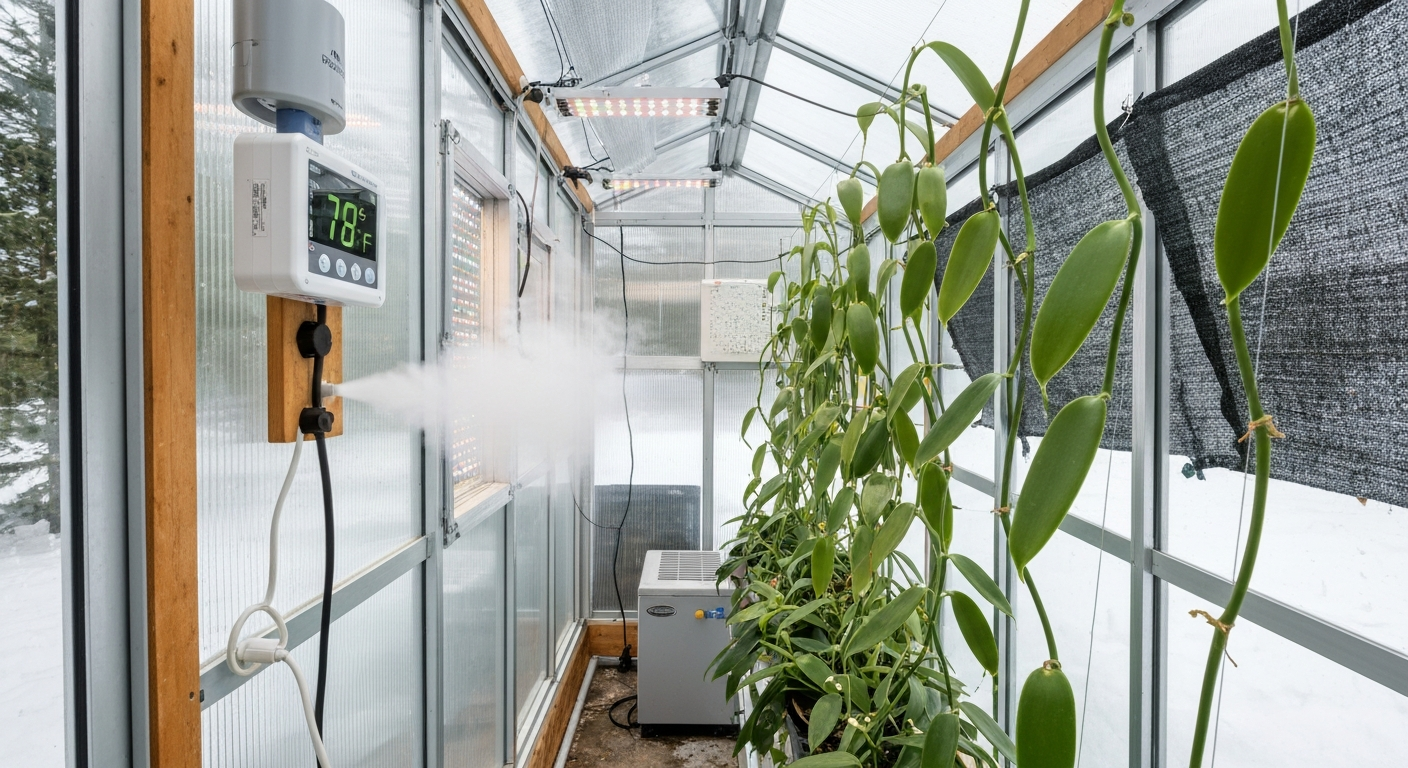
In a Wisconsin greenhouse during January, you're fighting two simultaneous battles: keeping temperature up and keeping humidity up. Heating dry outdoor air and pumping it in drops RH fast. The solution is to humidify the air after heating, using a fogging or misting system controlled by a humidistat. High-pressure fogging systems (using RO water to prevent mineral deposits on leaves and equipment) are the professional standard and sized to your greenhouse volume. For a small hobby greenhouse under 200 square feet, an ultrasonic fogger with a humidistat and an RO water line is a reasonable DIY setup.
Ventilation matters too. Stagnant, high-humidity air promotes fungal disease. Run a small circulation fan continuously to keep air moving around the canopy without creating a cold draft. In summer, vent the greenhouse to prevent overheating; vanilla doesn't like temperatures above 90–95°F for extended periods. A thermostat-controlled exhaust fan is the easiest way to handle this automatically.
Support structures and training the vine
Vanilla naturally climbs and root-anchors at every node. Your job is to give it something to grip and to position the lateral shoots horizontally or in a slight downward arc, because that's where flowering racemes form. A post-and-wire trellis along the back wall of a greenhouse works well: vertical galvanized wire or bamboo canes for the main vine to climb, with horizontal wires to tie out lateral shoots. In a grow tent, a bamboo teepee or wooden dowel grid does the same job at a smaller scale.
Tie the main vine loosely with soft jute twine or plant velcro every 6–8 inches as it grows. When the vine reaches the top of its support, loop it back down and retrain it horizontally. This horizontal looping encourages lateral shoot production, which is where your pods will eventually come from. Keep the nodes in gentle contact with the support structure or wrap sphagnum moss around each node on the main stem to encourage aerial rooting, which feeds the plant and anchors it more effectively.
Seasonal care schedule for Wisconsin growers
| Season / Month Range | Key Tasks |
|---|---|
| Spring (March–May) | Resume bi-weekly fertilizing; increase watering frequency as growth picks up; inspect for pests after winter; repot if rootbound; propagate new cuttings |
| Summer (June–August) | Monitor for overheating in greenhouse (vent or shade); maintain 70–80% RH; watch for flowering racemes on mature vines; hand-pollinate flowers on the morning they open; continue fertilizing |
| Fall (September–October) | Transition to bloom fertilizer if buds forming; reduce nitrogen; begin checking greenhouse heating systems before cold arrives; reduce watering slightly |
| Winter (November–February) | Maintain minimum 60°F nights, 75–80°F days; increase humidity management as heating dries air; reduce fertilizing to once per month or stop; monitor for pests (spider mites thrive in dry heated air); check heating system alarms regularly |
Hand pollination: step-by-step
This is the step most new vanilla growers worry about, and honestly it's straightforward once you understand the anatomy. Each flower has one day to be pollinated. In regions without native pollinators, hand pollination is the only way to get pods. A skilled grower can pollinate around 200 flowers per day once they've got the technique down.
- Check your vine every morning during the flowering period. Flowers open in the early morning, usually before noon.
- Identify a fully open flower. The flower has a yellow anther cap at the top of the column and a stigma just below it, separated by a small flap called the rostellum.
- Using a toothpick, thin bamboo skewer, or fine artist's brush, gently lift the rostellum flap upward to expose the sticky stigma below.
- With the same tool, scoop or press the pollen mass (pollinia) from the anther cap downward onto the exposed sticky stigma surface.
- Press gently to ensure contact. You'll see a slight sticky bond if it's worked.
- Repeat for each open flower that morning. Each successfully pollinated flower will begin to swell at the base (the ovary) within a few days, indicating a pod is forming.
- Unpollinated flowers will drop within 24–48 hours of opening. If you see flowers dropping without swelling, you missed the window or the pollination didn't take.
From flower to harvest: what to expect
After successful pollination, the ovary (pod) swells and elongates over 9 months. A mature vanilla pod is typically 15–25 cm (6–10 inches) long. The pods are ready to harvest when they begin to show a slight yellow color at the tip, before they split open. If pods split fully on the vine, the volatile aromatics start to escape and quality drops. Harvest the entire pod by cutting cleanly at the stem.
Don't expect all your pods to be uniform. First-time flowering vines often produce smaller pods. Successive years typically see improvement as the vine matures. In a healthy greenhouse setup, a mature vanilla vine might produce 10–50 pods per flowering cycle, though home setups often see fewer, especially in the first productive years.
Curing vanilla beans: the practical method
Freshly harvested vanilla pods have almost no vanilla aroma. The familiar vanilla flavor comes from curing, a multi-step process that takes 3–6 months. Here's a practical method adapted for small-batch home growers.
Hot-water kill step (replaces traditional sun-wilting)
- Bring a pot of water to 140–150°F (60–65°C). Do not boil.
- Submerge green pods for 3 minutes. This kills the living tissue and stops plant processes, initiating the enzymatic curing reaction.
- Remove pods immediately and wrap them in a clean wool blanket or thick towels. Leave wrapped and sealed in a box for 24–48 hours (the 'sweating' phase). The pods will turn dark brown.
Sweating and drying phase
- After initial sweating, lay pods out on wooden racks or mesh screens in a warm room (80–85°F) in indirect light for 2–4 hours each morning for the first 1–2 weeks.
- Each evening, re-wrap pods in wool or cloth and seal them in a box to sweat overnight. This daily cycle of brief sun/warmth exposure and overnight sweating is the core of traditional curing.
- Continue this cycle for 2–4 weeks until pods are pliable, deeply brown, and beginning to show slight surface sheen.
- Transition to a slow-drying phase: lay pods on racks in a shaded, well-ventilated room at 70–75°F for 4–6 weeks. Pods should not dry so fast they become brittle.
- Final conditioning: place dried pods in airtight glass jars or curing boxes lined with wax paper for 1–3 months. Check weekly for mold. If mold appears on one pod, remove it, wipe with a cloth dampened in alcohol, and return if not widespread.
- Beans are fully cured when they are flexible but not wet, dark brown, wrinkled, and fragrant. They should bend without snapping.
Timeline and realistic yield expectations
| Stage | Timeline | Notes |
|---|---|---|
| Cutting to first roots | 4–8 weeks | From a healthy nodal cutting in warm, humid conditions |
| First year of growth | Year 1 | Focus on vine establishment; no flowers expected |
| First flowering (12-inch cutting) | Year 3–4 | Shorter cuttings take longer to reach flowering maturity |
| First flowering (3-foot cutting) | Year 2–3 | Longer cuttings from mature plants flower sooner |
| Pod development after pollination | 9 months | From pollination to harvest-ready pod |
| Curing time | 3–6 months | Traditional method; shorter methods sacrifice flavor |
| Total time from cutting to cured bean | 4–6+ years | Realistic minimum for a home grower |
Yield per plant in a home greenhouse setup realistically ranges from a few pods in early productive years to 20–50 pods on a well-established, properly trained vine in a good season. Commercial operations in tropical regions get much higher yields per vine with optimal year-round conditions, so don't benchmark against those numbers.
Setup and operating costs
Let's be real about what this costs. Vanilla is one of the more expensive crops to grow outside the tropics, and Wisconsin's climate makes it more expensive than in warmer states.
| Cost Category | Estimated Range | Notes |
|---|---|---|
| Starter vanilla cutting or plant | $15–$60 | From specialty orchid/tropical nurseries; larger cuttings cost more |
| Grow tent (indoor, single plant) | $80–$200 | Includes tent; add lights, humidifier, fans separately |
| Grow lights (full spectrum) | $80–$300 | LED panels sufficient for 1–3 plants |
| Ultrasonic humidifier + humidistat | $50–$150 | For tent/small room; upgrade to fogger system for greenhouse |
| Small hobby greenhouse (8x10 ft) | $500–$2,000 | Polycarbonate structure; add $500–$1,500 for heating system |
| Heating system (unit heater + thermostat) | $300–$1,500 | Propane, natural gas, or electric; scale to greenhouse size |
| Growing media and containers (first year) | $30–$80 | Orchid bark, moss, coir, perlite, pots |
| Annual heating costs (Wisconsin winter) | $300–$1,200+ | Depends on greenhouse size, insulation, and local energy prices |
| Annual fertilizer and supplies | $30–$80 | Fertilizer, pH adjusters, pest management |
| Total first-year startup (indoor) | $300–$900 | Modest indoor container setup |
| Total first-year startup (greenhouse) | $1,500–$5,000+ | Proper heated greenhouse setup |
Breakeven on vanilla is a very long horizon for hobbyists. High-quality cured vanilla sells for $3–$8 per bean retail, but you're looking at 4–6 years before your first harvest and significant ongoing heating and electricity costs in Wisconsin. This makes sense as a passion project or educational crop, not as a money-making venture for most home growers.
Decision checklist: should you actually try this?
Answer these honestly before committing to vanilla in Wisconsin.
- Do you have or are you willing to build a properly heated, insulated greenhouse or dedicate a heated indoor grow space year-round?
- Can you maintain temperatures of 60–85°F and humidity of 70–80% reliably through Wisconsin winters, including during power outages or equipment failures?
- Are you prepared to wait 3–6 years for your first harvest?
- Can you check your vines daily during the 1–3 week flowering window to hand-pollinate flowers that are open for only one day?
- Are you comfortable with $1,500–$5,000+ in initial setup costs plus $500–$1,500 in annual operating costs for a greenhouse?
- Do you accept that yields will be small (dozens of pods per year at best) and breakeven on cost is unlikely?
- Are you growing for the experience and the product, not for profit?
If you answered yes to most of these, go for it. Vanilla is a fascinating, rewarding plant to grow, and the cured beans you produce yourself are genuinely excellent. If you hesitated on the time, cost, or infrastructure questions, the alternatives below are worth considering.
Alternatives if vanilla isn't practical for you
If the infrastructure or timeline puts you off, there are practical alternatives that deliver similar flavors or aromatics with far less effort in Wisconsin's climate.
- Sweet cicely (Myrrhis odorata): a hardy perennial (zones 3–7) that grows outdoors in Wisconsin and produces leaves, seeds, and roots with a natural anise-vanilla sweetness. No greenhouse needed.
- Heirloom vanilla beans (bought): premium Madagascar, Tahitian, or Mexican vanilla beans from specialty importers give you the real product without the years of growing. Buy in bulk and store properly.
- Vanilla extract (DIY from purchased beans): buy Grade B beans and make your own extract in vodka or food-grade glycerin. Fraction of the cost of commercial extract and excellent quality.
- Vanilla-infused sugar: split a purchased bean into granulated sugar and seal for 2 weeks. Works beautifully for baking.
- Heliotrope or sweet vanilla grass (Hierochloe odorata): cold-hardy fragrant plants for the garden if you want vanilla-adjacent scents rather than culinary use.
- Lemon verbena or sweet basil (Thai/anise varieties): not vanilla, but add complexity to baked goods and beverages and grow easily in Wisconsin summers.
How Wisconsin compares to other states in this series
Wisconsin sits in the middle of this group in terms of growing difficulty: harder than Louisiana and Oregon, slightly easier than Minnesota, and similar in challenge to Pennsylvania and Utah, though for different reasons.
| State | Outdoor Feasibility | Key Climate Challenge | Best Growing Mode |
|---|---|---|---|
| Louisiana | Possible in the far south (zones 9–10) | Humidity is a natural asset; summer heat is already tropical; frost rare in southern parishes | Outdoor or greenhouse |
| Wisconsin | Not feasible | Deep winter cold (zones 3b–6a), long frost season | Heated greenhouse or indoor |
| Minnesota | Not feasible | Even colder than Wisconsin (zones 3a–5b); longer winters | Indoor or heated greenhouse with higher energy cost |
| Oregon | Possible in warmest zones only (coastal zones 8–9) | Mild but not warm enough in most areas; wet winters can promote rot | Greenhouse or indoor with heat |
| Pennsylvania | Not feasible statewide | Similar to Wisconsin in hardiness zones (5a–7a); frost season rules out outdoor | Heated greenhouse or indoor |
| Utah | Not feasible | Arid climate, temperature extremes, cold winters in most of state | Heated greenhouse with humidity system (hardest of the group) |
Louisiana growers have the easiest path to outdoor vanilla by a wide margin. If you're curious about how the near-tropical Gulf Coast compares to Wisconsin's constraints, or how Minnesota's even colder winters push the difficulty further, those state-specific guides cover the details. For a direct comparison, see can you grow vanilla beans in Pennsylvania for state‑specific guidance on climate and greenhouse requirements. Oregon is an interesting middle case where coastal growers have mild enough winters that greenhouse requirements are lighter. See the Oregon guide, titled "can you grow vanilla beans in Oregon", for details on coastal mild-winter strategies and lighter greenhouse requirements.
Final recommendations for Wisconsin growers
Vanilla in Wisconsin is a viable project with the right infrastructure, but you need to go in with clear eyes about the time, cost, and daily attention involved. My honest recommendation: if you have a heated greenhouse already being used for other tropical plants (orchids, citrus, ginger, passionflower), adding a vanilla vine is a natural and worthwhile addition. The incremental cost is low if your heating and humidity are already managed.
If you're starting from scratch just for vanilla, think hard about whether the 4–6 year payoff and the Wisconsin heating bill are worth it versus simply buying excellent vanilla beans or making your own extract. There's no shame in that call. But if you're the type who grows things because you love the process as much as the product, vanilla is one of the most interesting plants you can grow, and the first pod you cure yourself will feel like a genuine achievement.
Start with a single cutting, get your environment dialed in, document what works, and give it time. Wisconsin winters are hard on vanilla, but they're not impossible to work around when you're the one controlling the climate.
FAQ
Concise verdict: Can you grow vanilla beans in Wisconsin?
Yes — but only reliably indoors or in a heated, humid greenhouse. Outdoors is not feasible long‑term because vanilla (Vanilla planifolia) is tropical and frost‑sensitive. Growing in containers or a well‑controlled greenhouse is practical for hobbyists or small‑scale growers who accept multi‑year timelines, equipment costs, and active environment control.
What are the precise environmental requirements for vanilla?
Temperature: day ~24–32 °C (75–90 °F), night ~15–20 °C (60–68 °F); avoid frost. Humidity: 60–85% RH (target ~70–80%). Light: shaded/dappled light — about 30–50% full sun or 100–200 μmol·m⁻2·s⁻1 PPFD. Substrate: loose, well‑drained, high‑organic mix (orchid bark + long‑fiber sphagnum or coconut coir + perlite + compost); pH ~5.5–6.5. Support: vertical tutors/trellis to attach vine and keep nodes near substrate for adventitious rooting.
Equipment and materials checklist (minimum for Wisconsin indoor/greenhouse culture)
Heated greenhouse or climate‑controlled room; thermostat and backup heat; humidifier/fogger with humidistat (RO/filtered water recommended); shade cloth (30–50%); tubs/pots and high‑organic orchid‑type mix; sturdy tutors/trellis posts and soft ties; pruning tools, rooting hormone; hygrometer and thermometer (data logger recommended); grow/maintenance lights (only if natural light insufficient) and ventilation fans; fertilizers (balanced, dilute, plus micronutrients); supplies for hand pollination (toothpick/needle, magnifier) and curing equipment (drying racks, oven or solar box, air‑tight jars).
Propagation: how do you start vanilla plants?
Use healthy stem cuttings with at least 3–5 nodes, 30–60 cm (12–24 in) long. Rooting: place lower nodes in moist sphagnum/orchid bark mix, keep high humidity (70–90%) and warm (24–28 °C). Rooting time: weeks to months. Alternative: buy tissue‑culture plantlets from reputable suppliers to avoid disease and shorten timeline. Seed propagation is impractical for home growers.
Step‑by‑step: potting, training and daily care indoors/greenhouse
1) Pot in loose, well‑draining mix; use large pots to allow later growth. 2) Install vertical tutors and train vine to climb; secure with soft ties. 3) Maintain temperature and RH targets with heater and humidifier; use shade cloth to reduce direct sun. 4) Water to keep substrate evenly moist but not waterlogged; allow surface to dry slightly between waterings. 5) Fertilize lightly every 2–4 weeks during active growth with a balanced, dilute fertilizer (e.g., 10‑10‑10 at ¼–½ strength) plus occasional organic feed; flush occasionally. 6) Provide ventilation and air movement to avoid fungal problems. 7) Prune to encourage lateral growth and position flowering laterals horizontally/pendant for pollination.
Seasonal care schedule (annual) for Wisconsin greenhouse/indoor growers
Year‑round: maintain temp/humidity and monitor pests/diseases. Spring: increase light, reduce humidity fluctuations, resume regular fertilizing. Summer: shade during hot/sunny periods, keep RH and ventilation balanced. Fall: prepare for higher heating demand, monitor for fungal disease as temperatures cool. Winter: keep heating stable (no freezing), maintain humidification, consider energy curtains to conserve heat; reduce irrigation slightly if growth slows, but do not let plants dry out. Monitor for bud set and be ready to hand‑pollinate during flowering periods.
Next Articles
Can You Grow Vanilla Beans in Utah? Guide for Gardeners
Can you grow vanilla beans in Utah? Clear verdict, greenhouse & indoor how-to, timeline, costs, pests, practical steps.
Can You Grow Vanilla Beans in Minnesota? Feasibility Guide
Can you grow vanilla beans in Minnesota? Feasibility, 3 methods, care steps, timeline, costs, and alternatives.
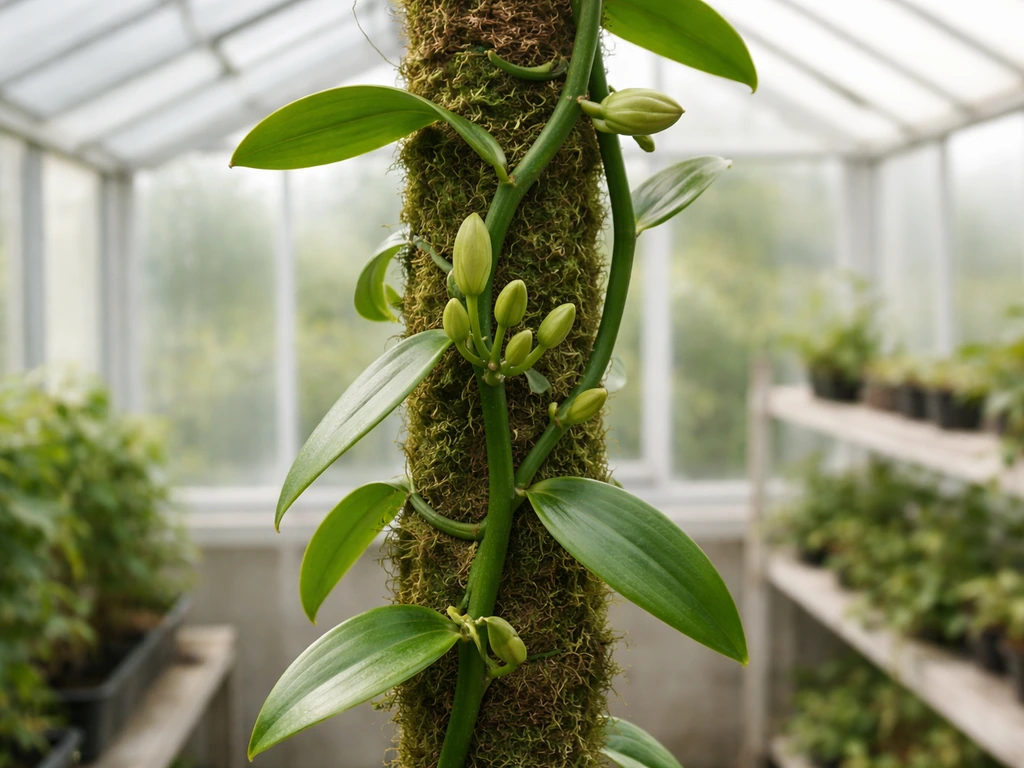
Can You Grow Vanilla Beans in Oregon? Indoor and Greenhouse Guide
Yes, but only indoors or in a greenhouse. Learn Oregon setup, temperature, humidity, hand pollination, and care for vani