
You can grow vanilla in Minnesota, but you cannot grow it outdoors year-round. The plant will die the first time temperatures drop near freezing, which in Minnesota happens reliably every single year. Realistically, your two best options are a heated greenhouse or an indoor container setup under grow lights. Both can get you to flowering and even bean production, but expect a multi-year commitment, some ongoing equipment costs, and a fair bit of hands-on attention. If you go in with those expectations, vanilla is a genuinely rewarding plant to grow here.
Can You Grow Vanilla Beans in Minnesota? Feasibility Guide
Marcus Holloway
23 Jul 2026
Why vanilla is so hard in cold climates
Vanilla planifolia, the species behind most commercial vanilla beans, is a tropical orchid vine native to eastern Mexico. It evolved in warm, humid, frost-free environments and has essentially no cold tolerance built into its biology. Temperatures near freezing stress the plant quickly, and a hard freeze kills it outright. Minnesota's frost-free window runs roughly from blank" rel="noopener noreferrer">mid-May to late September, depending on where you live in the state, giving you maybe 100 to 150 consecutive frost-free days. That sounds workable until you realize vanilla vines typically take three to five years to flower, and they cannot survive even one Minnesota winter outdoors. You are not dealing with a plant that can be coaxed through cold with a little mulch. You are dealing with a plant that needs to be kept warm every single night of the year.
The other challenge is that vanilla is not just cold-sensitive, it is chilling-sensitive. Royal Botanic Gardens, Kew maintains their Vanilla planifolia collection at a minimum night temperature of 20 °C (68 °F). That is not a luxury setting for a rare specimen. That is the floor. Below that temperature, growth slows, flowering becomes unreliable, and the plant gradually declines. Minnesota winters regularly push outdoor nighttime temperatures to -20 °F or colder. The gap between what vanilla needs and what Minnesota delivers outdoors is not a small one to bridge.
What vanilla actually needs to thrive
Before picking a growing pathway, it helps to know exactly what you are trying to replicate. Vanilla has four core requirements that you need to hit consistently.
| Requirement | Target Range | Notes |
|---|---|---|
| Temperature | 70–90 °F (21–32 °C) daytime; min 68 °F (20 °C) at night | Below 60 °F growth stalls; frost is fatal |
| Relative Humidity | 70–85% RH | Aim for ~80%; too low reduces flowering and fruit set |
| Light | Partial shade, ~40–60% of full sun (bright indirect) | Too much direct sun scorches leaves; too little shade delays fruiting |
| Space and Support | Vine can reach 30+ feet; needs vertical trellis or pole | Can be kept shorter indoors by pruning |
The humidity requirement is the one that surprises most Minnesota growers. Average winter indoor humidity in a heated Minnesota home can drop to 20–30% RH, which is far below the 70–85% vanilla needs. You will need dedicated humidification regardless of which pathway you choose. On the light side, vanilla is an understory vine in nature, so it does not want blasting direct sun. Indoors, that means bright indirect light or a grow light setup rather than a south-facing window with no filtering.
Three ways to grow vanilla in Minnesota
There is no single right approach. Your budget, available space, and how serious you are about actually harvesting beans will determine which pathway makes the most sense. Here is a quick overview before we dig into each one.
- Outdoor or microclimate growing: bring plants outside in summer, overwinter indoors. Low cost, but you get only a short season and little progress toward flowering each year.
- Heated greenhouse: the closest thing to a true vanilla production setup in Minnesota. High upfront cost, real operating costs in winter, but the best shot at flowering and beans.
- Indoor container growing: grow entirely inside under lights with a humidifier. The most accessible option for most home growers. Achievable results, but requires patience and consistency.
Pathway 1: Outdoor and microclimate growing in Minnesota
The honest version of this pathway is that you are growing vanilla as a summer annual and overwintering it indoors. From roughly late May through early September, you can move a containerized vanilla vine outside to a sheltered, humid spot. A south-facing wall with good thermal mass (brick or stone) in an urban area gives you the best microclimate. The Twin Cities urban heat island can add a few degrees of warmth compared to rural areas, which helps extend your outdoor window slightly, but we are talking days, not months.
The realistic limits here are significant. Minnesota's frost-free season is simply too short for meaningful cumulative tropical growth if you are relying on outdoor time alone. Vanilla flowers after years of vine development, and outdoor summers here give you maybe 90 to 100 days of warm-enough conditions, with true optimal temperatures (above 75 °F) covering an even shorter stretch. You will make some progress each summer, but you are doing the heavy lifting indoors the rest of the year. Think of outdoor time as a bonus, not the core strategy.
- Pros: no extra energy costs during summer months, natural humidity outdoors (especially in wetter years), good for vine growth during warm spells
- Cons: short usable season, must transition plants indoors by mid-September at the latest, no outdoor overwintering possible, progress toward flowering is slow
- Site tip: a sheltered south-facing patio corner near a masonry wall is your best microclimate option in Minnesota
- Hard limit: any outdoor placement requires a firm plan to bring plants inside before the first frost, typically late September to mid-October depending on your part of the state
Pathway 2: Greenhouse vanilla in Minnesota
A heated greenhouse is the most viable pathway for anyone serious about producing vanilla beans in Minnesota. University of Minnesota Extension's Deep Winter Greenhouse project has documented passive solar greenhouse designs that can dramatically reduce heating costs even in harsh Minnesota winters, but for vanilla specifically, you will almost certainly need active heating as a backup. Vanilla's 68 °F minimum night temperature is a hard line, and passive designs alone are unlikely to hold that reliably through a January cold snap in Duluth or even the Twin Cities.
For a small attached or freestanding greenhouse (say 100 to 200 square feet), plan for a well-insulated double or triple-wall polycarbonate structure with a forced-air or hydronic heating system sized to maintain 68 to 75 °F overnight even when outdoor temps hit -20 °F. Thermal curtains drawn at night significantly reduce heat loss and lower operating costs. Humidity management in a greenhouse is more achievable than indoors because you have more volume and can use evaporative systems, wet floors, or drip irrigation running near the plant to keep RH in the 70 to 85% range. Active humidifiers with a hygrostat are still a good idea as a backup.
The financial reality: winter heating is your dominant operating cost. Extension and industry guides consistently flag this for cold-climate greenhouse operators. A small greenhouse optimized with good insulation and thermal curtains can reduce heating bills meaningfully, but you should budget for meaningful monthly energy costs from November through March. If you are already running a greenhouse for other crops, adding vanilla is a relatively low incremental cost. If you are building one just for vanilla, do the math honestly before you start.
- Structure: double or triple-wall polycarbonate panels, good north-wall insulation, thermal curtains
- Heating: active forced-air or hydronic system, sized for -20 °F outdoor minimum, targeting 68–75 °F overnight
- Humidity: wet-floor evaporation, drip lines, or active humidifier with hygrostat set to 75–80% RH
- Light: vanilla does well under the filtered light of a polycarbonate greenhouse; supplemental grow lights useful in December and January when day length is short
- Vertical space: provide a trellis or horizontal wires at 6 to 8 feet; vanilla can be trained along the roof structure in a larger greenhouse
Pathway 3: Indoor container vanilla in Minnesota homes
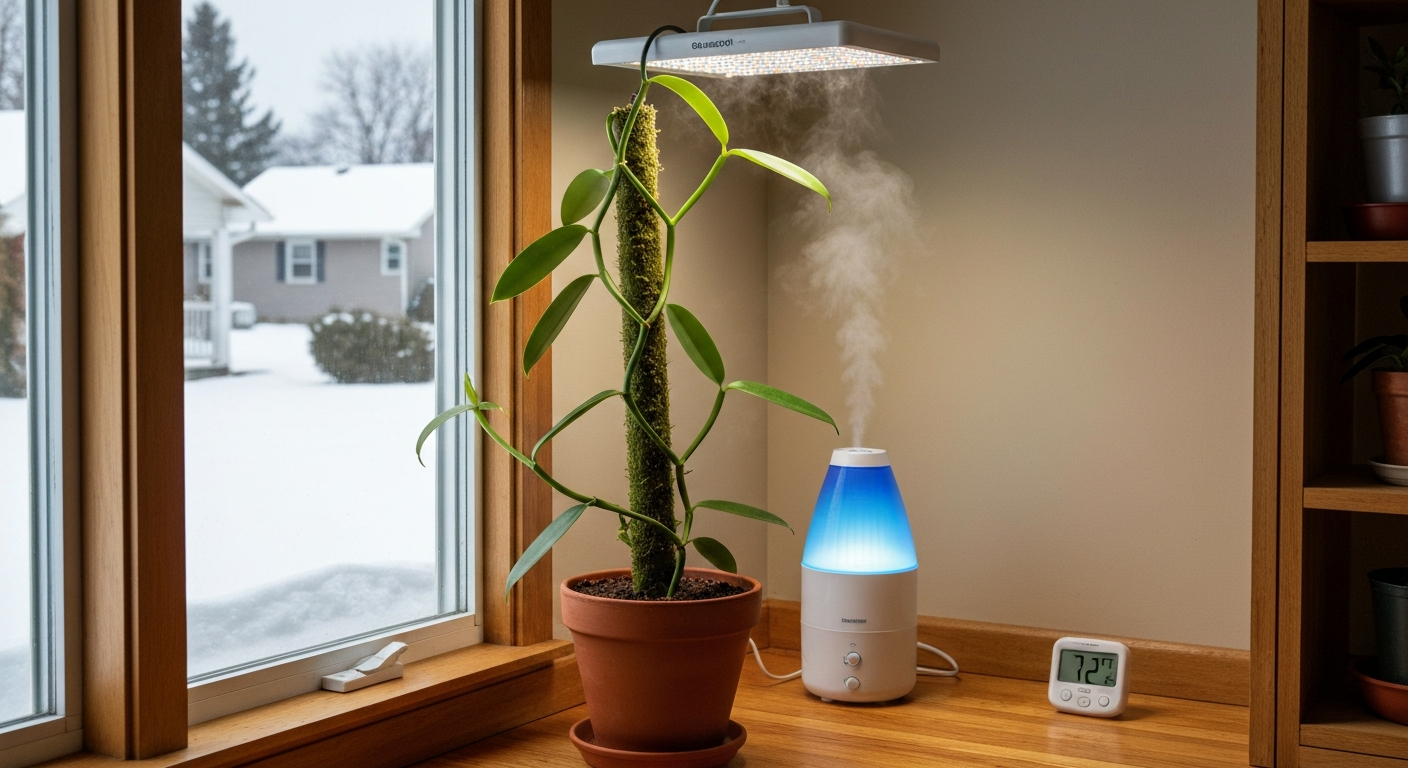
This is the most accessible option for most Minnesota home growers, and it is more doable than it sounds. A mature vanilla vine in a 10 to 14-inch container, trained up a moss pole or trellis, can live happily in a bright room supplemented with grow lights. The key investments are a quality full-spectrum LED grow light and a humidifier dedicated to the plant's corner or room.
For light, you want a full-spectrum LED panel providing moderate intensity, targeting the equivalent of bright indirect light. A 100 to 200-watt equivalent LED positioned 12 to 18 inches from the canopy and running 12 to 14 hours per day is a reasonable starting setup. Avoid blasting the plant with intense direct light even from an LED. For humidity, a cool-mist humidifier running in the same room and a hygrometer to monitor RH is essential. Target 70 to 80% RH around the plant. Grouping it near a pebble tray with water also helps locally.
Space planning matters. A single vine trained to a 5-foot moss pole can be kept manageable in a living room or spare bedroom. As the vine matures, it will want to keep climbing. You can prune it to redirect growth, and the cuttings can be rooted to start new plants. Keep the plant away from cold drafts near windows in winter. A Minnesota window in January can be 20 °F colder than the room a foot away from the glass, and vanilla roots sitting near that cold zone will suffer.
Step-by-step planting and early care plan
Choosing your variety and sourcing starter plants
Vanilla planifolia is the standard choice and the species most widely available from specialty nurseries and online orchid vendors. It is the same species used in Bourbon and Madagascar vanilla production. Vanilla tahitensis (technically a hybrid, V. x tahitensis) is also available and produces beans with slightly different flavor notes, but it has similar care requirements. Either works for a Minnesota indoor or greenhouse setup. Avoid generic unlabeled 'vanilla orchid' plants from big-box stores; sourcing from a reputable specialty orchid or tropical plant nursery gives you a plant of known species with a healthier start. A cutting of at least 3 to 4 nodes rooted in a small pot is the typical way vanilla is sold.
Potting mix and container
Vanilla roots want excellent drainage and good aeration. A mix of medium-grade orchid bark (roughly 60%), perlite (20%), and a small amount of coco coir or peat moss (20%) works well. Avoid standard potting soil, which stays too wet and can cause root rot in vanilla's sensitive root system. Use a terracotta or well-draining nursery pot, 8 to 10 inches for a starter cutting, moving up to 12 to 14 inches as the plant establishes over the first year. Terracotta breathes better than plastic, which helps prevent soggy conditions.
Planting technique and support
Plant the rooted cutting so the lowest node is just at or slightly above the soil surface. Vanilla produces aerial roots along its stem, and these will attach to whatever support structure you provide. Insert a moss pole or bamboo stake immediately at planting and loosely tie the stem to guide it upward. Mist the moss pole regularly to encourage aerial root attachment. The plant should be placed in its chosen location from day one: vanilla dislikes being moved once it has begun attaching aerial roots to its support.
Watering, fertilizing, and the dry period that triggers flowering
Water thoroughly when the top inch of the potting mix feels dry, then let it drain completely. In a heated Minnesota home in winter, you may need to water slightly more frequently because of lower ambient humidity drying the mix faster. Fertilize with a balanced liquid orchid fertilizer (such as 20-20-20 or similar) diluted to half strength every two weeks during active growth in spring and summer. Reduce fertilizing in late fall and winter.
Flowering in vanilla is triggered not by day length but by stress cues, primarily a drier and slightly cooler period of roughly six to eight weeks. Once your vine is mature (typically after three to five years of growth and at least 10 to 15 feet of vine development), you can attempt to induce flowering by reducing watering frequency and dropping temperatures slightly (to around 65 °F at night) for four to six weeks in late winter. Resume normal care afterward and watch for flower buds to develop over the following weeks to months.
Hand pollination: the step you cannot skip
There are no native pollinators in Minnesota (or anywhere in North America outside small parts of Mexico) that will pollinate vanilla flowers for you. Every bean you want requires hand pollination. Vanilla flowers open for only a few hours, typically in the morning. You need to check your plant daily when flowers are present and pollinate each one the morning it opens, ideally between 6 a.m. and noon.
The technique: using a toothpick or thin needle, gently lift or push aside the small flap (the rostellum) that separates the anther cap (containing the pollinia) from the stigma. Then press the pollinia down onto the sticky stigma surface. If pollination is successful, the base of the flower (the ovary) will begin to swell within a day or two rather than dropping off. The resulting pod takes roughly nine months to mature from successful pollination to harvestable bean, so a spring pollination event yields beans the following winter or early spring.
Pests, diseases, and overwintering
Indoors, the main pests to watch for are spider mites (especially in dry heated homes during Minnesota winters), mealybugs, and scale. Inspect the undersides of leaves weekly. Neem oil spray or insecticidal soap handles most infestations if caught early. Root rot from overwatering is the most common disease issue; good drainage and the orchid-bark potting mix described above are your best prevention. Fusarium and bacterial rots can affect vanilla in very humid, poorly ventilated conditions, so air circulation matters even as you maintain high humidity.
Overwintering is straightforward for indoor and greenhouse plants: you simply maintain the plant at its normal temperature and humidity year-round. There is no outdoor vanilla to bring in because vanilla should never have gone outdoors to overwinter in the first place in Minnesota. If you are running the summer-outdoor pathway, bring plants indoors well before your first fall frost, typically no later than mid-September in the southern part of the state and early September in northern Minnesota.
Timeline, expected yield, and honest difficulty assessment
Vanilla is not a quick payoff crop anywhere in the world, and Minnesota is no exception. Here is a realistic timeline for an indoor or greenhouse grower starting from a rooted cutting.
| Year | What to Expect |
|---|---|
| Year 1 | Vine establishes, produces new leaf nodes, and begins climbing support. Focus on healthy root and shoot growth. |
| Years 2–3 | Vine extends significantly; continue training upward and sideways. No flowers yet in most cases. |
| Years 3–5 | First flowering possible if vine has reached 10–15+ feet and you attempt a dry/cool induction period. |
| Year 5 onward | Regular flowering cycles possible with annual dry-period induction; hand pollination required for every bean. |
| Post-pollination | Each successfully pollinated flower produces one pod; pods take approximately 9 months to mature. |
A mature indoor vine in a container will produce a modest number of pods per flowering cycle, typically a handful to a few dozen depending on how many flowers are produced and how successfully you hand-pollinate them. This is not a commercial-scale yield by any measure. For home use, even a few vanilla beans per year from your own plant is genuinely satisfying and represents beans you simply cannot buy at that freshness level. Difficulty-wise, I would rate indoor vanilla in Minnesota as moderate to high, mainly because of the sustained humidity requirement and the multi-year commitment before you see any beans.
How Minnesota compares to nearby and similar states
Minnesota is one of the harder US states for vanilla growing, primarily because of the extreme winter cold and the long heating season required for a greenhouse. Wisconsin growers face almost identical challenges: similar climate zones, similar frost-free windows, and the same need for indoor or heated greenhouse cultivation year-round. For region-specific guidance, see can you grow vanilla beans in Wisconsin for climate comparisons and local recommendations tailored to Wisconsin growers. Pennsylvania growers have a slightly longer frost-free season in the south of the state, which helps marginally with outdoor summer placement, but the core indoor or greenhouse requirement is the same. See can you grow vanilla beans in Pennsylvania for a state-specific guide. Oregon's Willamette Valley offers a milder winter than Minnesota, making greenhouse vanilla somewhat less energy-intensive, though outdoor year-round growing is still not feasible. Can you grow vanilla beans in Oregon? Oregon's milder coastal and Willamette Valley winters make greenhouse production less energy-intensive than in Minnesota, though year-round outdoor cultivation remains impractical. Louisiana stands apart as one of the few continental US states where outdoor vanilla cultivation is genuinely possible in protected locations, given its subtropical climate and minimal frost risk. Utah's arid climate creates a different challenge: low ambient humidity requires intensive supplemental humidification even in a greenhouse, making it comparable in difficulty to Minnesota from an equipment standpoint. For a focused discussion of Utah's specific challenges and solutions, see can you grow vanilla beans in utah for guidance on humidity control and greenhouse strategies.
Realistic alternatives if vanilla feels like too much
If the multi-year timeline and infrastructure requirements feel like more than you want to take on, there are tropical specialty crops that reward Minnesota indoor growers with a faster or easier path. Ginger and turmeric can be grown in containers indoors and harvested in a single season. Cardamom is slower but manageable indoors with similar light and humidity requirements to vanilla. If you specifically want the vanilla flavor experience, growing the plant as an ornamental (enjoying the striking vining growth and occasional flowers without expecting a full bean harvest) is a lower-pressure approach that still lets you experience the plant. You can always scale up to the full bean production setup later once you are comfortable with the plant's needs.
Sourcing plants and equipment: where to start
For starter plants, look for specialty orchid nurseries online that list Vanilla planifolia cuttings or rooted plants. Vendors that specialize in tropical vines or orchids (rather than general houseplant retailers) tend to sell healthier, correctly labeled stock. For equipment, a quality full-spectrum LED grow light from a reputable horticultural brand, a cool-mist humidifier with a built-in hygrostat or paired with a separate hygrometer, and a bag of medium-grade orchid bark are your core starting purchases for the indoor pathway. University of Minnesota Extension is a solid local resource for greenhouse design guidance, freeze date data, and season extension strategies if you are considering the greenhouse route. See Extending the growing season: start early, end later (UMN Extension) for local freeze‑date maps and season‑extension strategies such as row covers and structures that help prolong Minnesota's May–September gardening window. Their Deep Winter Greenhouse materials are particularly relevant if you want to minimize heating costs through passive solar design while still maintaining the active heating backup vanilla requires.
FAQ
Can you grow vanilla beans in Minnesota?
Short answer: Yes — but not outdoors year‑round. Vanilla (mostly Vanilla planifolia) is a tropical, frost‑sensitive vine that cannot survive Minnesota winters outside. Growing vanilla in Minnesota is feasible only if you provide a controlled warm, humid environment year‑round (heated greenhouse or indoor/container culture) or treat plants as a seasonal summer display moved indoors before cold weather. Outdoor microclimates may extend the summer season by weeks but will not prevent winter kill.
Which cultivation pathways work in Minnesota and how feasible is each?
Three realistic pathways: 1) Outdoor/microclimate: Low feasibility for bean production. You can keep vines outdoors in summer in a sheltered, shady spot but must move them indoors before cool nights; unlikely to flower and set beans reliably. 2) Greenhouse (heated/humidified): High feasibility if you can maintain tropical temperatures (day ~21–32 °C/70–90 °F, nights ≈18–22 °C/65–72 °F), 70–85% relative humidity, and partial shade (about 40–60% sunlight). Requires investment in heating, humidity control, and insulation; most reliable route for beans. 3) Indoor/container (home/long‑term): Moderate feasibility. With a warm, humid indoor location (grow room, heated sunroom, or supplemental heat/humidity) and good light (bright indirect), you can flower and set beans, but controlling RH and temperature fluctuations is harder than in a greenhouse.
What temperature, humidity, and light conditions does vanilla need?
Temperature: daytime optimum ~21–32 °C (70–90 °F); keep nights warm (≈18–22 °C/65–72 °F) — avoid temperatures below ~15–18 °C for long. Humidity: high — aim for 70–85% relative humidity. Light: shade‑tolerant understory vine; provide bright, indirect light or about 40–60% shade if grown in a greenhouse (avoid full midday sun). Proper PAR and moderate shade improve flowering and reduce disease.
What potting mix, container size, and support does vanilla require?
Potting mix: loose, well‑draining, humus‑rich medium with good aeration — coarse orchid bark mixes amended with loam/peat/perlite or a rich soilless mix work well. Containers: start in 1–3 gallon for young plants, move to 10+ gallon or grow in hanging baskets/wider pots as vines mature. Support: vanilla is a climbing vine that needs a vertical tutor (tree trunk, moss pole, trellis, or living support). Provide a support with moisture retention (sphagnum/peat on a pole) to encourage aerial root attachment.
How do you pollinate vanilla flowers in Minnesota?
Vanilla flowers are short‑lived and self‑incompatible in the wild; commercial production relies on hand pollination. Technique: in the morning when the flower is open, gently lift or move aside the rostellum that separates the pollinia and stigma, use a fine tool (toothpick, wooden skewer, or needle) to pick up the sticky pollinia and press it onto the stigma. If successful, the ovary will swell and become a pod. Pollinate every open flower (many open for only hours). Practice is needed — a skilled person can pollinate many flowers per day.
What watering and fertilizing schedule is best for vanilla indoors/greenhouse?
Watering: keep media evenly moist but not waterlogged; allow a brief surface dry between waterings. Maintain high ambient humidity to reduce frequent foliar stress. Fertilizing: feed regularly during active growth with a balanced, diluted fertilizer (e.g., 10‑10‑10 or a balanced orchid fertilizer) at half strength every 2–4 weeks; increase potassium slightly as flowering approaches. Avoid salt buildup and flush pots periodically.
Next Articles
Can You Grow Vanilla Beans in Oregon? Indoor and Greenhouse Guide
Yes, but only indoors or in a greenhouse. Learn Oregon setup, temperature, humidity, hand pollination, and care for vani
Can You Grow Agave in Canada? Zone Guide & Growing Tips
Can you grow agave in Canada? Practical region-by-region guide, hardy species, container tips & winter care.
Can You Grow Okra in Canada? Ontario Guide & Short‑Season Tips
Can you grow okra in Canada? Regional verdict, Ontario-specific steps, varieties, season-extension & harvest tips.