
You cannot grow vanilla beans outdoors in Utah or Colorado. Both states are far too cold, too dry, and too variable in temperature for Vanilla planifolia to survive outside. Utah sits mostly in USDA zones 4–8 and averages well below the 59°F nighttime minimum vanilla needs year-round, and Colorado is even harsher at elevation. That said, you absolutely can grow vanilla in either state, you just have to do it in a greenhouse or indoors, where you control every variable the plant needs. It is a significant commitment: expect a minimum of 2–3 years before flowers appear, meticulous humidity management, and daily attention during pollination season. But it works, and growers in states far colder than Utah pull it off every year.
Can You Grow Vanilla Beans in Utah? Guide for Gardeners
Marcus Holloway
24 Jul 2026
What Vanilla planifolia actually needs to thrive
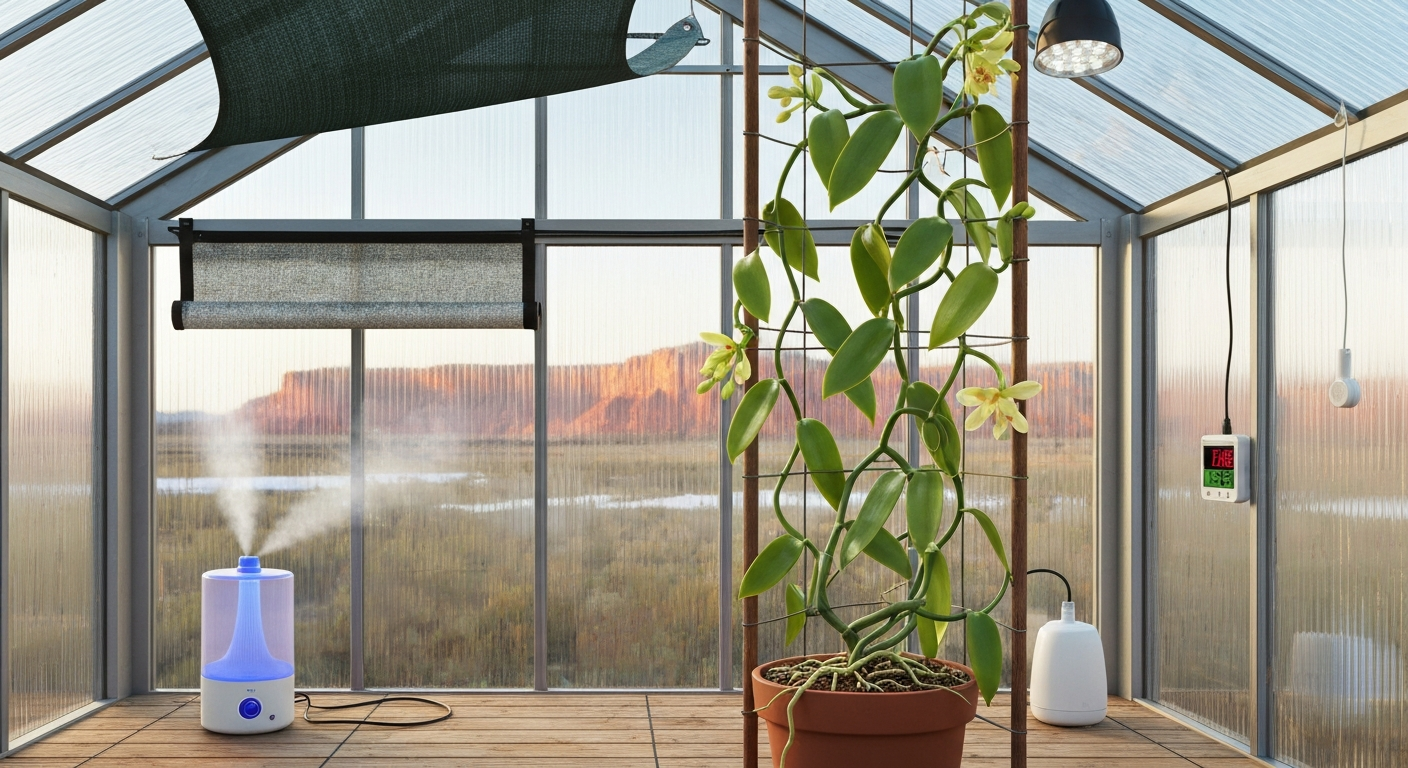
Vanilla planifolia is a tropical hemi-epiphytic vine, it grows in the canopy layer of rainforests in Mexico and Central America, clinging to trees with aerial roots while its base stays in loose, organic-rich soil. Every aspect of its biology reflects that origin, so before you commit to growing it in a cold state, it helps to understand exactly what the plant demands.
Temperature
Daytime temperatures should stay between about 70–90°F (21–32°C). Nighttime temperatures must stay above 59–64°F (15–18°C) at all times. Vanilla is genuinely cold-sensitive, not just frost-sensitive. Sustained chilling even above freezing can damage or kill the vine, and a single hard freeze finishes it outright. There is no cold hardening, no dormancy strategy, no short-term workaround. The plant simply needs consistent tropical warmth 365 days a year.
Humidity
Target relative humidity is 70–90%, with around 80% RH as a practical goal during active growth and propagation. Utah's average relative humidity often sits below 30% outdoors, and Colorado is similarly dry. Even inside most homes, winter RH can drop to 20–30% without active humidification. This is one of the biggest practical obstacles for inland growers.
Light
Vanilla is a shade-tolerant CAM orchid. It performs best under filtered, indirect light rather than full sun. blank" rel="noopener noreferrer">Effects of light intensity on the morphology and CAM photosynthesis of Vanilla planifolia (Universidad Nacional de Colombia, SciELO) report Vanilla is shade‑tolerant and recommend moderate shade, with experimental PAR maxima ~142–1,285 µmol·m⁻²·s⁻¹ and DLIs ~2.4–43.8 mol·m⁻²·day⁻¹. Research trials have measured optimal growth at moderate PAR levels, and exposure to intense direct midday sun can scorch the leaves. An excerpt in the Handbook of Vanilla Science and Technology (excerpt cited on ResearchGate) reports experimental conditions of ~37°C daytime, ~70% RH, PAR ≈92.6 µmol·m⁻²·s⁻¹ and a 14 h photoperiod used in physiological studies, illustrating trials quantify light with PAR and photoperiod rather than vague 'bright indirect light'. Indoors, a bright east- or north-facing window supplemented with grow lights, or a shaded greenhouse panel, replicates its natural canopy-understory conditions well.
Support and pollination
As a climbing vine, vanilla needs a sturdy trellis, pole, or wire system to grow on. In commercial settings, living support trees are used; indoors, a wooden stake or wire frame works fine. On the pollination side, vanilla's natural pollinators are stingless Melipona bees native to Mexico and Central America. Those bees do not exist in Utah, Colorado, or anywhere else in the continental US outside a very narrow subtropical range. That means every single flower you ever see on your vine must be hand-pollinated by you, by hand, the same morning it opens.
Why Utah and Colorado just don't work outdoors
Utah's winters routinely drop well below 0°F in northern areas, and even southern Utah sees temperatures in the low 20s°F during winter nights. Colorado is comparable or colder at most elevations. Both states are semi-arid to arid, Salt Lake City averages around 16 inches of precipitation per year, and much of Colorado's western slope is even drier. Vanilla needs warmth, high humidity, and stable temperatures every single day of the year. There is no outdoor microclimate in Utah or Colorado that stays above 60°F year-round, and no practical way to maintain 70–80% outdoor humidity in an inland high-desert environment. Outdoor cultivation is simply not feasible in either state, and that verdict holds whether you're in St. George in the southwest corner of Utah or in Denver.
Your real options: greenhouse, indoors, and microclimate growing
Outdoor microclimates
In Utah's Dixie region, around St. George and Washington County, summers are genuinely hot and humid enough to put vanilla outside from June through August, and you could use that window as supplemental outdoor time for a container plant. But the vine still needs to come inside well before the first fall frost, and 'outside for three months' does not replace year-round tropical conditions. It's a nice bonus for a plant that lives primarily indoors, not a growing strategy on its own.
Greenhouse growing
A heated, humidity-controlled greenhouse is the gold standard for vanilla in Utah or Colorado. It lets you maintain 70–80% RH and stable nighttime temperatures above 60°F regardless of what's happening outside. Glass or polycarbonate glazing with a shade cloth layer (30–40% shade) replicates the filtered-light environment the plant prefers. Heating costs in a Rocky Mountain winter are real, budget accordingly, especially for Colorado growers at elevation where nighttime lows can be brutal even in spring.
Indoor and houseplant growing
Growing vanilla as a houseplant is genuinely achievable and is what most Utah and Colorado hobbyists end up doing. The vine grows well in a large container near a bright window, with a grow light on a timer, a small ultrasonic humidifier running nearby, and a trellis or wooden stake for support. It won't win any records for pod production, but plants have been brought to flower and fruit in living rooms and spare bedrooms. The keys are keeping humidity consistently above 60% (ideally 70–80%), never letting nighttime temps drop below 60°F, and being home to hand-pollinate on the exact morning a flower opens.
How to grow vanilla in Utah or Colorado: a practical checklist
1. Site selection
Pick your space before you buy the plant. A greenhouse is ideal; a heated sunroom or bright interior room with a south or east-facing window is a solid second choice. The space needs to hold temperatures between 70–85°F during the day and never drop below 60°F at night, year-round. Confirm your heating setup can handle Utah or Colorado winter nights before committing.
2. Containers and substrate
Use a well-draining orchid-style mix: a blend of coarse bark, perlite, and a small amount of coco coir works well. Vanilla's aerial roots need airflow as much as moisture. A container 12–16 inches in diameter gives roots room to develop without holding excess water. Terracotta pots are fine; plastic works too if drainage is generous. Avoid dense potting soil mixes, vanilla roots rot quickly in waterlogged, compacted media.
3. Irrigation and watering
Water when the top inch of the growing medium feels dry. Vanilla likes consistent moisture but not soggy roots. In Utah's dry indoor air, that might mean watering every 3–5 days during summer and weekly in winter. During the deliberate dry rest period you'll use to trigger flowering (more on that below), pull back watering significantly for about 2 months. Use room-temperature water; cold tap water can shock the roots.
4. Humidity control
This is the hardest part in Utah and Colorado. Invest in a reliable hygrometer so you actually know what your RH is (not a guess). A cool-mist or ultrasonic humidifier running in the plant's space can realistically get a small room or greenhouse section to 60–75% RH. Grouping tropical plants together helps too. Misting the leaves occasionally is fine but is not a substitute for ambient humidity. If you're greenhouse growing, a misting system on a timer is worth the setup cost.
5. Light and temperature management
Place the vine where it gets bright, indirect light for most of the day, filtered sun through a sheer curtain or shade cloth is ideal. Avoid harsh direct afternoon sun, which can burn the fleshy leaves. If natural light is insufficient (common in Utah winters), supplement with a full-spectrum LED grow light on a 14-hour timer. Keep daytime temps at 75–85°F and confirm nighttime temps don't dip below 60°F, especially in winter.
6. Support structures
Install a trellis, bamboo stake, or wire frame before the vine outgrows its pot. Vanilla produces aerial roots along the stem that naturally grip supports; you can loosely tie new growth to guide it. Many indoor growers train the vine in a horizontal loop or along a wall-mounted wire grid to maximize the number of flowering nodes within reach.
7. Fertilizing
Feed with a balanced orchid fertilizer (such as a 20-20-20 formula diluted to half strength) every 2–3 weeks during the active growing season (spring through early fall). Reduce fertilizing during the dry rest period. Avoid heavy nitrogen applications, which push leafy growth at the expense of flowering.
Propagation and getting to your first flower
Vanilla is propagated almost universally from stem cuttings, and the length of your cutting directly affects how long you wait for flowers. The commercial standard is to take cuttings with at least 2–5 healthy nodes. Let the cut end callus for 1–2 days before planting, this reduces rot risk significantly. Plant the callused end shallowly in your bark/perlite mix, keep humidity high, and mist the cutting regularly until new root growth appears. Warmth (75–85°F) and consistent moisture are the main success factors.
Cutting length matters more than most new growers realize. A 30 cm (12-inch) cutting will typically take 3–4 years to flower under good conditions. A 1-meter (39-inch) cutting can flower in 2–3 years. If you want beans in a reasonable timeframe, start with the longest cutting you can source. Once the vine is established, flowering is typically induced by implementing a deliberate dry rest of about 2 months, reducing watering and slightly dropping nighttime temperatures (but never below 60°F), followed by resuming normal care. This mimics the seasonal dry period the plant experiences in its native range.
Hand-pollination: the window is one day, every time
Each vanilla flower opens once, for a single day, typically in the early morning. If you miss that window, the flower drops and you get no bean from it. Vanilla flowers usually appear in clusters (racemes) of 10–20 buds, opening one or a few per day over a period of weeks, so you get multiple chances per flowering event, but you need to check the plant every morning during flowering season.
The hand-pollination process is straightforward once you've done it a few times. Do it between about 6:00 a.m. and noon while the flower is fully open. Here's the method used by growers worldwide, including in commercial operations:
- Locate the open flower and gently pull back or lift the lower petal (the labellum/hood) to expose the column inside.
- Find the rostellum — a small flap or membrane that separates the pollen (pollinia) from the stigma. Use a toothpick, thin wooden skewer, or needle to gently push the rostellum aside.
- With the same tool or your finger, press the yellow pollinia down onto the sticky stigma so pollen makes direct contact.
- Mark the pollinated flower with a small piece of string or colored tape so you can track pod development.
- Repeat every morning for each newly opened flower throughout the flowering period.
A successfully pollinated flower will begin to swell at the base within a week or two. An unpollinated flower simply drops off within a day or two of opening. The UF/IFAS Extension guide for South Florida growers includes photos illustrating each step of this process and is worth bookmarking.
Harvesting and curing your pods
When to harvest
From the day of successful pollination, pods take approximately 6–9 months to mature, with 8–9 months being the most commonly cited timeline in both FAO production guides and extension literature. Harvest individual pods (not the whole bunch at once) when the pod is fully grown and shows a slight yellow tinge at the tip. Do not wait for the pod to turn fully yellow or split, harvest at first color change. Plan to begin curing within one week of harvest to preserve the aromatic precursors.
The curing process
Raw green vanilla pods have virtually no aroma, the characteristic vanilla scent develops entirely through the curing process. Expect 40–60% moisture loss by the time curing is complete. The FAO-documented curing protocol used in commercial production involves four stages:
- Killing/wilting: Immerse pods in hot water at 65–70°C (149–158°F). Grade I pods (highest quality, longest) are immersed for about 5 minutes; Grade II for about 4 minutes; Grade III for about 2 minutes. This stops vegetative processes and begins enzymatic activity that develops vanillin.
- Sweating: Wrap the treated pods in wool blankets or place in an insulated box for several days, maintaining warmth. This enzymatic sweating phase is where vanillin precursors convert to vanillin and the characteristic aroma begins to develop. Pods turn dark brown during this stage.
- Slow drying: Move pods to shade drying, then low-heat or sun drying over several weeks, gradually reducing moisture content. This stage typically takes 4–6 weeks or longer depending on your setup and ambient conditions.
- Conditioning and packing: Once dried to the target moisture level, bundle pods and store in a cool, regulated environment at approximately 50–59°F (10–15°C) and 60–65% RH for several weeks to a few months to allow flavor to fully develop before use.
Common problems to watch for
- Root rot: The most common killer indoors. Caused by overwatering or dense, poorly draining substrate. Use a bark-heavy mix and let the medium partially dry between waterings.
- Spider mites: Thrive in the low-humidity conditions typical of Utah and Colorado homes in winter. Check the undersides of leaves regularly; treat with neem oil or insecticidal soap early.
- Mealybugs: Show up as white cottony masses at leaf joints. Remove manually with isopropyl alcohol on a cotton swab and treat the plant proactively.
- Leaf scorch: Direct afternoon sun on the fleshy leaves causes yellowing and brown patches. Move to filtered light or add shade cloth.
- Failure to flower: Usually caused by skipping the dry rest period, insufficient vine maturity, or chronic low light. Vanilla needs that deliberate 2-month dry-down to trigger bloom.
- Dropped flowers without fruit set: Pollination missed the window, or the technique didn't transfer pollen to the stigma. Practice the motion on a sacrificed flower first.
How Utah and Colorado compare to other states for vanilla growing
Utah and Colorado are among the more challenging states for vanilla cultivation due to the combination of cold winters, low humidity, and high elevation. Here's a quick comparison of where they stand relative to the sibling states covered on this site:
| State | Outdoor feasibility | Primary challenge | Best approach |
|---|---|---|---|
| Utah | Not feasible | Cold winters, arid climate, low humidity | Greenhouse or indoor with active humidification |
| Colorado | Not feasible | Cold winters, high elevation, very low humidity | Greenhouse or indoor with active humidification |
| Louisiana | Possible in southern areas (zone 9–10) | Occasional freeze events, some humidity gaps | Outdoor with protection or greenhouse |
| Minnesota | Not feasible | Severe winters, USDA zones 3–5 | Greenhouse or indoor only |
| Oregon | Not feasible outdoors statewide | Cold and wet winters, insufficient summer heat inland | Heated greenhouse in western lowlands |
| Pennsylvania | Not feasible | Cold winters, low winter humidity indoors | Greenhouse or indoor only |
| Wisconsin | Not feasible | Severe winters, USDA zones 3–5, low humidity | Greenhouse or indoor only |
Louisiana stands out as the only state in this group with any realistic outdoor potential, and even there it's limited to the warmest southern parishes. See our guide "Can you grow vanilla beans in Louisiana" for details on outdoor potential and which southern parishes might work. The remaining states, Utah, Colorado, Minnesota, Oregon, Pennsylvania, and Wisconsin, all require controlled environments. If you wonder whether you can grow vanilla beans in Wisconsin, the answer is the same: only in controlled environments such as a heated greenhouse or indoors with strict humidity and temperature control can you grow vanilla beans in wisconsin. If you're in Minnesota, see can you grow vanilla beans in Minnesota for state-specific guidance on indoor and greenhouse options. See the state-specific guide can you grow vanilla beans in Pennsylvania for details on indoor and greenhouse growing in that climate. For state-specific advice and microclimate notes, see our guide on can you grow vanilla beans in Oregon which covers Oregon's unique coastal and inland differences. The effort and cost of doing it right are essentially the same across all of them, so if you're in any of these states and committed to vanilla, the greenhouse or indoor approach described in this article is your path.
Is it worth it for Utah and Colorado growers?
Honestly, growing vanilla in Utah or Colorado is a project for people who genuinely enjoy the process as much as the harvest. You're looking at 2–4 years before your first flowers, daily vigilance during pollination season, ongoing humidity management in a climate that fights you every winter, and then a months-long curing process after harvest. The yield from an indoor plant will never compete with buying vanilla beans in bulk. But if you want to understand the plant, enjoy the challenge, and eventually hold a cured bean you grew yourself in a Salt Lake City apartment or a Denver greenhouse, it is absolutely achievable. Go in with realistic expectations, start with the longest cutting you can find, get a good hygrometer, and commit to the humidity management. That's the whole secret.
FAQ
Can you grow vanilla beans outdoors in Utah or Colorado?
No for typical outdoor cultivation. Vanilla planifolia is a tropical vine sensitive to freezing and requires consistently warm temperatures and very high humidity; Utah and Colorado’s climates (including winter freezes and low winter humidity) are unsuitable for outdoor field culture except possibly in very rare, protected microclimates (e.g., year‑round frost‑free courtyard with extreme humidity control). For practical home growing in these states choose greenhouse or indoor/controlled environments.
Is it possible to produce vanilla beans in Utah/Colorado in a greenhouse or indoors?
Yes. With a heated greenhouse or a well‑controlled indoor setup that provides tropical temperature ranges, sustained high humidity, filtered light, a climbing support, and hand‑pollination, home growers in Utah and Colorado can grow Vanilla planifolia and produce pods. Expect higher costs and effort than typical houseplants.
What are the core tropical requirements of Vanilla planifolia?
Temperature: daytime ~21–32°C (70–90°F) and nights above ~15–18°C (59–64°F); intolerant of freezing. Humidity: high—roughly 70–90% relative humidity during growth. Light: bright, filtered/indirect light (moderate shade preferred). Support: a vertical support or host (hemi‑epiphytic habit) to climb. Pollination: flowers open one day and require pollination that morning—natural pollinators are absent in most introduced regions, so hand‑pollination is standard.
Can outdoor microclimates in these states work for vanilla?
Rarely. If you have a permanently frost‑free, sheltered courtyard with year‑round humidity near 70% and the ability to control temperature and light (e.g., inside a conservatory or heated lean‑to), it might be marginally possible. Most backyard microclimates still fall short on winter heat and humidity.
What are the feasible growing options for home growers in cold states?
1) Heated greenhouse with humidity control and shading. 2) Indoor/houseplant setup using a humidifier, grow lights (if light is low), and a tall support. 3) Move plants outdoors only in summer into a shaded, humid location and bring indoors before nights drop. A heated greenhouse offers the best chance for consistent flowering and pod set.
Step‑by‑step checklist — site and environmental controls for greenhouse or indoor growth
Site: location with access to electrical heat/humidity control and filtered light. Temperature control: maintain day 21–32°C and night ≥15–18°C year‑round. Humidity: target ~70–85% RH while actively growing; use humidifiers, misting, or humidity benches. Light: provide bright, indirect light; avoid hot midday sun—shade cloth for greenhouse or 12–14 hour photoperiod with grow lights indoors. Airflow: gentle circulation to prevent stagnation and fungal buildup. Vertical support: moss pole, tree fern trunk, trellis or slat support for vines to climb.
Next Articles
Can You Grow Vanilla Beans in Minnesota? Feasibility Guide
Can you grow vanilla beans in Minnesota? Feasibility, 3 methods, care steps, timeline, costs, and alternatives.
Can You Grow Vanilla Beans in Oregon? Indoor and Greenhouse Guide
Yes, but only indoors or in a greenhouse. Learn Oregon setup, temperature, humidity, hand pollination, and care for vani
Can You Grow Agave in Canada? Zone Guide & Growing Tips
Can you grow agave in Canada? Practical region-by-region guide, hardy species, container tips & winter care.