
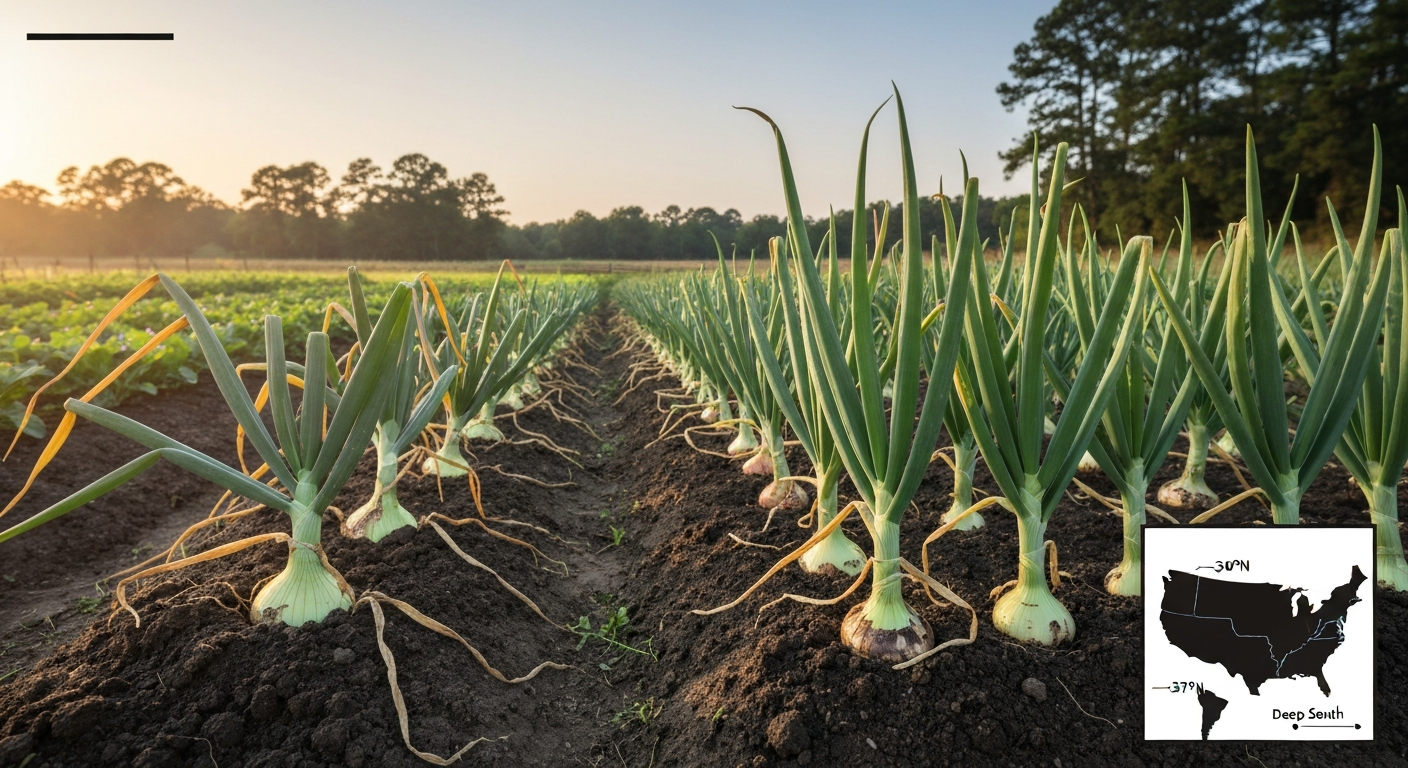
Long-day onions will almost always disappoint you if you're gardening in the Deep South. They need 14 to 16 hours of daylight to trigger bulbing, and most of the South never sees that. At 30°N latitude (think New Orleans or Jacksonville), the longest day of the year tops out around 13.9 hours. At 35°N (the northern edge of Tennessee or North Carolina), you might scrape 14.5 hours in late June, which is borderline at best. Plant a Walla Walla or Copra in Georgia and you'll likely get a lush stand of green tops with a marble-sized bulb underneath. That's the honest answer, but there's more nuance worth knowing before you write off the project entirely.
Can You Grow Long-Day Onions in the South? Practical Guide
Marcus Holloway
19 Jul 2026
Long-day, short-day, and intermediate onions: what the labels actually mean
Every onion variety falls into one of three photoperiod categories, and that category determines where in the country the variety can produce a usable bulb. The difference is simply about how many hours of light per day the plant needs before it stops growing leaves and starts forming a bulb.
| Type | Daylength needed to bulb | Best latitude range | Example varieties |
|---|---|---|---|
| Short-day | 10–12 hours | South of ~35°N (Zones 7–10) | Granex, Texas 1015Y, Red Creole, Vidalia types |
| Intermediate / day-neutral | 12–14 hours | ~32°N–38°N (transition zones) | Candy, Super Star, Intermediate Yellow |
| Long-day | 14–16 hours | North of ~37°N (Zones 3–6) | Walla Walla, Copra, Ailsa Craig, Yellow Sweet Spanish |
These thresholds are widely confirmed across U.S. land-grant extension systems from Oregon State to Texas A&M, and the underlying physiology is documented in plant science research showing distinct gene expression changes in Allium cepa cultivars as daylength increases. Peer‑reviewed molecular and physiological studies confirm distinct photoperiodic responses between long‑day and short‑day Allium cepa cultivars and document cultivar‑level differences in critical daylength and timing of bulbing Peer‑reviewed studies (see Temporal and Spatial Expression of Arabidopsis Gene Homologs Control Daylength Adaptation and Bulb Formation in Onion (PMC)) confirm cultivar‑level differences in critical daylength and bulbing gene expression in Allium cepa.. Seed companies like Johnny's Selected Seeds publish daylength-by-latitude maps specifically so growers can match variety type to their location before they buy a single packet.
Why daylength controls whether you get a bulb at all
An onion plant spends its early life building leaf mass. Each leaf added above ground corresponds to a ring inside the eventual bulb, so you want the plant to put on as many leaves as possible before it shifts into bulbing mode. That shift is triggered by photoperiod, not temperature. When day length crosses the cultivar's critical threshold, the plant redirects its energy from producing new leaves to swelling the base into a bulb. If the critical daylength never arrives, the plant just keeps growing leaves or, if conditions are right for flowering, bolts and sends up a seed stalk without ever forming a proper bulb.
There's a secondary factor too: the plant needs to reach a minimum vegetative size before bulbing produces a marketable result. Research from Japan's Horticultural Journal confirms that even when daylength conditions are met, plants that haven't developed enough leaf biomass produce undersized bulbs. This is why transplant timing matters so much, and why the grow-and-overwintering strategy used across southern states targets a specific plant size before the days lengthen.
Which onion type fits which part of the South
The South isn't monolithic. A grower in Pensacola, Florida and a grower in Asheville, North Carolina are working with meaningfully different daylength ceilings, and that changes what's realistic.
| Region / State | Approx. latitude | Max. summer daylength | Recommended onion type |
|---|---|---|---|
| Southern Florida | ~25°N | ~13 h 42 min | Short-day only |
| Central Florida, Gulf Coast LA/MS | ~29–30°N | ~13.9 h | Short-day only |
| Georgia, Alabama, South Carolina | ~31–33°N | ~14.0–14.2 h | Short-day; intermediate may work |
| North Carolina (piedmont/mountains), Tennessee, Arkansas | ~35–36°N | ~14.4–14.6 h | Intermediate; long-day marginal in mountains |
| Northern edge (northern VA, KY border) | ~37–38°N | ~14.7–15.0 h | Intermediate to long-day may succeed |
North Carolina State Extension specifically warns gardeners that many onion sets sold at retail stores in the state are long-day types unsuitable for the region's latitude, which is a real problem because those sets look perfectly normal and there's no obvious sign of the mismatch until you dig up a crop of tiny bulbs in summer. Always check the seed tag or catalog listing for the day-type classification before purchasing.
When long-day onions are likely to fail in southern gardens
If you're gardening anywhere south of approximately 35°N latitude, growing long-day onions for a marketable or kitchen-worthy bulb crop is a poor bet under normal outdoor conditions. The daylength simply doesn't reach 14 hours consistently before summer heat sets in, and heat after bulbing begins reduces storage quality and bulb size. The outcome in most cases is one of three things: the plant vegetates all season and never bulbs; it produces a tiny, tight bulb with minimal usable flesh; or it bolts and flowers early, particularly if a late cold snap is followed by warm temperatures, a combination that triggers early flowering regardless of daylength.
LSU AgCenter publications for Louisiana are explicit about this, directing growers to use short-day varieties and providing fall planting calendars built around that recommendation. UF/IFAS guidance for Florida says the same thing. The failure mode isn't a mystery and it's not a reflection of gardening skill. It's physics. The sun doesn't get high enough or stay up long enough at southern latitudes to flip the switch for long-day bulbing.
The best onion choices for southern growers
Short-day varieties are the right tool for the Deep South, and they produce excellent results when planted on the correct schedule. The South's most famous onion, the Vidalia from Georgia, is a short-day Granex-type variety grown under a tightly regulated regional system. Texas 1015Y (a University of Texas-bred sweet onion) is another standout. Red Creole is a proven performer in Louisiana and Mississippi. These varieties were bred for exactly the daylength conditions that southern latitudes provide.
For growers in the transition zone (roughly 32°N to 37°N), intermediate or day-neutral varieties like Candy and Super Star offer a wider window. They need 12 to 14 hours of light, which fits comfortably within the summer daylength range for central Georgia, the Carolinas, and Arkansas. Mississippi State University Extension recommends intermediate varieties for parts of that state where short-day types finish too early in the spring. The UGA onion variety trial reports from 2024 and 2025 continue to validate Granex-family and intermediate varieties as the most productive options for Georgia conditions.
- Deep South (FL, LA, MS, south GA, south AL): Granex 33, White Granex, Red Creole, Texas 1015Y
- Mid-South transition zone (central GA, SC, NC piedmont, AR, TN): Candy, Super Star, Southern Belle, Intermediate Red
- Upper South / border states (northern NC mountains, northern VA, KY): Candy, intermediate types, and some long-day varieties in the highest elevations
Workarounds if you still want to try long-day types in the South
The practical workarounds are real but come with honest trade-offs. None of them fully solve the daylength deficit for locations south of 33°N, but two of them can get you partway there in the right circumstances.
Supplemental lighting indoors or in a greenhouse
Controlled-environment research confirms that photoperiod extension through supplemental LED lighting can induce bulbing responses in Allium species. See Bulbing and light quality (ScienceDirect topic overview) for reviews showing spectral composition, particularly red:far‑red ratio sensed by young leaves, affects bulb initiation and that cultivars differ in sensitivity to spectrum and daylength rate of change. Studies have used configurations like a 10-hour natural day extended by 8 hours of supplemental LED lighting at roughly 400 to 500 micromoles per meter squared per second to simulate long-day conditions. In practical terms for a home grower, this means starting transplants indoors under supplemental grow lights set to run an extended photoperiod before transplanting outdoors. The challenge is that once those plants go into the ground in the South, outdoor daylength takes over and the bulbing signal weakens or stops. This approach is most useful for producing transplants that are well-developed and close to bulbing before they hit the field, not for sustaining long-day conditions through the entire growing season outdoors.
Staging transplants to hit the daylength window
At latitudes near 35°N to 37°N, where summer days do briefly touch 14 to 14.5 hours, it's possible to time transplants so the plants reach adequate vegetative size right as daylength peaks. This requires starting seeds indoors around December or January (10 to 12 weeks before the target transplant date) and getting transplants into the ground by late February or early March. The problem is that this window is narrow and the summer heat that follows bulbing initiation degrades quality fast. It's more viable in upper-South states like northern North Carolina or the Tennessee highlands than in Georgia or Louisiana.
Overwintering long-day onions: what it can and can't do
Overwintering is the most commonly discussed workaround for southern growers, and it's worth understanding exactly what it achieves and where it falls short for long-day types specifically.
The overwintering strategy works like this: plant seeds or transplants in fall (typically September to November in the South), let the young seedlings grow slowly through winter, and then harvest in late spring as days lengthen. This is the standard production method for short-day onions in the South, and it's the backbone of the Vidalia and Louisiana production calendar. For short-day varieties, it's an excellent approach because the plants overwinter as small seedlings, build leaf mass during the mild southern winter, and then bulb in March to May when daylength crosses 10 to 12 hours.
For long-day varieties, overwintering does get the plants through winter with good leaf development, which is a genuine advantage. The problem is that the bulbing trigger still requires 14 to 16 hours of light, which most southern locations never provide outdoors. So you end up with a large, well-developed plant in spring that still won't shift into bulbing mode properly. The overwintering method solves the vegetative size problem but not the photoperiod problem. At the northern edge of the South, around 36°N to 38°N, overwintered long-day plants that have built substantial leaf mass by late May may catch just enough of the daylength peak to produce a usable, if modest, bulb. South of 35°N, the result is still likely to be disappointing.
| Workaround | How it helps | Key limitation | Best suited for |
|---|---|---|---|
| Overwintering (fall planting) | Builds leaf mass before daylength peaks | Daylength still too short south of 35°N for long-day bulbing | Upper South near 35°N–38°N; ideal for short-day varieties everywhere in the South |
| Supplemental lighting (greenhouse/indoor) | Can extend photoperiod artificially during seedling stage | Outdoor conditions take over once transplanted; not scalable for field crops | Small-scale indoor/greenhouse trial, starting transplants only |
| Transplant staging (timing for daylength peak) | Targets the brief window when southern daylength approaches 14–14.5 h | Narrow timing window; summer heat degrades quality quickly after bulbing | Northern edge of South (~35°N–37°N), not Deep South |
Planting schedules and methods for the South
For short-day onions, the southern planting calendar runs from September through January depending on the state. Florida growers typically plant transplants from October through December. Louisiana and Mississippi growers target October and November. Georgia, Alabama, and South Carolina generally aim for September to November for direct-seeded crops and October to December for transplants. North Carolina growers in the piedmont and eastern regions plant transplants from late January to mid-February.
For starting methods, transplants are the most reliable choice for home gardens and small farms. They give you predictable timing and tend to outperform sets in both yield and consistency. Sets (the small dry bulbs sold in mesh bags) are easier to handle but are often unlabeled long-day types at garden centers, exactly the problem NC State Extension flags. If you use sets, verify the day-type on the packaging. Seed is the most economical option for larger plantings and gives you access to the widest variety selection, but it requires an 8 to 12 week lead time before transplanting and more attention during germination.
Soil, fertility, and the basics that matter
Onions are heavy feeders, and getting the fertility right makes a real difference in bulb size regardless of variety. They perform best in well-drained, loose soil with a pH between 6.0 and 6.8. In the heavy clay soils common across much of the Southeast, raised beds or deep tillage with added compost are worth the effort. Onions have shallow root systems and compete poorly with weeds, so clean cultivation in the early weeks is important.
Nitrogen is the key nutrient. A common practice recommended by Texas A&M AgriLife and other southern extension programs is to apply nitrogen in split applications: one at planting and additional side-dressings every three to four weeks through mid-season. Stop nitrogen applications once the tops begin to naturally fall over, which signals the bulb is approaching maturity. Too much late nitrogen delays maturity and produces soft bulbs that don't store well.
Common problems southern growers run into
- Small or no bulb formation: Almost always a photoperiod mismatch. If you planted a long-day variety south of 35°N, daylength is the cause. Switch to a short-day or intermediate type next season.
- Bolting (flower stalk emerges before bulb forms): Common when onions experience a cold period followed by warm temperatures, especially with sets or transplants that were too large at planting. Use transplants that are pencil-thin (about the diameter of a pencil) to reduce bolting risk.
- Doubles and splits: Caused by planting sets that already began differentiating internally, or by temperature fluctuations during bulb development. Transplants grown from seed are less prone to this than sets.
- Thrips damage: The most common insect pest across the South. Thrips scar and silver the leaves, reducing photosynthesis and ultimately bulb size. UF/IFAS insect management guides for onions recommend monitoring and treating early with approved insecticides or biocontrols.
- Pink root and fusarium: Soilborne diseases that are worse in heavy, wet soils and in fields with a history of allium production. Crop rotation and well-drained beds are the primary preventive tools.
How to verify the day-type on a seed packet or catalog listing
Seed companies that specialize in vegetable production (Johnny's Selected Seeds being a reliable example) always label onion varieties by day-type in their catalog descriptions and comparison charts. Look for the terms 'long-day,' 'short-day,' or 'intermediate/day-neutral' in the variety description. If a packet from a mass-market retailer doesn't include that information, that's a red flag. You can often search the variety name plus 'day type' online to find the classification, or cross-reference against a land-grant extension publication for your state, which will list recommended varieties by category. Never plant unnamed or unclassified onion sets if you're gardening south of 35°N without confirming what you're buying.
Making the right call for your state and zone
The decision tree for southern onion growers is actually pretty simple once you know the photoperiod rules. If you're in Florida, Louisiana, Mississippi, or coastal Alabama and Georgia, plant short-day varieties in fall and harvest in spring. For advice on other regional crops, see our guide on growing chickpeas in Georgia. If you're curious about other region-specific crops, see our short guide on whether you can grow celery in Minnesota can you grow celery in minnesota. That system works and produces genuinely excellent onions. If you're in the Carolinas, Tennessee, or Arkansas, short-day and intermediate varieties both work, with intermediates giving you slightly more flexibility in timing. If you're in the upper-South border zone near 37°N to 38°N, intermediate varieties are your safest bet, and long-day types are an experiment worth trying once with realistic expectations.
Long-day types are genuinely excellent onions for growers in the northern U.S., just like short-day varieties are the natural fit for the South. The parallel challenge in the other direction, trying to grow short-day onions in northern latitudes, runs into the same kind of mismatch for the opposite reason. For practical guidance on the reverse problem, whether you can grow short day onions in the north, see our regional advice on adapting short-day varieties to northern climates can you grow short day onions in the north. If you're exploring how other crops navigate similar regional adaptation challenges, the same principle of matching a crop's fundamental requirements to your local climate applies whether you're looking at legumes in the Midwest, specialty vegetables in the Great Lakes region, or onions anywhere in between. For related regional-legume guidance, see can you grow chickpeas in Texas for suitability and practical tips on growing chickpeas in warm U.S. climates. For gardeners interested in regional suitability for legumes, see resources on topics like 'can you grow chickpeas in Ohio' to understand how local climate limits and supports specific crops. See Can you grow celery in Ohio? for regional tips on growing celery in the Midwest. For a concrete example of regional legume suitability, see can you grow black beans in Ohio for specifics on growing beans in Midwest climates. For a related example on regional suitability, see can you grow chickpeas in Michigan.
The most practical thing I can tell you is this: a well-grown short-day Granex onion harvested from a Georgia garden in April is a genuinely excellent onion. A struggling long-day variety producing a golf-ball-sized bulb in June from the same garden is a frustration. Match the tool to the conditions, and you'll get better results with far less work.
FAQ
Can home gardeners in the U.S. South successfully grow long‑day onion varieties?
Generally no for most of the Deep South. Long‑day onions need about 14–16 hours of daylight to initiate bulbing; many southern locations (especially below ~35°N) never reach those daylengths at peak summer, so long‑day varieties often fail to form large bulbs or produce many small/bolt‑prone bulbs. However, growers in northern parts of southern states (near or above ~35°N), or those who use overwintering, protected culture, or supplemental lighting, can sometimes succeed.
Why does daylength matter for onion bulbing?
Onions are photoperiodic: they sense daylength and initiate the switch from vegetative growth to bulb formation once a cultivar‑specific critical daylength is met. Short‑day types bulb at ~10–12 h, intermediate/day‑neutral at ~12–14 h, and long‑day at ~14+ h. If days never reach a variety’s critical length, the plant keeps growing leaves and produces small or no bulbs.
Which onion day‑types are recommended for southern growers?
Short‑day (≈10–12 h) and intermediate/day‑neutral (≈12–14 h) varieties are recommended across most of the U.S. South. Short‑day types are standard for Deep South/Florida/Coastal areas; intermediate types can work in more northern southern regions or higher elevations. Use region/state extension guides for recommended cultivars.
What practical alternatives should I plant instead of long‑day onions in the South?
Choose short‑day varieties (Vidalia, Texas, Granex types) or intermediate/day‑neutral varieties listed by seed companies and state extensions for your latitude. Bunching (green) onions, shallots, and storage short‑day hybrids are also suitable alternatives depending on season and use.
If I still want to try long‑day varieties, what workarounds might help?
Possible approaches: 1) Overwinter small transplants (fall planting) so they are mature when daylength increases; 2) Grow in greenhouse or high tunnel and extend daylength with supplemental lighting to simulate 14+ h; 3) Stage transplants started earlier in the season in northern areas and bring them south as transplants; 4) Use aggressive fertility and spacing to maximize leaf growth so plants reach the vegetative size threshold before critical daylength.
How effective is supplemental lighting for inducing bulbing?
Supplemental lighting can work: controlled‑environment studies and hobby greenhouse trials show extending daylength (e.g., adding enough light to reach ~14–16 h total) can trigger bulbing. It requires adequate light intensity and duration and can be energy‑intensive for large plantings; results depend on cultivar sensitivity and plant size at the switch.
Next Articles
Can You Grow Chickpeas in Georgia? Dates, Varieties, Care
Learn if you can grow chickpeas in Georgia, with timing, varieties, soil care, pests, and harvest tips by region.
Can You Grow Celery in Minnesota? How to Grow It Successfully
Learn if you can grow celery in Minnesota, which varieties to pick, when to start and transplant, and how to avoid bolti
Can You Grow Chickpeas in Ohio? Planting Guide and Tips
Learn if chickpeas grow in Ohio and get an Ohio-specific planting plan, variety tips, soil care, and harvest timing.