
Yes, you can grow edamame in Canada, but where you live and how long your frost-free season runs determines whether it's straightforward or a stretch. Most of southern British Columbia, Ontario, Quebec, and the Maritimes have enough warmth to bring early-maturing varieties to harvest without season-extension tricks. The Prairies are harder but doable with the right short-season cultivar and a bit of indoor starting. Northern Canada above roughly 55°N is generally too short-seasoned for reliable outdoor production without greenhouse support. The single biggest variable is growing-degree-days: edamame needs somewhere between 1,100 and 1,400 GDD (base 10°C) depending on the variety, and most southern Canadian gardens can deliver that in a normal summer.
Can You Grow Edamame in Canada? Practical Guide for Short Seasons
Quick feasibility checklist for your location
Before you order seed, run through these four checkpoints for your specific spot. If you tick all four, edamame is a realistic crop. If you miss one, you have a workaround to consider before planting.
- Frost-free days: You need at least 90–100 consecutive frost-free days at a minimum, with 110–120 being comfortable for most early varieties. Check Environment and Climate Change Canada's Climate Normals or ClimateData.ca for your nearest station.
- Growing-degree-days: Look up cumulative GDD (base 10°C) for your location over the May–September window. Early edamame varieties need roughly 1,100–1,250 GDD; mid-season types need 1,250–1,400 GDD. If your site can't reliably hit 1,100, stick to the earliest cultivars or use row cover to boost heat.
- Last and first frost dates: Use the 50% probability frost dates as your baseline planting anchor. Edamame seed should not go into cold ground. Aim for soil at least 18°C (65°F) at planting depth, which typically arrives 2–4 weeks after your last spring frost date.
- Variety days-to-maturity (DTM): Match your variety's DTM to your frost-free window with a buffer. If your frost-free window is 105 days and your variety needs 85 DTM, you have 20 days of buffer — enough. A 95-DTM variety in that same window leaves only a 10-day margin, which is risky in a cool summer.
Edamame vs. other beans: what actually makes it different
Edamame is a vegetable soybean, the same species as the field soybeans grown commercially across Ontario and Manitoba (Glycine max), but harvested green at the R6 stage when pods are around 85–90% full and the beans are still plump and sweet. Field soybeans are left to dry completely on the plant and then combine-harvested as a commodity oilseed or livestock feed crop. The eating quality of edamame depends on catching that narrow harvest window, which can close in as little as 18–20 days. Miss it and the beans lose their sweetness and soft texture.
Dry beans, black beans, navy, kidney, are a completely different crop category. They belong mostly to Phaseolus vulgaris rather than Glycine max, and they're managed for dry seed weight rather than fresh pod quality. If you're curious about dry bean options for Canadian gardens, growing black beans in Canada follows a similar short-season calculus but with different variety constraints and soil needs. The cultural overlap between all these legumes is that they all fix nitrogen when properly inoculated, and they all dislike wet, cold soils at germination.
Province-by-province climate suitability
British Columbia: coast vs. interior
The BC coast, Vancouver Island, the Lower Mainland, the Fraser Valley, is generally warm enough for early edamame, with frost-free seasons often exceeding 150–200 days in the most sheltered areas. The challenge here is not length but summer heat. The coast can be cloudy and cool in June, so GDD accumulation is slower than the calendar suggests. Organic BC variety trials emphasize selecting early-maturing cultivars specifically because heat accumulation, not just frost-free days, limits yield in coastal BC. The BC interior (Okanagan, Similkameen) tends to accumulate GDD faster and is often an easier environment for edamame than the coast, hot summers and reliable 120–150 frost-free day windows in valley floors.
Prairies: Alberta, Saskatchewan, Manitoba
This is the most challenging zone for outdoor edamame in Canada. Frost-free seasons in the agricultural zones of the Prairies typically range from 90 to 120 days, with GDD accumulation depending heavily on location. Southern Manitoba (around Winnipeg) and southeastern Saskatchewan are the most viable, with summer heat sums reaching 1,100–1,300 GDD in good years. Alberta's agricultural belt (Lethbridge, Red Deer corridor) can work with very early 70–75 DTM varieties but late frosts in May and early September frosts are real risks. If you're on the Prairies, look at what soybean growers in Manitoba are doing, the expansion of early soybean maturity groups (MG 000 and 00) into southern Manitoba is a useful proxy for what edamame heat needs are achievable. Double-check your specific location's GDD rather than going by province alone.
Ontario
Ontario is the most favorable large-scale edamame region in Canada. Southern Ontario (Windsor-Essex, Niagara, Huron County, and the Lake Erie shore) accumulates 1,400–1,700+ GDD and has frost-free seasons of 150–180 days, comfortable for mid-season varieties of 85–95 DTM. The Ontario Ministry of Agriculture, Food and Rural Affairs (OMAFRA) explicitly identifies edamame as suitable for Ontario production and recommends field seeding in the first 10 days of May (or mid-May to early June in cooler areas), with varieties like Envy and Harronami among those that have performed well in provincial trials. Central and northern Ontario tighten up quickly; above Sudbury the season becomes too short for most outdoor edamame without season extension.
Quebec
Southern Quebec, particularly the Montérégie region south of Montreal and the Eastern Townships, can grow early edamame reliably. The Montreal corridor has frost-free seasons of around 150–165 days and adequate summer heat for 75–85 DTM varieties. Moving north toward Quebec City conditions tighten, with shorter seasons and lower GDD, so stick with the earliest cultivars and consider black plastic mulch to boost soil temperature. The St. Lawrence River valley retains some moderating heat, which helps.
Atlantic provinces
Nova Scotia and PEI have surprisingly workable edamame seasons in their warmest pockets, the Annapolis Valley in Nova Scotia and central PEI can reach 120–140 frost-free days with enough summer heat for early varieties. New Brunswick is more variable, with the Saint John River valley being more favorable than coastal areas. Newfoundland is generally too short-seasoned and cool for reliable outdoor production; container or polytunnel growing is a more practical option there.
Northern limits
As a general rule, consistently growing edamame outdoors becomes unreliable above roughly 53–55°N latitude (northern Manitoba, northern Ontario, far northern BC). The GDD just isn't there in most years. Container growing in a heated greenhouse is possible further north, but outdoor field or garden production becomes too weather-dependent to recommend.
Checking your site and season length
The most practical starting point is ClimateData.ca or the ECCC Climate Normals database, look up your nearest weather station and pull frost-free season length and cumulative GDD (base 10°C) from May through September. Don't just rely on province-level averages; local conditions like elevation, lake proximity, and urban heat islands can shift your effective growing season by 2–4 weeks either way. A south-facing slope in the Okanagan or Niagara escarpment behaves very differently from a north-facing field 5 km away.
When you have your frost dates, work backward from your average first fall frost date using your variety's DTM. If your last spring frost is around May 15 (50% probability) and first fall frost is around September 20, you have about 128 days. Soil reaches 18°C about 2 weeks after last frost in most southern Canadian locations, so your practical sowing window opens around June 1. A variety needing 80 DTM would hit harvest around August 20, a full month before first fall frost. That's a comfortable fit.
Planting windows by region and comparable U.S. states
Canadian planting windows for edamame map fairly closely to the short-season U.S. states just south of the border. If you're familiar with edamame growing in Minnesota, Wisconsin, or Pennsylvania, the guidance translates well to comparable Canadian regions. If you're asking 'can you grow edamame in Pennsylvania', its generally longer season is comparable to Essex County or the Niagara Peninsula, so mid-season varieties often perform well there. For guidance tailored to Wisconsin's climate and planting windows, see our can you grow edamame in Wisconsin guide. Minnesota's growing conditions are directly analogous to southern Manitoba and parts of Saskatchewan, growers there rely on the same early DTM varieties and similar late-May to early-June planting windows. Wisconsin conditions map roughly to southwestern Ontario. Pennsylvania's longer season is closer to Essex County, Ontario, or the Niagara Peninsula.
| Region | Recommended sowing window | Target soil temp at sowing | Comparable U.S. state |
|---|---|---|---|
| Southern Ontario (Lake Erie/Niagara) | Late April – mid May | 18°C (65°F) | Pennsylvania / Ohio |
| Central Ontario / Southern Quebec | Early – mid May | 18°C (65°F) | Wisconsin |
| BC Lower Mainland / Fraser Valley | Mid May – early June | 18°C (65°F) | Western Washington |
| BC Okanagan / Interior | Early – mid May | 18°C (65°F) | Idaho / eastern WA |
| Southern Manitoba / SE Saskatchewan | Late May – early June | 18°C (65°F) | Minnesota |
| Alberta agricultural belt | Early – mid June | 18°C (65°F) | North Dakota |
| Atlantic provinces (NS/PEI) | Late May – early June | 18°C (65°F) | Maine |
| Northern Ontario / Northern Quebec | Early – mid June (indoors mid-May) | 18°C (65°F) | Northern Minnesota |
Choosing the right varieties for Canada
Variety selection is the most important decision you'll make for Canadian edamame. The closer you are to the northern edge of viability, the more you should prioritize days-to-maturity over yield potential or pod size. Look for varieties in the 70–85 DTM range for most Canadian conditions; anything over 90 DTM is only realistic in the warmest parts of southern Ontario or the BC interior.
West Coast Seeds, one of Canada's most accessible seed retailers for this crop, lists Tohya at approximately 78 DTM and Kuroshinju (Black Pearl) at 80–85 DTM, both appropriate for most southern Canadian gardens. Midori Giant comes in around 75 DTM and is frequently recommended for short-season production. Envy has performed well in OMAFRA Ontario trials. When comparing varieties, check both DTM and whether the supplier provides GDD data, DTM ratings are typically based on average-warmth conditions, and a cool summer can add 5–10 days to maturity even with the same variety.
Agriculture and Agri-Food Canada has active breeding programs for short-season food-grade soybean germplasm, and some of that material is making its way into commercial variety listings. Provincial seed growers and local feed/seed stores in Ontario and Manitoba sometimes carry trial varieties not yet widely listed online, worth asking about if you're in those regions.
| Variety | Approximate DTM | Notes | Suited to |
|---|---|---|---|
| Midori Giant | ~75 days | Good pod fill, widely available | All Canadian growing regions |
| Tohya | ~78 days | Reliable, available from West Coast Seeds | BC, ON, QC, Maritimes |
| Envy | ~75–80 days | OMAFRA-tested for Ontario conditions | Ontario, Quebec |
| Kuroshinju (Black Pearl) | ~80–85 days | Black-seeded type, nuttier flavour | Southern ON, BC interior |
| Harronami | ~85 days | Named in OMAFRA Ontario trial results | Southern Ontario |
Seed preparation and getting germination right
Edamame is not a particularly fussy germinator once soil is warm, but cold, wet soil is the fastest way to rot your seed and waste your season. Here's the full process I'd walk you through step by step.
- Check soil temperature first: Use a soil thermometer at seeding depth (about 2.5–5 cm / 1–2 inches). You want at least 18°C (65°F), and ideally 21°C (70°F) or warmer. West Coast Seeds specifies an optimal range of 21–32°C for soya bean germination. Planting into soil below 15°C significantly slows emergence and invites seed rot.
- Pre-soaking (optional but helpful in cool conditions): Soaking seed for 4–6 hours in room-temperature water before planting can speed emergence by softening the seed coat. Don't soak for more than 8–12 hours — waterlogged seed loses vigor. In warm southern Ontario soils, this step is less critical; in cooler BC coastal or Prairie soils, it can give you 2–3 days faster emergence.
- Inoculate your seed: Unless you've grown soybeans in the same field within the last 3–5 years, inoculate with Bradyrhizobium japonicum. This is non-negotiable on new soybean ground. Commercial inoculants (peat, liquid, or granular in-furrow) are widely available at farm supply stores across Canada. Apply inoculant according to product label directions — typically coat seed just before planting, protecting treated seed from direct sunlight and heat.
- Consider double inoculation on new ground: Alberta Pulse Growers and Manitoba Pulse & Soybean Growers both recommend a double-inoculation strategy for first-time soybean fields — seed coating plus an in-furrow granular application. Manitoba trial data shows this increases nodule counts and yield on fields with no soybean history. It costs a few dollars more but pays off.
- OMAFRA also notes that some edamame varieties nodulate less efficiently than commodity soybeans, so if you're not seeing good nodulation by 3–4 weeks after emergence (small pink-interior nodules on roots), a modest supplemental nitrogen application may be warranted.
- Plant at the right depth and spacing: Set seed 2–5 cm (about 1 inch) deep. Rows should be about 60 cm (24 inches) apart, with seeds spaced 5–10 cm (2–4 inches) apart in the row. Emergence typically takes 8–16 days depending on soil temperature and seed vigor.
- Use row cover or black plastic mulch in cool regions: In BC coastal gardens, on the Prairies, or in Atlantic Canada, black plastic mulch warms soil by 3–5°C and can accelerate both germination and early-season GDD accumulation. Row cover (spunbond fabric) provides frost protection and additional warmth at emergence but should be removed once plants are flowering to allow pollination.
- Thin if needed: If you had to plant thicker to compensate for expected germination gaps, thin to about 7–10 cm in-row spacing once seedlings are 5–8 cm tall. Overcrowded plants reduce pod set and make disease management harder.
Soil, fertility, and nitrogen management
Edamame prefers a well-drained, slightly acidic to neutral soil (pH 6.0–7.0). Heavy clay that holds moisture is the enemy of good germination and root development. If you have clay-heavy soil, add compost or grow in raised beds to improve drainage. Like other legumes, edamame fixes its own nitrogen once nodules are established, usually within 3–4 weeks of emergence. Avoid heavy nitrogen fertilization, which suppresses nodule development and wastes money. A modest starter application (following a soil test) can help establishment on low-fertility soils, but OMAFRA notes that excessive N reduces nodulation. University of Maryland extension recommends modest starter nitrogen (about 25 lb N/acre in some scenarios) and banded P/K based on soil tests, while noting that high starter N can suppress nodulation University of Maryland extension recommends modest starter nitrogen (about 25 lb N/acre in some scenarios) and banded P/K based on soil tests, while noting that high starter N can suppress nodulation.. Phosphorus and potassium should be based on soil test results. Edamame does not need heavy fertility inputs when properly inoculated.
Pests, diseases, and crop rotation
The main pest pressures on Canadian edamame are deer and rabbits (especially in rural gardens), soybean aphid, bean leaf beetles, and cutworms. Aphid populations can build quickly in warm summers and warrant monitoring, particularly in Ontario where soybean aphid pressure is well-established. On the disease side, white mold (Sclerotinia), root rots (Phytophthora, Pythium), and bacterial pustule are the main risks identified in OMAFRA's vegetable crop production guidance. Good drainage is the single best preventive measure against root rots. Rotate edamame with non-legume crops on at least a 3-year cycle to reduce disease carryover and maintain rhizobia populations without over-relying on inoculant.
Harvesting, blanching, and storage
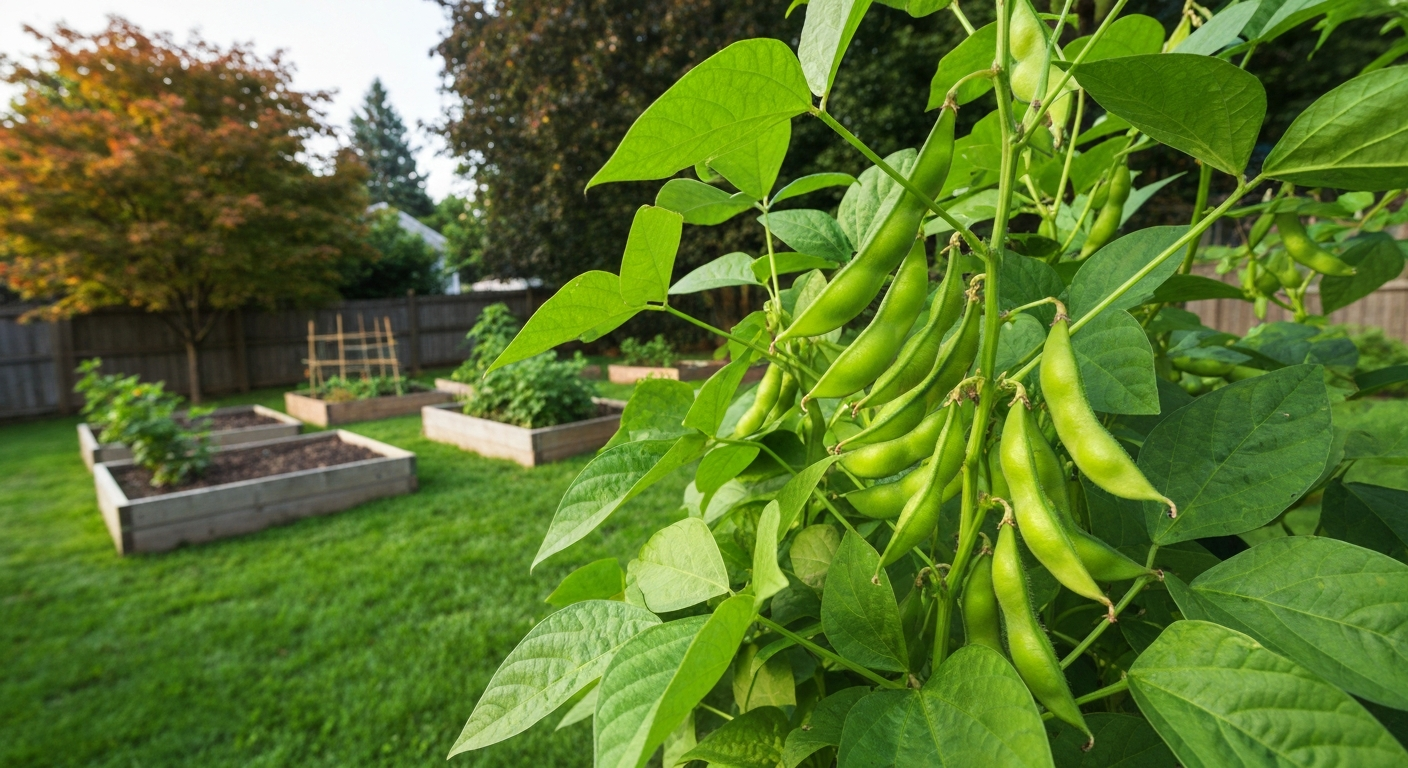
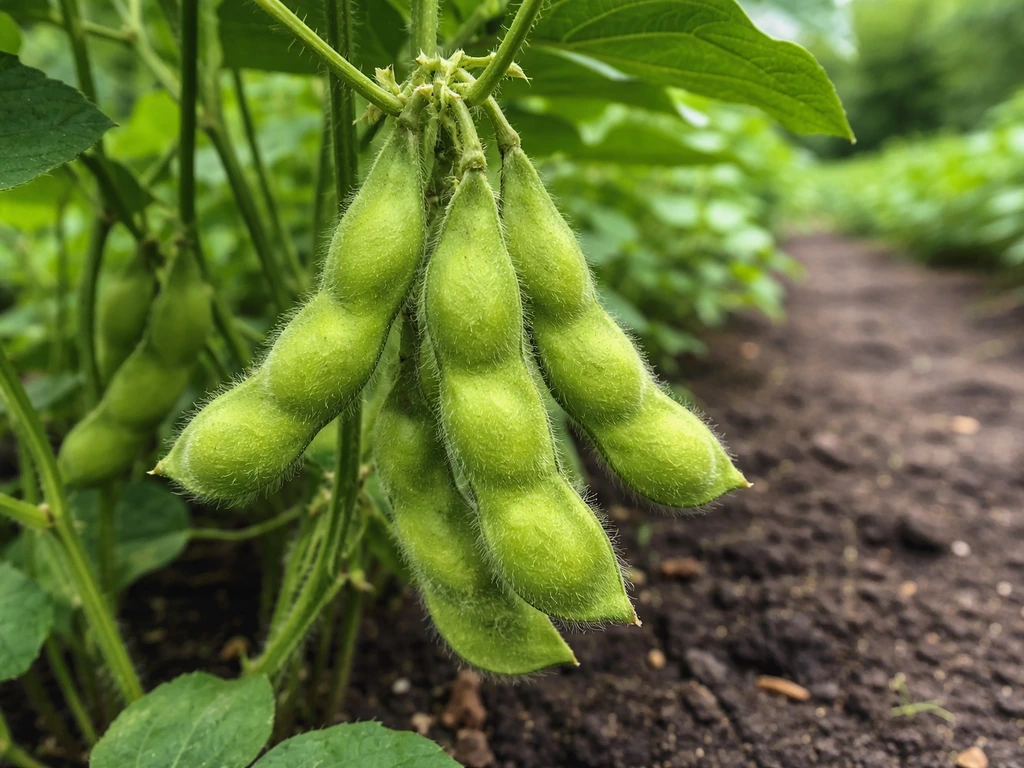
Harvest timing is critical and the harvest window is genuinely short, often 18–20 days or less. You're aiming for the R6 stage, when pods are plump, beans fill about 85–90% of the pod interior, and the pod is still green. Squeeze a pod: if the beans push back with resistance and the pod feels full, you're there. If the beans feel soft and mushy, you've gone too late. For a small home garden, check daily during the harvest window. Pull entire plants or snap pods by hand.
To preserve quality, blanch pods in boiling water for 2–3 minutes within a few hours of harvest, then plunge into ice water. Eat fresh or freeze in airtight bags, properly blanched edamame freezes well for 6–12 months. Flavor deteriorates quickly at room temperature after harvest, similar to sweet corn, so the fewer hours between plant and pot or freezer, the better.
Realistic yield expectations
Home garden yields vary considerably with variety, growing conditions, and season length. A well-managed plant in a warm Ontario or BC interior garden can produce 25–40 harvestable pods. A 3-metre (10-foot) row of plants spaced 8 cm apart will give you roughly 35–45 plants and a very worthwhile harvest for fresh eating. Don't expect supermarket-style uniformity, Canadian home-grown edamame will have some variation in pod fill and timing. That's normal, especially in cooler years when heat accumulation is slower.
Short-season strategies and container growing
For gardeners in tighter climates, northern Ontario, the Prairies, Atlantic Canada, a few tactics extend what's possible. Starting seed indoors 2–3 weeks before last frost (in deep cells or biodegradable pots to minimize root disturbance) gives you a head start without exposing seed to cold soil. Transplant out only once soil has warmed to at least 18°C and overnight temperatures stay consistently above 8°C. Black plastic mulch, low tunnels, and spunbond row cover can each add meaningful warmth to your microclimate in the critical early weeks.
Container growing is a practical option for northern gardeners or those with limited space. Use large containers of at least 15–20 litres per plant, filled with well-draining potting mix, and inoculate as you would for in-ground planting. Alberta Pulse Growers recommends inoculation, often both seed-applied and in‑furrow granular, on fields with no soybean history to increase nodulation and potential yield Alberta Pulse Growers recommends inoculation—often both seed-applied and in‑furrow granular—on fields with no soybean history to increase nodulation and potential yield.. Containers warm faster than ground soil in spring, which is a genuine advantage in cold climates. Move them to the warmest, most sheltered south-facing spot available.
Troubleshooting quick-reference
- Slow or no germination: Soil temperature too low — wait until consistent 18°C+ before planting or use row cover/black plastic to pre-warm soil.
- Spindly, pale plants with no root nodules at 4 weeks: Inoculation failed or skipped — apply granular in-furrow inoculant at next planting; consider a modest N side-dress for current crop.
- Pods present but beans not filling: Heat stress during flowering or inadequate soil moisture during pod fill — consistent watering at R3–R6 stages is critical.
- Plants flower but no pods set: Usually caused by extreme heat (>35°C) during flowering causing flower drop — more common in southern Ontario heat waves; there's not much to do except wait for cooler conditions.
- Frost damage at emergence: Plant lost — resow if you still have enough season; use row cover next time to protect emerging seedlings.
- White, cottony mold at soil level: White mold (Sclerotinia) — improve air circulation, avoid overhead watering, and rotate out of legumes for 3+ years.
Where to get seed and next steps
West Coast Seeds carries multiple edamame varieties and ships across Canada, a reliable starting point for home gardeners. Ontario-based growers should also check with local farm supply stores, as OMAFRA-evaluated varieties like Envy and Harronami may be stocked regionally. For Prairie growers, Alberta Pulse Growers and Manitoba Pulse & Soybean Growers both maintain extension resources and can point you toward agronomic support and early-maturing material suited to short Prairie seasons. If you're evaluating other legume crops alongside edamame, the growing calculus for standard soybeans and black beans in Canada follows a similar regional logic, worth exploring as companion crops or rotational options. For more detail on regional suitability for soybeans specifically, see can you grow soybeans.
FAQ
Quick answer — can you grow edamame in Canada?
Yes. Edamame (vegetable soybean) can be grown across much of Canada if you choose early‑maturing varieties, plant when soils are warm, and manage frost risk. Success depends on local frost‑free days / growing‑degree‑days (GDD), soil temperature at sowing, variety maturity (days to harvest), and good agronomy (inoculation, drainage, fertility). In many southern Ontario, BC, Quebec and parts of the Prairies and Maritimes, home gardeners and small growers routinely succeed; for colder/shorter regions, growers use short‑season varieties, season extension, containers, or greenhouses.
Feasibility checklist — how to tell quickly if edamame will work at your location
Check these four things: 1) Frost‑free window: Do you have at least ~75–95 frost‑free days from safe soil warming to first fall frost? 2) Growing‑degree‑days (GDD): Do local GDD and heat accumulation match your chosen variety’s maturity (many edible varieties need ~75–90 days or corresponding GDD)? 3) Soil temperature: Can you sow when soil is consistently ~18°C (65°F) or warmer for rapid, reliable germination? 4) Season timing: Can you plant after last spring frost and harvest before first fall frost or use season‑extension (row cover/greenhouse) to protect pods? Use local climate normals, extension frost‑date tools, or ClimateData/Environment Canada station data to answer these.
How does edamame differ from other beans and soybeans used for dry grain?
Edamame is a vegetable soybean harvested at R6 (pods full, green) for fresh or frozen eating; it is not the same as common dry beans (kidney, black beans) which are Phaseolus spp. vs Glycine max. Compared with commodity soybeans: edamame is bred for taste, pod/seed size, and green seed color, often has earlier maturity for fresh harvest and may nodulate differently (some varieties need more starter nitrogen or inoculation attention). Agronomy (planting depth, spacing, inoculation) is similar to soybean but harvest timing and quality window are narrower.
Recommended planting window, depth, spacing and germination needs
Sow edamame after soil temperatures reach ~18°C (65°F) and risk of hard frost has passed. Typical parameters: depth 2–5 cm (about 1 inch); row spacing ~45–75 cm (18–30 in) depending on equipment (24 in/60 cm common); in‑row spacing 5–10 cm (2–4 in) for a dense stand or wider for machine harvest. Expect emergence in 8–16 days depending on soil warmth. Plant early‑maturing varieties in short‑season areas and avoid late cool wet soils that delay emergence.
Variety selection — what to choose for Canada and where to buy seed
Pick early‑maturing, food‑grade edamame varieties that list days‑to‑maturity ~75–90 days or are trialed in Canadian provinces. Varieties often recommended for shorter seasons include Tohya, Midori Giant, and regionally tested lines (ask local extension or seed suppliers). Buy certified food‑grade edamame or soy seed from Canadian seed companies/retailers or licensed breeders to ensure germination and food safety; garden seed suppliers and provincial trial reports (Ontario, BC) list adapted cultivars.
Soil, fertility and inoculation guidance
Use well‑drained soil with good organic matter and pH near 6.0–7.0. Base P and K applications on soil tests. In fields without recent soybean history, inoculate seed with an appropriate Bradyrhizobium inoculant (peat or liquid) — many Canadian sources recommend inoculation and sometimes double‑inoculation (seed plus in‑furrow granular) for first‑time soybean ground. Apply modest starter N only if nodulation is uncertain; excessive N can suppress nodulation and reduce protein quality.
Can you grow edamame in Pennsylvania? Yes, PA planting dates, short-season varieties, care, harvest & storage tips.
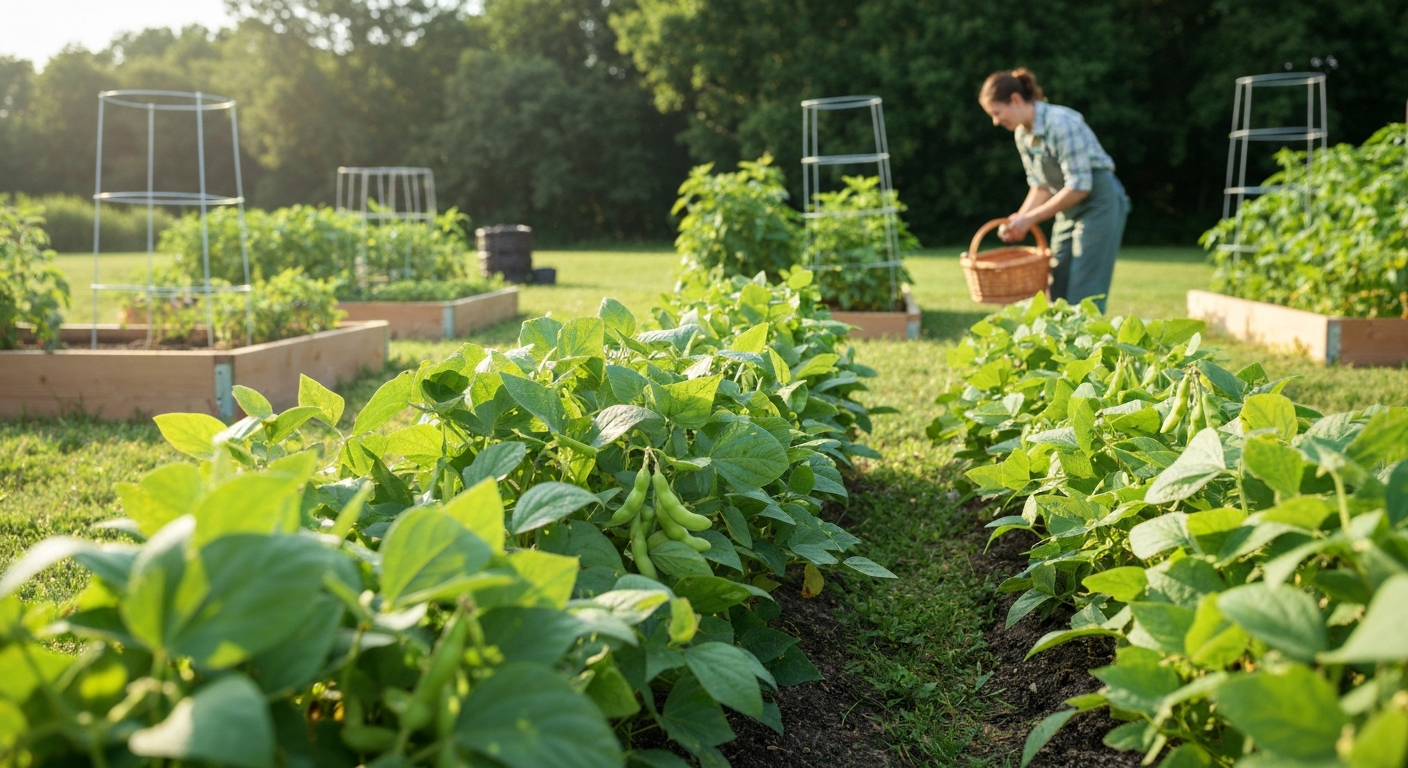
Yes, you can grow edamame in Wisconsin: cold-tolerant varieties, planting dates, care, harvest, storage, and tips.
Learn if you can grow edamame in Minnesota, choose short-season varieties, plant dates, care tips, and harvest timing fo