
You can grow Phoenix dactylifera date palms in Louisiana, particularly in the southern parishes, and they will often survive and look impressive. What you almost certainly cannot do, at least reliably, is harvest a consistent crop of ripe, high-quality edible dates from them. Louisiana's combination of high summer humidity, frequent rainfall, and occasional hard winter freezes in the north creates conditions that work against the fruit, even when the palm itself stays healthy. That said, with the right variety, site, and expectations, a date palm in Louisiana is a legitimate project. Here is what you actually need to know.
Can You Grow Dates in Louisiana? Home Gardeners' Guide
Marcus Holloway
17 Jul 2026
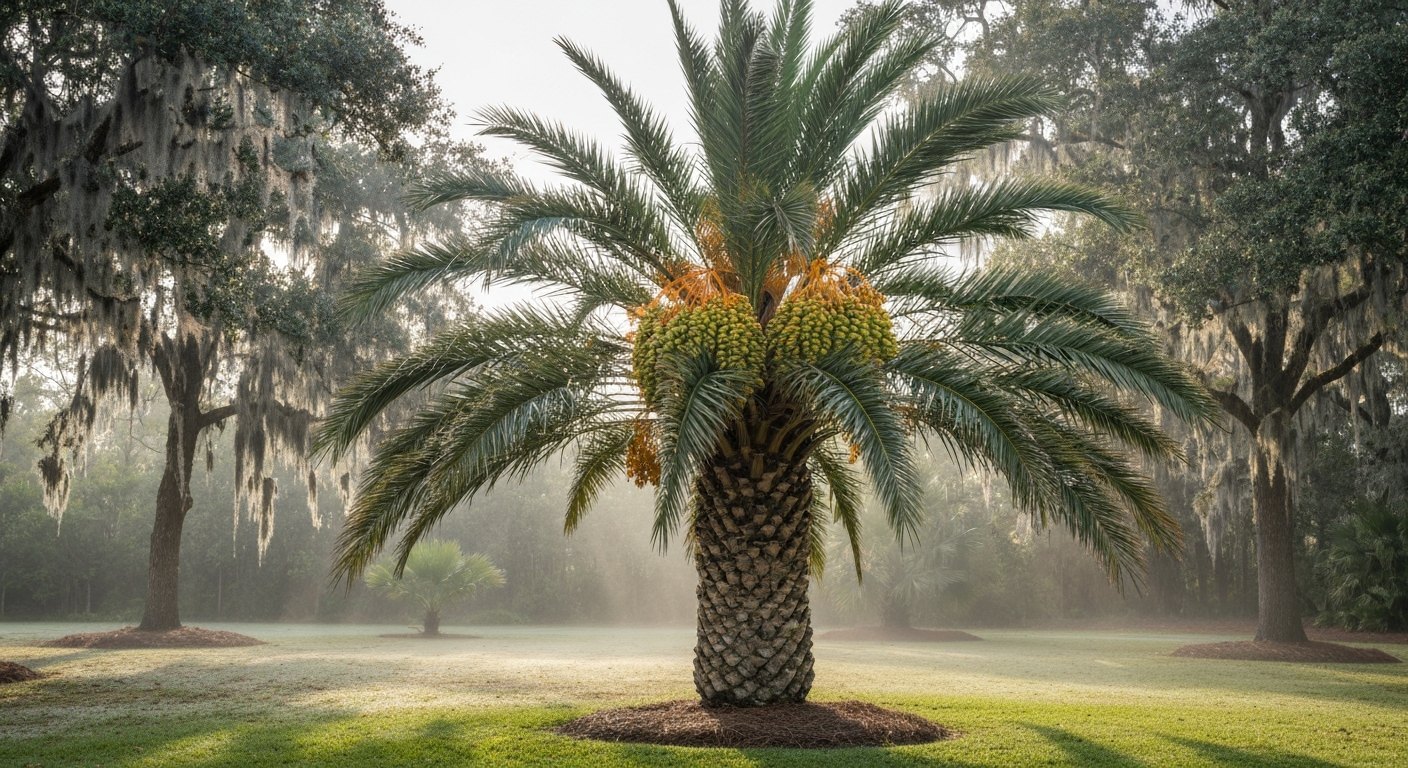
Louisiana's climate and USDA hardiness zones, what it means for date palms
Louisiana spans a wider climate range than most people expect. Louisiana Gridded Climate Data | LSU Office of State Climatology provides parish-covering PRISM and station datasets and tools to extract 1991–2020 normals (min/max/mean temperature, dewpoint/humidity, precipitation) at parish and point scales for Louisiana. According to the 2023 USDA Plant Hardiness Zone Map, northern interior parishes like Claiborne or Union sit in Zone 8a, where winter extreme minimums can drop to the mid-teens °F (around -9 to -10 °C). As you move south toward the coast, zones shift steadily warmer, coastal parishes near New Orleans and the Atchafalaya Basin reach Zone 9b and in the far southern tip Zone 10b, where extreme winter lows hover only around -1 to -2 °C. For a date palm's cold tolerance, that range matters a lot.
An established, acclimated adult Phoenix dactylifera can survive brief dips to around -5 °C (about 23 °F), but sustained cold, wet freezes push that threshold hard. Young transplants and seedlings are far more vulnerable. Northern Louisiana is genuinely risky territory for date palms without serious winter protection. South of Baton Rouge and into the greater New Orleans metro area, the cold risk drops considerably, but it never disappears entirely, hard freezes do hit south Louisiana, sometimes without much warning.
Beyond temperature, Louisiana's climate profile is defined by humidity and rainfall. Annual precipitation regularly tops 55 to 65 inches across most of the state, and summer relative humidity is persistently high. This is the opposite of what dates want. The Coachella Valley in California and the Sonoran Desert of Arizona, where virtually all U.S. commercial date production happens, receive just 3 to 6 inches of annual rain, with hot, bone-dry summers. That contrast alone tells you most of what you need to know about growing edible dates in Louisiana.
What date palms actually need to set and ripen fruit
Phoenix dactylifera has very specific fruiting requirements that go well beyond just surviving winter. FAO agronomy guidance is clear: the palm needs a long, intensely hot, and dry summer for fruit to develop and ripen properly. The key requirements are roughly 95 to 105+ days of summer temperatures above 95 °F (35 °C) during fruit development, very low relative humidity during pollination and fruit set, and essentially no rain from bloom through harvest. Louisiana delivers the heat part reasonably well in July and August. It fails badly on the dry, low-humidity part.
Pollination is a particular bottleneck. Date palms are dioecious, you need both a male and a female tree, and pollen viability is highly sensitive to moisture. Research shows that wet inflorescences at pollination time dramatically reduce fruit set. The paper 'Water spray as a potential thinning agent for date palm flowers (ScienceDirect)' documents that water sprays or rainfall applied around pollination can reduce fruit set by washing away or degrading pollen. Even if you hand-pollinate (which is standard practice and often necessary even in good climates), a rain event right after application can wash pollen away or degrade it before fertilization is complete. Pollen stored dry at cold temperatures retains viability for months, but you still have to apply it during a dry window, something Louisiana's spring weather makes unpredictable.
Beyond pollination, high ambient humidity throughout the summer growing season promotes fungal fruit rots. Alternaria, Aspergillus, and Fusarium species, documented in FAO date palm disease literature, thrive in warm, humid Gulf Coast conditions. Dates that do form often crack, mold, or drop before reaching the ripened Tamar (fully dry) stage. Most growers who have tried in south Louisiana report harvesting dates at the Khalal (crisp, colored) stage at best, and losing a significant percentage even then to rot.
Realistic outcomes: ornamental specimen, occasional fruit, or reliable production?
LSU AgCenter has documented that Phoenix dactylifera palms have been widely planted in south Louisiana since the early 1990s, and that mature female specimens in the region have produced large clusters of edible fruit under local conditions. So fruit production is not impossible. The honest framing, though, is that it is occasional and variable, not reliable. A good year with a dry spring and a stretch of low-humidity summer weather can produce a partial crop. A wet spring or a humid July wipes it out. Year-to-year consistency is simply not there the way it is in the Coachella Valley or even in the drier parts of Texas.
| Outcome | Most Likely Location | Key Limiting Factor |
|---|---|---|
| Healthy ornamental specimen | South Louisiana, Zones 9a-10b | Phytoplasma disease risk, occasional freeze |
| Occasional partial fruit crop | Greater New Orleans area, sheltered sites | Humidity, rain at pollination, fruit rots |
| Reliable annual edible harvest | Extremely unlikely anywhere in Louisiana | Persistent humidity, rainfall, fungal pressure |
| Reliable fruit in containers/greenhouse | Statewide with infrastructure investment | Space, cost, management intensity |
If your goal is a dramatic landscape palm that also gives you the occasional taste of homegrown dates in a good year, south Louisiana can deliver that. If your goal is a dependable annual date harvest, Louisiana is the wrong state for it, and I would rather tell you that upfront than have you invest years finding out.
Commercial feasibility: is growing dates for profit realistic in Louisiana?
The short answer is no, not as a primary crop. All meaningful U.S. commercial date production is concentrated in California's Coachella Valley and Imperial County, and in Yuma County, Arizona. Those regions have the arid heat accumulation, dry harvest windows, and established infrastructure (pollination services, packing facilities, cold storage) that make commercial production work. Louisiana has none of those conditions.
Beyond climate, there is a serious additional threat to any commercial Phoenix planting in Louisiana: lethal palm phytoplasma disease, also called Texas Phoenix Palm Decline or lethal bronzing. LSU AgCenter first reported detections in Louisiana in 2013, and the disease has caused rapid, fatal decline in susceptible Phoenix palms across the state. There is no cure once a palm is infected, and the pathogen spreads via sap-feeding insects. Planting a commercial-scale block of Phoenix palms in Louisiana without a clear phytoplasma management strategy would be a significant financial risk.
For small-scale or specialty growers curious about unusual crops, a trial planting of a few palms in south Louisiana is a reasonable experiment. Selling fruit commercially is a different question entirely. The per-tree yields in humid climates, the crop loss from rot and weather, and the disease pressure make it very hard to build a viable business around Louisiana-grown dates.
Variety selection: which date palms give you the best shot in Louisiana
Not all Phoenix species are equal in Louisiana conditions, and not all goals require Phoenix dactylifera. If you want a palm that looks like a date palm and gives you the best ornamental result with some fruiting upside, you have a few options worth knowing about.
Phoenix dactylifera (true edible date palm)
For edible date potential, Medjool and Deglet Noor are the two commercially proven cultivars in U.S. production. In Louisiana, Medjool is often cited by growers as more tolerant of humid conditions than Deglet Noor, though neither is truly adapted to Gulf Coast humidity. If you are going to try for edible fruit, Medjool gives you the best odds and the highest reward if you succeed. Select a female tree and have at least one male available for hand pollination. Sourcing from a reputable Florida or Texas nursery that has propagated from established Gulf-region stock is better than buying generic seedling-grown palms.
Phoenix sylvestris (silver date palm or wild date palm)
Phoenix sylvestris is more cold-tolerant than dactylifera and handles humidity considerably better. It is widely planted as an ornamental in the Gulf South. Its small fruits are edible but not the quality eating dates you are probably imagining, they are used for palm sugar production in South Asia. As a landscape palm that is genuinely suited to Louisiana's climate, sylvestris is a much easier grow.
Phoenix roebelenii (pygmy date palm)
A popular ornamental throughout Louisiana, the pygmy date palm is not cold-hardy below about 25 °F and produces only tiny, barely edible fruit. Its value is purely aesthetic. If you are in Zone 9 or warmer and want a low-maintenance landscape palm with a date-palm look, this works well.
| Species | Cold Hardiness | Humidity Tolerance | Fruit Quality | Best Use in Louisiana |
|---|---|---|---|---|
| Phoenix dactylifera (Medjool) | ~23°F (-5°C) | Poor | Excellent if ripened | Specimen planting with fruiting trials, south LA only |
| Phoenix dactylifera (Deglet Noor) | ~23°F (-5°C) | Poor | Excellent if ripened | Riskier than Medjool in humid conditions |
| Phoenix sylvestris | ~15°F (-9°C) | Moderate | Low (sugar palm) | Ornamental, more reliable statewide |
| Phoenix roebelenii | ~25°F (-4°C) | Good | Negligible | Ornamental only, Zone 9+ landscapes |
Better fruit crops for Louisiana growers
If your real goal is a productive, reliable fruit tree for a Louisiana garden or small farm, there are much better options than date palms. These crops are well-suited to Louisiana's heat, humidity, and occasional winter freezes, and some of them are genuinely productive with much less management.
- Figs (Ficus carica): Exceptional performers in Louisiana. Varieties like Celeste and Brown Turkey thrive across most of the state, tolerate the humidity, and produce reliable crops annually. LSU AgCenter has long recommended them for home orchards.
- Pomegranates (Punica granatum): Well-adapted to south and central Louisiana. They handle heat and moderate humidity well, and varieties like Wonderful or Salavatski produce reliably in Zones 8b-9b.
- Jujube (Ziziphus jujuba): Increasingly popular with Gulf South growers. Tolerates heat, humidity, poor soils, and occasional flooding better than most tree fruits. Varieties like Li and Lang produce sweet, apple-like fruits with minimal inputs.
- Satsuma mandarin (Citrus unshiu): The go-to backyard citrus for south Louisiana. Cold-hardier than most citrus, it produces excellent fruit in Zones 9 and warmer.
- Mayhaw (Crataegus opaca): A native Louisiana tree that produces tart fruit used for jellies and syrups. Thrives in the coastal plain and requires no special management.
- Pawpaw (Asimina triloba): Suited to central and north Louisiana, preferring part shade and moist soils — exactly what the region naturally offers.
Louisiana growers comparing their state's prospects to neighbors like Alabama or Georgia will find a similar story: the Gulf South climate is humid and warm enough to keep date palms alive but not ideal for fruiting. For a look at how prospects change farther north, see can you grow dates in Missouri for region-specific guidance. For a comparison of prospects slightly farther north, see can you grow dates in north carolina. The farther you move inland and toward a drier summer climate, the better the fruit odds get marginally, but none of the southeastern states approach the arid conditions of the commercial date-growing Southwest.
Step-by-step: site selection, soil prep, and planting date palms in Louisiana
If you have weighed the trade-offs and still want to plant a date palm in Louisiana, and there are good reasons to do it as a specimen or trial crop, here is how to give it the best possible chance.
Step 1: Choose the right site
Full sun is non-negotiable. Date palms want at least 8 to 10 hours of direct sun daily and perform best on south- or southwest-facing exposures. In Louisiana, seek out a microclimate that provides a little extra warmth and wind protection in winter, a south-facing wall, a courtyard, or a spot sheltered from north and northwest winds by a structure or dense windbreak. Avoid low-lying areas where cold air pools on clear nights; even a few extra degrees of warmth on a hard-freeze night can be the difference between a damaged and an undamaged palm.
Step 2: Prepare well-drained soil
Drainage is critical. Date palms absolutely cannot tolerate standing water, and many Louisiana soils, especially in the coastal alluvial plain, are heavy clays with poor natural drainage. Raise the planting area by 12 to 18 inches using a sandy loam mix or a blend of coarse sand, pine bark, and native soil. University extension guidance (UF/IFAS, UC ANR) consistently recommends well-drained soils for palms; in Louisiana this usually means you are creating that condition artificially rather than finding it naturally. Amend to a target pH of 6.5 to 7.5, and avoid high-phosphorus fertilizers at planting, excess phosphorus can interfere with micronutrient uptake in palms.
Step 3: Plant at the right time
Plant in late spring, after soil temperatures have warmed consistently above 65 °F and after the last credible freeze date for your parish. In south Louisiana, that is typically late March to mid-April. Avoid fall planting, a palm transplanted in fall has not had time to establish its root system before winter, and root-zone cold tolerance in newly transplanted palms is significantly lower than in established trees.
Step 4: Irrigate carefully
Newly planted palms need consistent moisture to establish, water deeply two to three times per week during the first summer. Once established (12 to 18 months), date palms are drought-tolerant and should be watered on a schedule that allows the root zone to partially dry between waterings. Louisiana's rainfall usually provides enough ambient moisture; the goal is supplemental drip irrigation during extended dry stretches, not regular overhead watering. Overhead irrigation mimics rain and increases foliar and fruit disease pressure, avoid it on date palms.
Step 5: Fertilize with potassium emphasis
Palms are potassium-hungry. Use a slow-release palm-specific fertilizer with an 8-2-12 or similar NPK ratio (with added magnesium and micronutrients), applied three to four times per year from spring through early fall. Potassium deficiency shows up as necrotic leaf tips and reduced vigor, it is one of the most common nutrition problems in Gulf South palms. Do not over-apply nitrogen; high nitrogen pushes lush vegetative growth that is more vulnerable to cold and disease.
Step 6: Hand-pollinate and manage for fruit
If you have a female Phoenix dactylifera and want to attempt fruit production, you need a male tree or access to stored pollen. Collect or purchase dried male pollen and apply it by brush or shaker directly into the female inflorescence during a dry spell, check a 5-day forecast and choose a window with no rain predicted and humidity below 60 percent if possible. Louisiana spring weather makes this easier said than done, but timing your hand pollination during dry stretches materially improves fruit set. Pollen stored at -20 °C retains viability for months, so sourcing quality pollen from a reliable supplier is a practical option.
Step 7: Protect from cold and disease
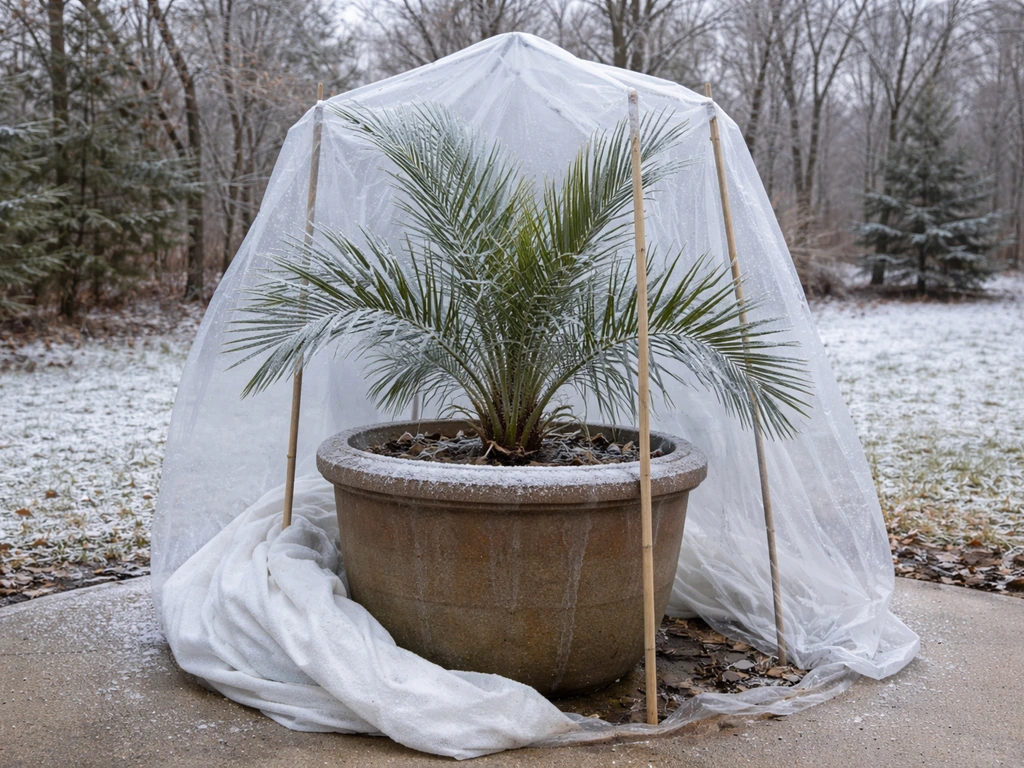
When temperatures threaten to drop below 28 °F, wrap the crown (the growing bud) of smaller palms with frost cloth, this is the most cold-sensitive part of the tree. For larger specimens, a heat lamp or incandescent string lights under a burlap wrap around the crown can provide meaningful protection on the coldest nights. Monitor for early signs of lethal palm phytoplasma: rapid browning and collapse of new fronds, spear leaf death, and fruit drop. There is no treatment, but removing infected trees promptly and managing the insect vectors (planthoppers) helps protect neighboring plantings. Maintain good tool sanitation to reduce fungal disease spread.
Timeline: how long before a date palm fruits in Louisiana?
Seed-grown Phoenix dactylifera palms take 4 to 8 years to reach reproductive maturity, and you cannot know the sex of a seedling-grown palm until it blooms, which means potentially years of waiting before discovering you have all males or all females. Offset-propagated palms (suckers from a known female) will fruit sooner, sometimes within 3 to 5 years of transplanting. Even then, meaningful fruit clusters typically develop from palms that have had several years to fully establish in their site. Budget for a 5 to 8 year investment before expecting any real fruit production from a transplanted sucker, and longer from seed.
The bottom line for Louisiana growers: date palms are a fascinating long-term project, and south Louisiana's warmest microclimates give you a realistic shot at an ornamental specimen and occasional fruit crops. For reliable annual dates, the Gulf Coast climate is simply not the right match. For similar guidance and regional differences, see our article on can you grow dates in South Carolina. Neighbors in Alabama and Georgia face a nearly identical set of trade-offs. If you wonder 'can you grow dates in Alabama', the short answer is similar, Alabama's humid climate makes reliable edible date production unlikely. If you’re asking “can you grow dates in Virginia,” the situation is comparable, Virginia’s cooler, more humid climate generally rules out reliable edible-date production, though isolated specimen palms may survive in warm, sheltered microclimates. For a state-by-state comparison, see Can you grow dates in Georgia. If you want a productive fruit tree that thrives in Louisiana's heat and humidity, figs, pomegranates, and jujube will reward you far more consistently for the effort you put in.
FAQ
Can you grow edible date palms (Phoenix dactylifera) in Louisiana?
Short answer: Yes as specimen/ornamental trees in the warmest parts of the state, but reliable commercial fruit production is unlikely statewide. In southern coastal parishes and protected microclimates mature date palms can survive and sometimes set fruit; however, Louisiana’s humid climate, variable winter lows outside the warmest zones, and rain during pollination make consistent, high‑quality date crops difficult compared with arid production regions.
Which parts of Louisiana are most suitable for attempting to grow date palms?
The best prospects are the far southern parishes that fall into USDA Zones roughly 9b–10b and very protected sites (urban heat islands, south‑facing walls, coastal barrier islands with maritime buffering). Northern and interior parishes in Zones ~8a–9a experience winter lows and seasonal patterns that make reliable fruiting and seedling survival much less likely.
What climate and seasonal conditions do true date palms need to reliably set and ripen fruit?
They need long, hot, dry summers with high heat accumulation to ripen sugars, mild and mostly frost‑free winters, and dry weather at and after pollination. High humidity and rainfall around flowering reduce pollen viability/transfer and raise fungal/insect pressure that harms fruit set and quality.
Will a single palm in my yard produce edible dates, and how long until fruit appears?
You must have a mature female tree (typically 4–10+ years to reach flowering age depending on variety and growing conditions) and a source of compatible male pollen. A single isolated female will not set viable fruit without nearby male pollen or hand pollination. Expect multiple years of growth and variable yields; in Louisiana yields are often small and irregular.
Do I need both male and female trees? Can I hand‑pollinate?
Yes—date palms are dioecious (separate male and female trees). For fruit, either plant a male nearby or collect/store pollen and hand‑pollinate female inflorescences. Hand pollination is commonly used in suboptimal climates to time pollen application for dry conditions and improve set.
Which date varieties are best if attempting fruit in Louisiana?
Commercial cultivars like 'Deglet Noor' and 'Medjool' are the standard for fruit quality but are adapted to arid, high‑heat production regions. If attempting in Louisiana, choose vigorous, late‑flowering/heat‑requiring cultivars and plan to trial a few. Also consider planting hardy, ornamental Phoenix species (P. sylvestris, P. canariensis, P. roebelenii) for landscape interest even if they produce small, lower‑quality fruit.
Next Articles
Can You Grow Dates in Alabama Yes How to Try
Yes, you can grow date palms in Alabama but fruit ripening is hard. Get site, variety, planting and winter protection ti
Can You Grow Dates in South Carolina? Cold, Varieties, Care
Learn if you can grow date palms in South Carolina, best varieties, planting, pollination, and winter protection tips.
Can You Grow Dates in Missouri? Cold-Hardy Options and How-To
Learn if you can grow date palms in Missouri, which types may survive, and step-by-step overwintering and care tips.