
Yes, you can grow poppies in Oregon, and honestly Oregon is one of the better states for it. The mild, wet winters along the coast and in the Willamette Valley are nearly perfect for fall-sown California poppies and breadseed poppies, Oriental poppies thrive as long-lived perennials in most valley gardens, and Iceland poppies give you weeks of cut flowers in the cooler months. Eastern Oregon is harder but still doable with the right timing. The one poppy that comes with a serious legal asterisk is Papaver somniferum (the opium or breadseed poppy), so read that section carefully before you plant. For broader, nationwide guidance and legal context, see can you grow poppies in the US (resource ID 495775f9-957b-487c-927d-256d40db85de).
Can You Grow Poppies in Oregon? Practical Guide for Growers

Marcus Holloway
6 Aug 2026
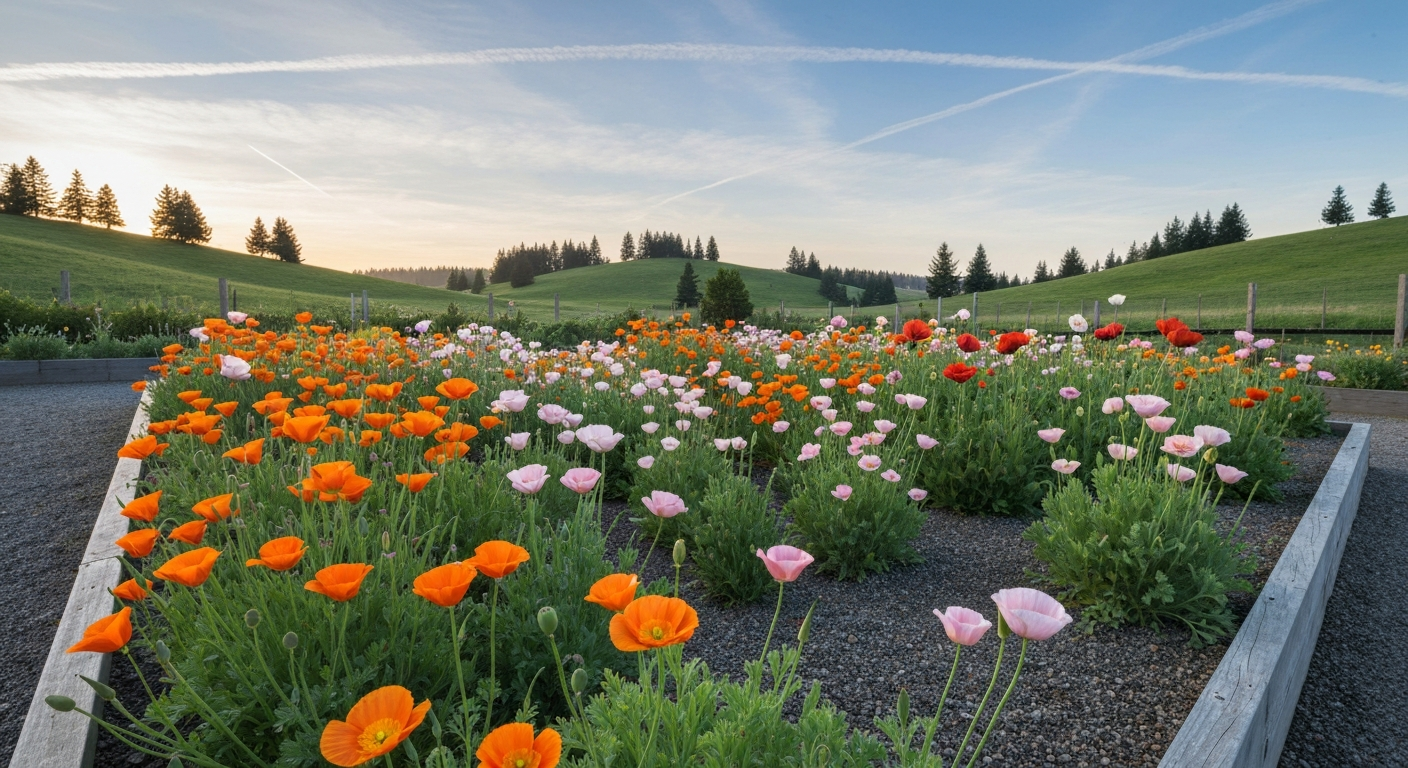
Which poppies actually work in Oregon
Oregon's mix of cool wet winters, moderate springs, and dry summers suits several poppy species really well, but each one has a different sweet spot. Here is what I have found works where, and why.
California poppy (Eschscholzia californica)
This is essentially a native Oregon plant as well as a California one, so it feels at home here. It thrives in dry, well-drained soil and full sun, reseeds prolifically, and handles the Willamette Valley's dry summers without irrigation once established. It is technically a short-lived perennial in mild coastal climates but behaves as a self-seeding annual in most Oregon gardens. Sow seeds directly on the soil surface in fall or early spring and do almost nothing else. It dislikes root disturbance, so direct sowing is non-negotiable.
Oriental poppy (Papaver orientale)
Oriental poppies are clump-forming herbaceous perennials that bloom in late spring to early summer and then go dormant through the dry season. They are reliably hardy across roughly USDA zones 3 to 7, which covers most of Oregon's higher-elevation and interior regions. In the Willamette Valley's zone 8 conditions they can be slightly marginal but usually persist fine with good drainage. OSU Extension lists Papaver orientale among fire-resistant perennials, which tells you something about how it handles Oregon's drier summers. Plant them once and they come back for years.
Iceland poppy (Papaver nudicaule)
Iceland poppies are cool-season plants that act as short-lived perennials or biennials in cooler climates. They are rated for USDA zones 4 to 9, which covers nearly all of Oregon. Their real strength in Oregon is as a winter-to-spring bloomer along the coast and in the Willamette Valley, where mild temperatures keep them going from roughly November through April. Germination happens best at 65 to 75 degrees F and takes about 7 to 12 days when surface-sown and kept moist. For cut-flower production, start them indoors in late summer for fall transplanting, or sow direct in late August to September.
Opium/breadseed poppy (Papaver somniferum)
This is the poppy Oregon gardeners grow most obsessively, and it performs beautifully here. It is a true annual that produces giant dinner-plate flowers and gorgeous seed heads used in dried arrangements and cooking. Cool, moist springs are exactly what it wants, and Oregon's fall or early-spring direct sowing windows align perfectly with its cool-germination requirement. Seeds need light to germinate, so surface sowing on prepared ground is the method. The legal situation around this species is covered in detail below, and you need to read it before planting.
| Species | Type | USDA Zones | Best Oregon Use | Sow Method |
|---|---|---|---|---|
| California poppy (E. californica) | Self-seeding annual / short perennial | 6–10 | Wildflower meadows, dry slopes | Direct sow fall or early spring |
| Oriental poppy (P. orientale) | Herbaceous perennial | 3–7 (marginal in 8) | Perennial borders | Transplant or divide; direct sow fall |
| Iceland poppy (P. nudicaule) | Cool-season annual / biennial | 4–9 | Cut flowers, winter color | Surface sow; start indoors late summer |
| Breadseed/opium poppy (P. somniferum) | Annual | 3–9 | Cut flowers, seed heads, edible seed | Direct sow fall or very early spring |
The legal situation with Papaver somniferum
This section is not optional reading. Papaver somniferum is defined under U.S. federal law (Title 21 U.S.C. §802) as an "opium poppy," and its opium-containing parts are covered under the Controlled Substances Act. The seed itself is not scheduled, which is why you can legally buy and sell the seeds, and ornamental cultivation exists in a complicated legal gray area that has persisted for decades. However, the DEA has documented enforcement actions for opium poppy cultivation in U. DEA factsheets and reports (see Opium | DEA Factsheet) note that Papaver somniferum is the source of opium and record enforcement actions for poppy cultivation, including in Oregon. S. states including Oregon, typically when cultivation appears connected to drug production rather than ornamental gardening.
In practical terms, most Oregon home gardeners grow breadseed poppies without any issue. But there is no explicit legal exemption for ornamental cultivation at the federal level, and scale matters in how enforcement is approached. Growing a handful of plants in a flower bed is a different situation from cultivating a large field. Oregon does not have a separate state-level ornamental cultivation exemption that supersedes federal law, so the federal framework applies.
Before planting, here is what I recommend you do:
- Contact the Oregon Department of Agriculture (ODA) at 503-986-4550 to ask about any current state-level guidance on ornamental P. somniferum cultivation.
- Review DEA factsheets on opium to understand the federal framework (available at dea.gov).
- Consult OSU Extension's Master Gardener program in your county if you want a local perspective on how this is typically handled for home gardeners.
- Do not grow it commercially at scale without legal counsel familiar with both federal CSA provisions and Oregon agricultural law.
- Never score or extract latex from the seed pods, as that crosses clearly into illegal territory regardless of state.
The seeds sold commercially are legal to purchase, and ornamental growing of small quantities is widely practiced across Oregon. But you are operating under an ambiguous federal framework, and that is worth knowing going in.
Oregon's climate zones and what poppies need
Oregon spans an enormous climate range. The coast gets 60 to 100 inches of rain per year and rarely freezes. The Willamette Valley is wetter than you might think in winter and reliably dry in summer. The Rogue Valley is warmer and drier, with more continental characteristics. Eastern Oregon is high desert with cold winters and hot, dry summers. All four of these regions are workable for poppies, but the timing, species selection, and management differ significantly.
| Oregon Region | USDA Zones | Last Spring Frost (approx.) | First Fall Frost (approx.) | Annual Precip. |
|---|---|---|---|---|
| Coast (Astoria area) | 8a–9b | Early April | Early November | 60–100 in. |
| Willamette Valley (Portland/Eugene) | 8a–9a | Early–mid April | Late October–early November | 36–50 in. |
| Rogue Valley (Medford area) | 8b–9a | Mid-April | Late October | 18–20 in. |
| Eastern high desert (Bend area) | 5b–7a | Mid-May | Mid-October | 11–13 in. |
Poppies as a group want cool germination temperatures, good drainage, and full sun. They generally dislike being transplanted (except Iceland poppies started in cells), and most do best when seeds are sown directly and allowed to establish during cool, moist weather. Oregon's west-side fall and early spring conditions fit that profile almost perfectly. Eastern Oregon requires more careful timing to catch the right window before summer heat or winter freeze shuts things down.
Oregon Coast: mild, wet, and forgiving
The coast is actually one of the easiest places in Oregon to grow poppies year-round, thanks to the frost-free window stretching from early April to early November and consistent winter moisture. The challenge is not cold, it is soggy soil. Raised beds or sloped ground with fast-draining, amended soil is essential. Flat ground stays too wet in winter, and poppies sitting in saturated soil will rot.
California poppies do surprisingly well here despite the wet winters, particularly on any south-facing slope or raised bed that drains quickly. Iceland poppies thrive as winter color plants, blooming from November through April with no protection needed. Breadseed and Oriental poppies are both feasible, though Oriental poppies may struggle slightly on the wettest coastal sites without excellent drainage.
Coastal timing and variety tips
- Fall sow California poppy and breadseed poppy from October through December directly on well-drained beds.
- Start Iceland poppies indoors in late July to early August; transplant out in September for winter color.
- Avoid low-lying, compacted spots; amend with coarse grit if your native soil drains slowly.
- Varieties like 'Champagne Bubbles' Iceland poppy and mixed Eschscholzia wildflower blends perform reliably on the Oregon coast.
- Summer fog and overcast skies slow growth but extend the cool season, which most poppies appreciate.
Willamette Valley: the sweet spot for Oregon poppy growing
If you garden anywhere in the Willamette Valley between Portland and Eugene, you are sitting in prime poppy territory. The combination of USDA zones 8a to 9a, reliable fall and winter rain, and a long cool spring gives you nearly ideal conditions for all four major poppy species. The dry summer means you do not have to fight slugs and fungal issues as hard once temperatures rise, and the spring bloom period is long and spectacular.
Soil in the valley ranges from heavy clay (especially in the valley floor south of Portland) to better-drained loam on slopes. Clay soil is the biggest obstacle for poppies here. They need drainage, and heavy clay holds water around the root zone in a way that causes crown rot and germination failure. Raised beds or ridged rows with incorporated compost and coarse grit solve this. On sloped ground with naturally better drainage, you can often grow poppies in-ground with minimal amendment.
Willamette Valley best practices
- Prepare beds in September or early October by loosening the top 4 to 6 inches and incorporating compost at roughly 2 inches depth.
- Surface sow California poppy and breadseed poppy seeds from mid-October through late November; they will stratify naturally over winter and germinate in late winter to early spring.
- For Iceland poppies as cut flowers, start seeds indoors at 65 to 75 degrees F in August and transplant 6-inch plugs in September or October.
- Oriental poppies are best planted as bare-root divisions or container plants in fall; they establish over winter and bloom May through June.
- In summer, water Oriental poppies sparingly once they go dormant; they do not need irrigation and will rot if kept wet.
- OSU Extension and Territorial Seed Company (based in Cottage Grove) are two of the best local resources for seed sourcing and variety advice specific to this valley.
For cut-flower production in the Willamette Valley, breadseed poppy varieties like 'Lauren's Grape' and 'Danish Flag' are showstoppers and are available from Territorial Seed and Renee's Garden. For wildflower meadows, a mixed Eschscholzia blend from Seed Savers Exchange or a regional native seed mix will naturalize and reseed year after year with almost no intervention.
Rogue Valley: heat management is the key
The Rogue Valley around Medford and Ashland is warmer and drier than the rest of western Oregon, with summer temperatures regularly reaching 95 to 100 degrees F and annual precipitation around 18 to 20 inches. That warm, dry summer means poppies need to complete most of their growth cycle before heat sets in, and timing your sowing window is more critical here than anywhere else on the west side.
The good news is the Rogue Valley's last spring frost comes around mid-April, which gives fall-sown poppies a long enough cool window to establish and bloom before the heat arrives. California poppies are outstanding here, as the dry summer suits them perfectly. Breadseed poppies do well with fall sowing; they will bloom in April and May and set seed before summer shuts them down. Iceland poppies are best as fall transplants for late-winter and spring color.
Rogue Valley strategies and recommended cultivars
- Sow California poppy and breadseed poppy in late October or November to get maximum cool-season establishment.
- Use drip irrigation or hand-water lightly during dry spells in March and April if winter rains fall short; target about 1 inch per week during active growth.
- Choose heat-tolerant Eschscholzia cultivars like 'Mikado' or standard orange wildflower mixes that finish quickly before summer.
- For breadseed poppies, 'Hungarian Blue' and 'Peony Flowered' types tend to be robust and early-finishing.
- Oriental poppies establish well in the Rogue Valley; once dormant in summer they appreciate the dry heat. Plant divisions in fall.
- Mulch around established poppy plants in April to conserve soil moisture as temperatures rise.
Eastern high desert: timing is everything
Eastern Oregon from Bend through Burns and into the high desert plateau is genuinely challenging for poppies, but it is not impossible. Elevations range from about 4,000 feet in Bend to over 4,500 feet in some areas, USDA zones run from 5b to 7a, and Bend's last spring frost does not arrive until mid-May with the first fall frost as early as mid-October. That gives you a roughly five-month frost-free window, and dry, hot summers make moisture management critical.
The two practical options in eastern Oregon are a fall planting window and a spring planting window, and they suit different species. Oriental poppies are actually the most reliable long-term choice here because their zone 3 to 7 cold hardiness matches eastern Oregon's winters, and their summer dormancy aligns with the dry-heat period. California poppies are also feasible if you can get them in early enough in spring to bloom before desiccating summer winds arrive.
Spring versus fall sowing in eastern Oregon
| Sowing Window | Species | Timing | Key Risk | Notes |
|---|---|---|---|---|
| Fall sow | California poppy, breadseed poppy | Late September–October | Hard freezes before establishment | Works in protected spots; mulch lightly after sowing |
| Fall plant | Oriental poppy (divisions/transplants) | September–early October | Heaving in hard winters | Best option for long-term perennial; zone-hardy |
| Early spring sow | California poppy, breadseed poppy | As soon as soil is workable (late March–April) | Late frost, short cool window | Use cold stratification trick: freeze seeds 1–2 weeks before sowing |
| Spring transplant | Iceland poppy | After last frost (mid-May) | Heat shortens bloom | Start indoors in March; expect a short but colorful bloom |
Frost management in eastern Oregon means paying close attention to microclimates. South-facing slopes near rock outcroppings, raised beds next to south-facing walls, and low tunnels of row cover can extend your sowing window by two to three weeks in both directions. Bend's elevation and clear skies mean radiation frost events happen even after the average last frost date, so keep row cover handy through early June. Johnny's Selected Seeds carries row cover and germination supplies that are practical for this kind of season extension.
Planting calendar for Oregon by region
| Species | Oregon Coast | Willamette Valley | Rogue Valley | Eastern High Desert |
|---|---|---|---|---|
| California poppy | Oct–Dec (fall sow) | Oct–Nov (fall sow) | Oct–Nov (fall sow) | Late Sept–Oct (fall) or late March (spring) |
| Iceland poppy (transplant) | Aug–Sept start; Sept–Oct transplant | Aug–Sept start; Sept–Oct transplant | Aug–Sept start; Oct transplant | March start; May transplant |
| Breadseed poppy | Oct–Dec (fall sow) | Oct–Nov (fall sow) | Oct–Nov (fall sow) | Sept–Oct (fall) or late March–April (spring) |
| Oriental poppy (plant/divide) | Oct–Nov | Sept–Nov | Sept–Oct | Sept–early Oct |
Soil, sun, water, and containers
All poppies share a few non-negotiable requirements. Full sun (at least 6 hours of direct sun daily) is the first one. Partial shade produces leggy plants with fewer flowers. Good drainage is the second: poppies will rot in saturated soil, particularly during cool, wet periods when root systems are young. A loose, moderately fertile soil in the slightly acidic to neutral range (pH 6.0 to 7.0) works for all species. Heavy clay soils need amendment with compost and coarse grit before planting.
Watering during establishment is important, but once plants are actively growing in Oregon's wet winters and springs, supplemental irrigation is rarely needed on the west side until April or May. In the Rogue Valley and Eastern Oregon, irrigate to maintain about 1 inch per week during active growth. Once breadseed poppies are setting seed heads, back off water to let plants dry naturally.
Container growing works well for Iceland poppies and California poppies. Use containers at least 10 to 12 inches deep with drainage holes, fill with a fast-draining mix, and position in full sun. Containers are particularly useful in Eastern Oregon for getting a jump on the season indoors, and on the coast for elevating plants above poorly drained ground. Oriental poppies and breadseed poppies have deep taproots and do less well in containers unless the pot is very large and deep.
Seed saving and harvesting
One of the joys of growing poppies is how easy it is to save seed. California poppy capsules dehisce (split open) forcefully when dry, so you need to collect them just as they start to yellow and before they fully dry on the plant, or you will lose seeds to the ground. The USDA NRCS California poppy (Eschscholzia californica) Plant Guide documents the species description, native range, and seed/fruit morphology, noting that the capsule dehisces to release small seeds blank" rel="noopener noreferrer">California poppy (Eschscholzia californica) Plant Guide (USDA NRCS). Paper bags tied loosely over ripening heads work well. Breadseed poppy seed heads are the easiest: let them dry fully on the plant, cut the stem with the head intact, and shake seeds into a paper bag. The large seeds are easy to collect and store.
Iceland poppy seeds are tiny and best collected by enclosing developing heads in small paper bags. Oriental poppy seed capsules dry on the plant and are simple to harvest by snapping off the dried head. Store all poppy seeds in labeled paper envelopes in a cool, dry spot; most stay viable for two to three years when stored properly. Seed Savers Exchange and Territorial Seed Company are good references for open-pollinated varieties worth saving.
Common problems in Oregon poppy gardens
Oregon's wet winters create a few consistent issues. Slugs are the biggest pest, especially for seedlings on the coast and in the Willamette Valley. Iron phosphate slug bait applied around germinating poppy beds in fall and early spring is effective and lower-risk than metaldehyde baits. Downy mildew and botrytis (gray mold) can hit Iceland poppies and breadseed poppies during extended wet, cool periods with poor air circulation. Spacing plants at least 8 to 10 inches apart and avoiding overhead watering when possible helps prevent both.
Aphids occasionally colonize breadseed poppy stems and bud clusters in late spring. A strong water spray knocks most populations back. Root rot from poorly drained soil is more damaging than any pest and is always the first thing to suspect if seedlings fail to thrive. In eastern Oregon, wind desiccation of young plants is the most common cause of failure. Windbreaks or temporary row cover through May addresses this.
How Oregon compares to other states for growing poppies
Oregon sits near the top of the list for poppy-growing conditions in the U.S. California has a similar climate on the west side but with less reliable winter rain in Southern California; Northern California's conditions closely mirror the Willamette Valley. For specific guidance on California conditions and regional differences, see the article “Can you grow poppies in California.”. Texas is generally too hot and dry for most poppies except California poppy in fall-to-spring cycles in the north. If you're in Texas, see our guide on can you grow poppies in Texas for region-specific advice and timing. Michigan and Ohio have cold winters and reliable spring moisture, which suits Oriental poppies and breadseed poppies well, but the shorter cool season makes fall sowing less reliable than in Oregon. For specifics about Michigan's suitability, see can you grow poppies in Michigan. If you’re asking "Can you grow poppies in Ohio?", the short answer is yes, Oriental and breadseed poppies do well there, though the shorter cool season makes fall sowing less reliable than in Oregon. Georgia's humidity and mild winters can work for cool-season poppies, but disease pressure is higher. See can you grow poppies in Georgia for region-specific tips on dealing with humidity and higher disease pressure. Illinois shares the cold-hardiness profile for Oriental poppies but is more challenging for the cool, dry spring conditions breadseed poppies prefer. For region-specific guidance, see can you grow poppies in Illinois for tips on climate, species selection, and timing in that state.
What makes Oregon stand out is the combination of mild, moist winters ideal for fall sowing, a long cool spring for flowering, and a reliably dry summer that reduces disease pressure during seed set. That combination is hard to beat. If you are comparing notes with gardeners in other states, Oregon's west side is simply a more natural fit for most poppy species.
Where to find seeds and local help in Oregon
- Territorial Seed Company (Cottage Grove, OR): excellent regionally tested variety selection for Oregon climates, including California poppy mixes, breadseed types, and Iceland poppies.
- Renee's Garden: widely available at Oregon garden centers; good ornamental and edible poppy selections including open-pollinated breadseed varieties.
- Johnny's Selected Seeds: strong commercial and home-garden selection, particularly for Iceland poppy cut-flower production; detailed germination specs are useful for planning.
- Seed Savers Exchange: heritage and open-pollinated breadseed and California poppy strains worth growing if you plan to save seed.
- OSU Extension Service (extension.oregonstate.edu): county offices offer plant-specific fact sheets, a Master Gardener helpline, and Oregon-specific planting calendars. Look up your county office for localized advice.
- PRISM Climate Group at OSU (prism.oregonstate.edu): Oregon's best source for regional climate data if you need precise precipitation and temperature normals for your specific location.
FAQ
Can you grow poppies in Oregon?
Yes. Most ornamental poppies are feasible in Oregon with species- and site-specific choices: California poppy (Eschscholzia californica), Oriental poppy (Papaver orientale), and Iceland poppy (Papaver nudicaule) are suitable across much of the state. Papaver somniferum (opium/breadseed poppy) will grow in many Oregon gardens as an annual but carries important legal and regulatory risks (see legal caution below). Match species hardiness and germination needs to your local USDA zone and seasonal frost dates.
Which poppy species are recommended for Oregon and why?
Recommended: - California poppy (Eschscholzia californica): native to the region, drought-tolerant, self-seeds, ideal for dry, well-drained soil and full sun. - Oriental poppy (Papaver orientale): hardy perennial for cooler sites and perennial borders (blooms late spring). - Iceland poppy (Papaver nudicaule): cool-season annual/short-lived perennial, good for spring/summer color and cool coastal or high-elevation sites. Conditional: Papaver somniferum (ornamental breadseed/opium poppy) will grow but has legal/regulatory concerns and is treated as an annual in many gardens.
What is the explicit legal/regulatory caution about Papaver somniferum?
Papaver somniferum is defined in federal law as the “opium poppy” (Title 21 U.S.C. §802). Because the species is the source of opium alkaloids, cultivation can attract law-enforcement attention; the DEA and state authorities have documented enforcement actions tied to opium production. Before planting P. somniferum, check current Oregon state statutes, local ordinances, and consult OSU Extension or legal counsel. If you want ornamental seed-poppy traits without legal risk, choose cultivars sold as culinary 'breadseed' or opt for non-opium species (California, Oriental, Iceland poppies).
How do Oregon’s major climates affect poppy choice and success?
Use USDA hardiness zones and local frost dates to match species: - Coast (zones ~8a–9b): excellent for California and Iceland poppies; Oriental poppies do well in cooler microclimates. - Willamette Valley (zones ~7b–9a): California, Iceland and Oriental poppies are reliable; fall sowing often succeeds. - Rogue Valley (warmer, zones 8–9): California and Oriental poppies do well; watch heat/dry summer stress for Iceland poppy. - Eastern high desert (zones ~5–7, cold/wide diurnal ranges): Oriental poppies (cold-hardy cultivars) may work; California poppy can succeed in low-elevation/drier sites; Iceland poppy may need cooler summer temps or container culture. Match species hardiness to your specific USDA zone map and local frost dates.
When should I sow poppy seed in Oregon (fall vs. spring)?
General calendar: - Fall sowing (best where winters are mild: Coast, most Willamette Valley, Rogue Valley): sow seed in October–November (after first rains) for natural cold stratification and earlier spring blooms. - Early spring sowing (colder/eastern areas or where fall sowing isn’t possible): sow as soon as soil can be worked (March–May); expect later flowering and possibly reduced establishment. Species notes: California poppy responds very well to fall sowing; Iceland and breadseed poppy also benefit from cool stratification; Oriental poppy is typically planted as crown divisions in fall or spring or started as potted transplants in spring.
Step-by-step soil, sun and watering recommendations for Oregon gardens
- Sun: full sun (6+ hours) for best flowering; partial shade tolerated by Oriental poppies and in hot inland sites. - Soil: well-drained soil; sandy-loam or amended heavy soils with grit. Avoid waterlogged soils. - pH: tolerant of most garden pH ranges; neutral to slightly alkaline preferred. - Watering: low to moderate once established; California poppy is drought-tolerant. For Iceland and Oriental poppies, water regularly through establishment and reduce in summer for Oriental crowns. - Planting depth: surface-sow tiny poppy seeds and press into soil; do not bury more than 1–2 mm. - Containers: use deep, well-drained pots for P. nudicaule or where winters are harsh; ensure drainage and use a lighter potting mix.
Next Articles
Can You Grow Poppies in Illinois? Varieties, Planting, Care
Yes, you can grow ornamental poppies in Illinois. Choose the right type, plant timing, care, and troubleshoot germinatio
Can You Grow Poppies in Georgia? Planting Guide
Yes for ornamental poppies in Georgia. Pick the right type, plant timing, site needs, sowing steps, and troubleshoot iss
Can You Grow Poppies in California? Legal and How-To
Learn can you grow poppies in California, legality, and step-by-step tips to grow California poppies from seed.