
Yes, you can absolutely grow hops in Michigan. The state's cold winters, long summer days, and deep soils in many regions are genuinely well-suited to hops, and Michigan has a growing commercial hop industry to prove it. You'll deal with more disease pressure than growers in the dry Pacific Northwest, but with the right variety selection, a well-drained site, and a proactive spray program, a Michigan hop yard can produce excellent cones for home brewing or small-scale sale.
Can You Grow Hops in Michigan? Feasibility, Varieties & How-To
Marcus Holloway
5 Aug 2026
Michigan's climate and USDA zones for growing hops
Michigan spans USDA hardiness zones 4a through 6b on the 2023 Plant Hardiness Zone Map. That's a wide range, running from the cold Upper Peninsula (zone 4a, with average annual extreme lows around -30°F) down to the comparatively mild southwestern Lower Peninsula near Lake Michigan (zone 6b, lows around -5°F). Hops are perennial plants that thrive in zones 4 through 8, so virtually every part of Michigan falls within their comfort zone for winter survival.
What matters beyond winter hardiness is the summer daylength and heat accumulation needed for hops to flower and set cones. Michigan sits between roughly 42° and 47° north latitude, which gives it long summer days comparable to hop-growing regions in Germany and the Czech Republic. That daylength is key: hops initiate flowering in response to shortening days in late summer, and Michigan's latitude means that transition happens at the right time of year for cone development before the first fall frost.
Which Michigan areas are best suited, and microclimates to watch
The northwestern Lower Peninsula, especially Leelanau, Benzie, and Grand Traverse counties, is Michigan's most established hop-growing region. The Lake Michigan moderating effect extends the frost-free season and reduces temperature extremes. MSU has run variety trials at the Northwest Michigan Horticultural Research Station in this area, making it a benchmark for what works in the state. The Thumb region and southwestern Lower Peninsula also perform well. The Upper Peninsula can grow hops, varieties like Cascade and Centennial handle zone 4 winters, but the shorter frost-free window (sometimes under 130 days) means you need earlier-maturing cultivars and possibly raised beds to warm the soil faster in spring.
Urban heat islands in Detroit, Grand Rapids, and Lansing can push local zone conditions warmer by half a zone or more. South-facing slopes near water bodies benefit from cold air drainage and earlier soil warming. Low-lying frost pockets in inland areas are the spots to avoid: late spring frosts in May can burn emerging bines back to the crown, which stresses young plants and sets back first-year establishment significantly.
Best hop varieties for Michigan gardens and farms
Choosing the right variety matters more in Michigan than almost any other decision you'll make. Michigan's humid summers create serious pressure from downy mildew (Pseudoperonospora humuli) and powdery mildew (Podosphaera macularis), so you want varieties with documented disease tolerance. Here are the cultivars that consistently perform well in Michigan trials and in growers' yards.
| Variety | Type | Alpha Acids | Cold Hardiness | Disease Tolerance | Notes for Michigan |
|---|---|---|---|---|---|
| Cascade | Aroma/dual-use | 4–7% | Zone 4 | Moderate | The most widely grown in Michigan; handles wet springs reasonably well; floral/citrus aroma |
| Centennial | Dual-use | 9–12% | Zone 4 | Moderate | Higher alpha, versatile; good vigor in Michigan soils |
| Chinook | Bittering/dual-use | 12–14% | Zone 4–5 | Moderate–good | Strong grower; slightly better downy mildew tolerance than Cascade |
| Nugget | Bittering | 12–14% | Zone 4–5 | Good | Reliable yielder; more forgiving of wet conditions |
| Hallertau Mittelfrueh | Aroma | 3–5% | Zone 5 | Poor–moderate | Traditional lager hop; needs attentive disease management in humid Michigan summers |
| Columbus (CTZ) | Bittering | 14–16% | Zone 5 | Moderate | High alpha; vigorous; performs well in zone 5–6 areas |
| Glacier | Aroma | 5–9% | Zone 4–5 | Moderate–good | Bred partly for humid climates; worth trialing in the LP |
| Newport | Bittering | 13–17% | Zone 4–5 | Good | Strong disease package; good choice for growers wanting low-input management |
For most Michigan home brewers, Cascade is the default starting point because of its wide availability, solid cold hardiness, and the fact that it's forgiving of beginner mistakes. If you're planning a small commercial yard and want to minimize fungicide applications, Nugget and Newport give you more tolerance and still produce cones useful for bittering. Avoid susceptible German noble varieties like Spalter or Tettnanger unless you're willing to commit to a rigorous spray schedule, Michigan's humidity will punish them quickly.
Picking the right site in Michigan
Hops need full sun: at least six hours per day, and eight or more is better. They'll stretch toward light, so a site with consistent southern or southeastern exposure is ideal. In Michigan, that often means a south-facing slope is your best friend, it warms faster in spring, drains cold air away on frosty nights, and maximizes sun angle during the growing season.
Wind exposure matters more than most people expect. Hops trained on a tall trellis act like sails, and Michigan's spring wind events can shred young bines or topple inadequately anchored trellis systems. A site with a windbreak to the north or west (tree line, barn, hedgerow) is ideal, as long as it doesn't shade the south side of your trellis. Avoid planting in a tight hollow or depression, those spots collect cold air, hold moisture, and tend to have the highest disease pressure.
Drainage is non-negotiable. Hops absolutely hate waterlogged soil. Their root systems can reach 10 feet deep in established plants, and crown rot from poorly drained wet spots is one of the fastest ways to lose a planting. If your site has a hardpan layer or heavy clay subsoil, either select a different location or plan to install tile drainage or raised beds before you plant.
Soil requirements and pH: testing and preparing your hop bed
Hops prefer deep, well-drained sandy loam soils with a target pH of 6.0 to 6.8, MSU Extension typically recommends aiming for around 6.5. Sandy loam gives you the drainage hops need while still holding enough moisture and nutrients to support their aggressive summer growth. Heavy clay soils can work if drainage is addressed, but they'll slow establishment and increase disease pressure.
Before you plant anything, get a soil test. MSU Extension runs a soil testing service, and the results come with buffer-based lime requirement calculations specific to Michigan soils. If your pH is below 6.0, apply agricultural lime the fall before planting and till it into the top 8–12 inches. Ground calcitic limestone works well in most Michigan soils; dolomitic lime is appropriate if your magnesium is also low. Don't skip this step, hops planted into acidic soil show nutrient deficiencies (especially iron and manganese uptake problems) that look like disease and are much harder to correct after the rhizomes are in the ground.
Amend the planting bed with 3–4 inches of compost worked into the top foot of soil. This improves both drainage in heavier soils and moisture retention in sandier profiles. Phosphorus and potassium levels from your soil test will tell you whether you need pre-plant fertilizer; hops are heavy nitrogen feeders during the growing season, but excess nitrogen at planting encourages lush, disease-susceptible foliage over root establishment.
Planting methods: rhizomes, crowns, and potted starts compared
You have three practical options for starting hops in Michigan, and each has real trade-offs depending on your budget, timing, and disease risk tolerance.
| Planting Material | Best For | Timing in Michigan | Cost | Disease Risk | Key Consideration |
|---|---|---|---|---|---|
| Bare-root rhizomes | Home gardeners, budget-conscious starters | Late April to mid-May (soil workable, 50°F+) | Low ($3–$8 each) | Moderate (if source not certified) | Buy from certified/pathogen-tested suppliers; look for NCPN-linked nurseries |
| Crowns (dormant) | Established plantings, commercial starts | Early spring, same window as rhizomes | Moderate ($8–$20) | Lower if certified | Larger root mass means faster first-year growth |
| Potted starts (liners) | Late starters, greenhouse-grown | After last frost (mid-May in most of LP) | Higher ($10–$25) | Lowest if tissue-culture sourced | Easiest to establish but more expensive; look for tissue-culture liners for lowest pathogen risk |
Step-by-step planting for Michigan conditions
- Test and amend soil the previous fall; apply lime if pH is below 6.0.
- Mark your rows. Space plants 3–5 feet apart within a row and 8–12 feet between rows. For a home garden with a single trellis row, 3–4 feet between crowns is standard.
- Till or loosen the soil to at least 12 inches deep. Hops need room for their root system to develop.
- Dig planting holes about 4 inches deep. For rhizomes, lay them horizontally with buds facing up, just 1–2 inches below the soil surface. For crowns, set the growing points at or just below soil level.
- Backfill with amended soil, firm gently, and water in thoroughly.
- Mulch with 2–3 inches of straw or wood chips to conserve moisture and suppress weeds, keeping mulch a few inches away from the crown.
- Mark each variety clearly — once the bines get going, they all look very similar.
- Water consistently through the first four weeks while the rhizomes establish. Don't let newly planted crowns dry out.
One strong recommendation: source rhizomes from certified, pathogen-tested suppliers whenever possible. The National Clean Plant Network (NCPN) model maintains pathogen-tested foundation stocks that nurseries can purchase for propagation. Using certified material dramatically reduces the risk of introducing hop viroids, mosaic viruses, and other systemic problems that can silently reduce yields for years. Ask your supplier specifically whether their stock is pathogen-tested.
First-year vs. established-plant expectations, and how to train your bines
Set realistic expectations for year one: you will get bine growth and probably a small number of cones, but your main job is establishing the root system. Many experienced growers remove all flowers in the first year to encourage root development, accepting no harvest in exchange for a much stronger plant in year two. If you can't resist harvesting, at least remove half the flower clusters to redirect energy.
By year two, a healthy crown will send up 20 or more shoots in spring. You'll select the strongest 2–3 bines per string (or 4–6 for larger plantings) and remove the rest at the base. This thinning is important: leaving too many bines per crown reduces airflow, increases humidity inside the canopy, and sets up conditions for downy and powdery mildew, Michigan's two biggest hop problems.
Training happens when bines reach about 1–2 feet tall, typically in late May to early June in most of Michigan's Lower Peninsula. Wrap bines clockwise around their support string (hops have a strong preference for clockwise twining that you don't want to fight). Train 2–3 bines per string in the same clockwise direction. If you unintentionally train them counter-clockwise, they'll unwind themselves, which is genuinely frustrating.
By year three, an established Michigan hop plant can yield 1–2 pounds of dried cones per plant for home garden varieties, with well-managed commercial plantings targeting 1,500–2,000 pounds of dry hops per acre. Growth from established crowns is aggressive, bines can grow 6–12 inches per day during peak June growth, which is when Michigan growers typically see their highest irrigation and nutrient demands.
Pruning and early-season management
In early spring, as shoots emerge from the crown, do a first pruning pass: cut back the first flush of shoots to the ground. This sounds counterintuitive, but this first flush is often weak and disease-prone, and the second flush that follows is more vigorous. Once the second flush reaches 1–2 feet, select your training bines and remove everything else. Keep the area around the crown clear of weeds and debris, this is where downy mildew spores overwinter.
Trellis and support systems for Michigan
Hops need tall, strong vertical support, and your trellis is the most significant infrastructure investment you'll make. Getting it right before you plant saves a lot of frustration.
Home garden trellis
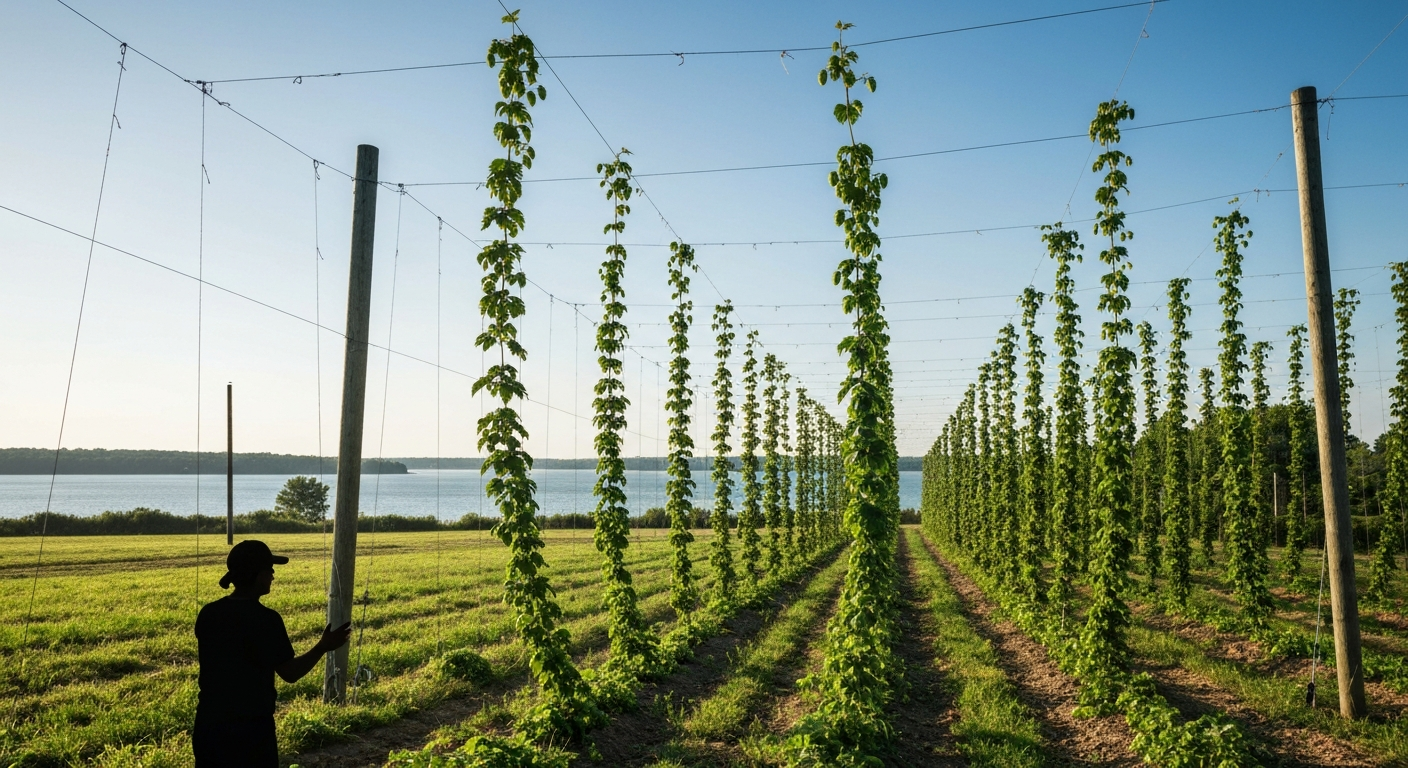
For a backyard setup, a minimum height of 14–15 feet is the practical standard. At that height, most home varieties will reach the top wire and begin lateral growth before harvest. Use 4x4 pressure-treated posts or round timber posts set at least 3 feet deep (deeper in softer soils). Anchor end posts with diagonal bracing or deadman anchors, as the weight of mature bines plus Michigan wind events is substantial. String coir (coconut fiber) twine from the overhead wire down to a ground stake or hook at the base of each plant. Coir is biodegradable and rough enough that bines grip it easily; synthetic twine often gets cut and removed during fall cleanup, while coir can be composted with the spent bines.
For a single row of home plants, space posts every 15–20 feet and run a 12-gauge galvanized high-tensile wire across the top. A simple two-wire system with a top wire and a mid-height spreader wire at 8–9 feet works well for training and adds stability.
Small farm and commercial trellis
Commercial Michigan hop yards use trellis systems 18–20 feet tall, consistent with the standard cited in national extension literature and used by established Great Lakes producers. The typical commercial layout uses driven or anchored H-brace end assemblies with 18–20 foot posts spaced 20–30 feet apart in-row. A top wire (usually 11 or 12.5 gauge high-tensile) runs the length of each row, with cross wires or aerial stringers at the top connecting adjacent rows for stability. Individual coir strings run from the top wire at an angle down to ground staples located 12–18 inches from the base of each plant, allowing two or three strings per plant.
Standard commercial spacing in Michigan is 3. OSU Extension's Growing Hops in the Home Garden recommends planting rhizomes vertically with buds up about 1–2 inches below the soil and spacing plants roughly 3–5 feet within rows and 8–12 feet between rows OSU Extension recommends planting rhizomes vertically with buds up about 1–2 inches below the soil and spacing plants roughly 3–5 feet within rows and 8–12 feet between rows.. 5–5 feet between plants within rows and 10–12 feet between rows, giving roughly 870–1,250 plants per acre depending on the configuration. Tighter spacing increases yield potential per acre but demands more aggressive disease management due to reduced airflow. MSU Extension's enterprise budgets (documented in the Estimated Costs of Producing Hops in Michigan bulletin) can help you size trellis investments against realistic revenue expectations before committing to infrastructure.
Trellis spacing summary
| Setup Type | Trellis Height | Post Spacing | Plant Spacing (in-row) | Row Spacing | Strings per Plant |
|---|---|---|---|---|---|
| Home garden (single row) | 14–15 ft | 15–20 ft | 3–4 ft | N/A (single row) | 2–3 |
| Small farm (multi-row) | 16–18 ft | 20–25 ft | 4–5 ft | 10–12 ft | 2–3 |
| Commercial yard | 18–20 ft | 20–30 ft | 3.5–5 ft | 10–14 ft | 3–4 |
Feeding and irrigation through the Michigan growing season
Hops are heavy feeders and heavy drinkers once they get going. In Michigan, the rapid June and July growth phase is when your plants are most demanding. MSU Extension guidance has noted that vigorous hop plants can require multiple gallons of water per plant per day during peak growth, this varies by soil type, weather, and plant size, but it illustrates why drip irrigation is strongly recommended over relying on rainfall alone. Michigan summers can be wet, but they can also go dry for two to three weeks at a time, and water stress during cone fill significantly reduces yield and quality.
For nitrogen, the standard approach is to apply a balanced fertilizer at bud break (early spring), then side-dress with a nitrogen-heavy fertilizer as bines reach 2–3 feet. A second nitrogen application at the base of the trellis in late June supports the cone-development phase. MSU soil test recommendations will give you rates calibrated to your specific soil. Avoid high nitrogen applications after mid-July, late-season nitrogen pushes vegetative growth at the expense of cone ripening and can increase susceptibility to powdery mildew.
Common pests and diseases in Michigan, and how to manage them
This is where Michigan growing differs most sharply from Pacific Northwest production. Michigan's humid summers are a paradise for the two fungal diseases that can devastate a hop yard: downy mildew and powdery mildew. MSU Extension's Michigan Hop Management Guide (updated April 2026) covers these in detail with season-by-season recommendations, and if you're growing hops in Michigan seriously, that publication should be in your hands.
- Downy mildew (Pseudoperonospora humuli): The biggest threat in Michigan. Overwinters in infected crowns and spreads via spores in wet, cool conditions (60–72°F). Symptoms appear as angular yellow lesions on leaves ('basal spikes' on young shoots are a classic early sign). Management: choose tolerant varieties, remove basal spikes immediately, apply copper-based or phosphonate fungicides at bud break and on a 7–14 day schedule during wet periods, improve airflow by removing excess shoots and lower leaves.
- Powdery mildew (Podosphaera macularis): White powdery coating on leaves and cones, thrives in warm dry conditions after humid nights. Can render cones unusable for brewing. Management: sulfur-based fungicides (not during heat above 90°F), potassium bicarbonate, or newer SDHI fungicides on a regular rotation; avoid excessive nitrogen.
- Hop aphid (Phorodon humuli): Colonizes undersides of leaves and can transmit viruses. In Michigan, populations build in late June through August. Management: monitor regularly, encourage beneficial insects (lacewings, parasitic wasps), use insecticidal soap or pyrethrin for serious outbreaks.
- Two-spotted spider mite (Tetranychus urticae): More common in dry, hot periods in southern Michigan. Causes bronzing of foliage. Management: miticides, predatory mites, maintain soil moisture to reduce plant stress.
- Hop looper and other caterpillars: Occasional defoliators; hand-pick or use Bt (Bacillus thuringiensis) for organic management.
The key mindset for Michigan hop growers is that disease management is preventive, not reactive. By the time you see severe downy mildew symptoms across your yard, you've already lost a significant portion of the season's potential yield. Scout weekly, start your fungicide program early in spring, and rotate chemistries to avoid resistance buildup.
Michigan hop harvest: timing, drying, and storage
In Michigan, most varieties reach harvest maturity between mid-August and mid-September, which is slightly later than the Pacific Northwest benchmark due to different heat accumulation patterns. The exact timing varies by variety, location, and season. Cones are ready when they feel papery and dry rather than green and moist, the lupulin (yellow powder inside the cone) is bright yellow and aromatic, and the cone springs back when gently squeezed. Alpha and beta acid levels peak at this point and drop quickly if you wait too long.
At harvest, cut the bines down at the base, carry them to a shaded area, and pick cones by hand or strip them through a picking frame. For home gardeners, hand-picking works fine. For a commercial planting of even a quarter acre, mechanical picking equipment or hiring a picking crew becomes necessary very quickly.
Fresh hops must be dried to about 8–10% moisture content within 24 hours of picking to prevent spoilage and preserve alpha acids. For small quantities, a food dehydrator at 95–105°F works well. For larger harvests, a dedicated hop kiln (oast) with forced-air heating and temperature control is the right tool. Spread cones in a single layer on mesh screens and dry them gently, high heat above 120°F degrades the oils you worked all season to develop.
After drying, cool the hops completely before packaging. Vacuum-seal in airtight bags and freeze immediately if you won't use them within a few weeks. Frozen, vacuum-sealed hops hold their alpha acids for 12–24 months. Without freezing, alpha acids degrade quickly, especially in bags that aren't fully airtight.
Michigan hop seasonal calendar at a glance
| Month | Key Tasks |
|---|---|
| March–April | Soil test results arrive; apply amendments; order rhizomes/crowns from certified suppliers; plan trellis installation |
| Late April–mid-May | Plant rhizomes or crowns when soil reaches 50°F; install trellis if not already done |
| May | First shoots emerge; prune first flush; begin disease scouting; install drip irrigation |
| Late May–June | Select and train bines on strings (clockwise); side-dress with nitrogen; begin fungicide program for downy mildew |
| June–July | Rapid vertical growth (6–12 in/day possible); maintain irrigation; second nitrogen application late June; monitor for aphids and mites; continue fungicide rotation |
| Late July–August | Lateral growth and cone development; reduce nitrogen; monitor cone maturity; continue disease management |
| Mid-August–mid-September | Harvest cones at peak maturity; dry to 8–10% moisture within 24 hours; vacuum-seal and freeze |
| September–October | Cut bines back; clean up plant debris (reduces overwintering disease inoculum); apply fall fertilizer if soil test warrants |
| November–March | Crowns dormant; plan next season; review disease and pest notes; source planting material for expansion |
Greenhouse and season extension options
Growing hops in a greenhouse full-time in Michigan is not practical for commercial production, hops need winter chilling (soil temperatures below about 40°F for one to two months) to break dormancy and produce well. For related climate-specific growing questions, see our guide can you grow goji berries in california for guidance on regional suitability and season-extension tactics. If you're curious about alternative warm‑climate succulents and how they handle Michigan winters, see can you grow agave in Michigan for guidance on agave winter hardiness and season‑extension options. MSU Extension notes this chilling requirement explicitly as part of hop production planning for Michigan. A hop plant kept in a constantly warm greenhouse through winter will produce poorly the following season.
Where greenhouse or high tunnel production does make sense in Michigan is for season extension at the margins: using an unheated high tunnel or cold frame to warm soil 2–3 weeks earlier in spring, giving you a head start on root establishment. This is especially valuable in the Upper Peninsula and other zone 4 areas where the frost-free window is tight. You can also start rhizomes in pots inside a heated greenhouse in March and transplant outdoors after the last frost, gaining about four weeks of growth compared to direct-field planting. The tradeoff is that potted indoor starts need careful hardening off before transplanting, moving them outside too quickly after a warm indoor environment invites cold damage. For related guidance on season extension and greenhouse decisions for other regional specialty crops, see can you grow hatch chiles in California.
If you're exploring greenhouse cultivation more broadly, the question of growing hops in a greenhouse as a controlled-environment system is worth investigating separately, there are growers experimenting with this approach, particularly for out-of-season fresh hop production, though it's a niche and capital-intensive option. If you're also curious about growing subtropical trees, see our guide on growing longan in California for climate and cultural considerations.
Where to source rhizomes and find Michigan-specific resources
For rhizomes and crowns, prioritize suppliers who can document that their stock is pathogen-tested. Several Michigan and Great Lakes nurseries sell hop rhizomes in spring, and some Michigan homebrew supply shops stock them seasonally. For larger plantings, suppliers linked to the National Clean Plant Network or the Clean Plant Center Northwest at Washington State University offer the highest biosecurity assurance.
MSU Extension is your best local resource. The 2026 Michigan Hop Management Guide, the Sustainable Hop Production in the Great Lakes Region bulletin (E-3083), and the Michigan Fresh: Growing Hops fact sheet (E-3210) are all available through the MSU Extension website and cover Michigan-specific variety performance, fertility recommendations, and IPM protocols in much more detail than any general guide can. MSU Enviroweather provides county-level frost date and growing-degree-day data that lets you time planting and harvest decisions to your specific location rather than relying on state-level averages. If you're also curious about other region-specific crops, see can you grow agave in California for guidance on growing agave in that state's climates. If you're considering a commercial planting, the MSU enterprise budget publication (Estimated Costs of Producing Hops in Michigan, E3236) gives you realistic startup and operating cost figures based on actual Michigan production data. If you're curious about growing other warm‑climate succulents, see can you grow agave in the US for tips on climate zones and care.
Troubleshooting common problems
- Bines not reaching the top wire: Usually a combination of late planting, poor soil drainage, or insufficient nitrogen. Check soil pH first — low pH locks out micronutrients and stunts growth even when macronutrients are adequate.
- Yellow leaves with angular lesions in spring: Classic downy mildew. Remove affected shoots immediately and begin a copper-based fungicide program. Check whether your crowns were sourced from a certified, pathogen-free supplier.
- White powdery coating on leaves or cones: Powdery mildew. Apply sulfur-based spray (not in heat above 90°F) or potassium bicarbonate. Improve canopy airflow by removing excess shoots.
- Crown rot or poor emergence in spring: Almost always a drainage problem. Waterlogged soil in winter and early spring destroys crowns. If this happens repeatedly in a spot, you need to either relocate the planting or install drainage.
- Poor cone set in summer: Can be caused by low light (check shading), water stress during cone fill, or daylength disruption from artificial lighting near the yard (this is uncommon but real).
- Cones smell wrong or have off flavors after drying: Usually excessive heat during drying (above 120°F degrades oils) or storage in non-airtight bags at room temperature. Always vacuum-seal and freeze.
FAQ
Can you grow hops in Michigan?
Yes. Hops are feasible across Michigan’s USDA zones (roughly 4a–6b) and are successfully grown by home gardeners, hobby brewers and small commercial growers. Michigan’s winter chilling and long summer daylengths support bine dormancy and cone set, but the state’s humid summers increase disease pressure (notably downy and powdery mildew) versus the Pacific Northwest. Use Michigan‑specific guidance (MSU Extension hop management) and local weather/GDD/frost data (NOAA, MSU Enviroweather) to time planting, sprays and harvest.
Which hop varieties work best in Michigan? (recommended list)
Choose varieties proven in Great Lakes/Midwest trials and with good disease tolerance or regional performance. Reliable options: - Aroma/dual‑use: Cascade, Centennial, Chinook (popular, widely available) - Disease‑tolerant / regionally trialed: Nugget, Willamette, Crystal - Newer regionally tested varieties with mildew resistance: [refer to MSU variety trial lists in MSU hop management guide] Always check alpha‑acid and aroma profiles for your brewing goals; source certified, pathogen‑tested planting material when possible.
How do I select a planting site in Michigan?
Pick full sun (minimum 6–8 hours direct sun; 8–10+ ideal), well‑drained deep soils (sandy‑loam preferred), and a site with good air movement to reduce humidity around bines. Avoid low wet spots and heavy shade. Locate near a water source for irrigation and where you can install tall trellising (12–20 ft). Check county frost dates and local GDD via NOAA/MSU Enviroweather to plan planting and anticipate harvest timing.
What soil and pH do hops need in Michigan and how do I prepare soil?
Target soil: well‑drained, deep (rooting depth ≥2 ft), sandy‑loam to loam. Target pH ≈ 6.0–6.8 (MSU commonly cites ~6.5). Stepwise: 1) Get a soil test (MSU recommended) to check pH and nutrients. 2) Apply lime per MSU recommendations to reach target pH before planting. 3) Incorporate organic matter (2–4 in) and balanced starter fertilizer guided by soil test (nitrogen needs high during vegetative ramp‑up). 4) Improve drainage if compaction or perched water is present (raised beds, deep tilling, drainage tile if needed).
What planting methods work (rhizomes, crowns, liners, bines) and how to plant?
Common planting stock: rhizomes (early spring), crowns, or certified tissue‑culture liners. Plant rhizomes in early spring when soil is workable and frost risk is ending; place buds upward ~1–2 in below soil surface or plant vertically per local extension specs. Space single plants 3–5 ft within rows and 8–12 ft between rows (commercial spacing varies). Mulch the base after establishment to conserve moisture and suppress weeds. Use pathogen‑tested material from Clean Plant Network sources or reputable nurseries to reduce virus/pathogen risk.
What trellis systems and spacing should I use in Michigan?
Home gardens: 12–15 ft single‑pole or A‑frame trellises. Small commercial: 16–20 ft high crossarm/twine trellis with posts and durable wire. For spacing: 3–5 ft between plants in a row; rows 8–12 ft apart. Install sturdy vertical supports and high‑quality twine or wire; train 3–6 main bines per crown for best yields (remove excess shoots early). Ensure trellis allows good air flow to mitigate disease.
Next Articles
Can You Grow Goji Berries in California: Regional Guide
Can you grow goji berries in California? Regional answers, top varieties, planting checklist, and quick troubleshooting.
Can You Grow Hatch Chiles in California? Regional Guide
Can you grow Hatch chiles in California? Regional yes/no, planting schedule, top cultivars, care, pests & roasting tips.
Can You Grow Longan in California? Zones, Tips, and Next Steps
Can you grow longan in California? Learn zones, best regions, container tips, winter freeze protection, and realistic fr